Watching the climate news, we often swing between two feelings. One is anxiety: the problem is so large, and I am doing so little. The other is powerlessness: since large corporations and governments are the main sources of emissions, nothing I do matters.
Both feelings are real, yet both miss one thing: individuals and institutions have never been separate worlds.
What we buy shapes markets; how we vote, work, invest and take part in our communities creates pressure on policy and business; and institutions in turn determine whether sustainable choices are convenient, affordable, or even possible at all.
Ten years after the Paris Agreement: the direction is set, the pace is still not enough
2025 marks the tenth anniversary of the adoption of the Paris Agreement, and it is also an important year for countries to submit a new round of Nationally Determined Contributions. The UNFCCC’s 2025 synthesis report initially covered only 64 new submissions; later updates showed the emissions curve beginning to bend downward, but the UN Environment Programme still estimates that even with full implementation of current pledges, warming this century could reach 2.3°C to 2.5°C.
COP30, held the same year in Belém, Brazil, showed once again that international cooperation has not disappeared, but it also exposed the distance between pledges and implementation. The world is not short of targets; what it lacks is the capacity to break those targets down into budgets, regulations, engineering, jobs and measurable results each year.
This is much like a personal New Year’s resolution. Writing down “I want to be healthy” is not difficult; what is difficult is what to eat tomorrow, how to exercise each week, and how to avoid slipping back to the starting point when life gets busy. The same is true of national net-zero commitments.
Change moves through four layers
The Vision Association organises action into four layers.
The first is awareness. Knowing what we eat, what we use and what we support, and understanding the cost behind each choice. Not in order to blame ourselves, but to reclaim the ability to decide.
The second is passing it on. Children do not only listen to what we say; they watch how we live. When valuing what we have, saving energy, caring about society and respecting nature become family habits, sustainability stops being the fashion of a single generation.
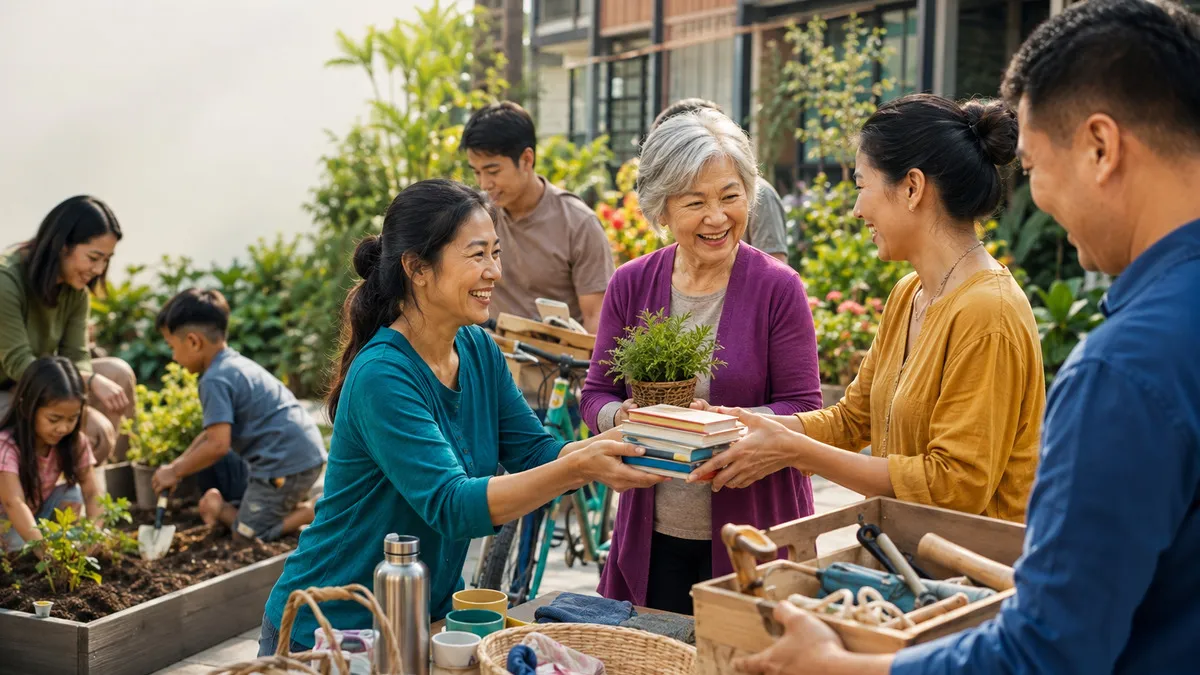
The third is mobilisation. When individual actions remain invisible to one another, they tire easily. When communities, businesses, schools and professionals connect, scattered choices can become public issues, joint procurement, policy advocacy and action at scale.
The fourth is coexistence. We do not speak of “saving the planet”, because the Earth has a history far longer than our own. What truly needs to change is how we arrange our lives and our economy within limited resources and natural boundaries.
Sharing resources, not only sharing things
Some people have knowledge, some have time, some have space, skills, funding or connections. If resources stay where they are, they are merely possessions; only when they begin to circulate can they become change.
That is why the Vision Association’s aim is not to ask everyone to become a perfect model of sustainability, but to build a shared platform where people can learn together, act together, and still be imperfect.
When change stops with one person, it is self-discipline; when it stops with one generation, it may be only a trend. Through family, community connection and one generation handing on to the next, it can become culture.
Everyone’s everyday choices are a starting point for changing the world. It is fine for that starting point to be small; what matters is whether, in the end, these points can join up into a road.
References
-
UNFCCC, 2025 NDC Synthesis Report and subsequent updates.
-
UNFCCC, outcomes of COP30, the Belém Climate Change Conference, November 2025.
-
UNEP, Emissions Gap Report 2025.