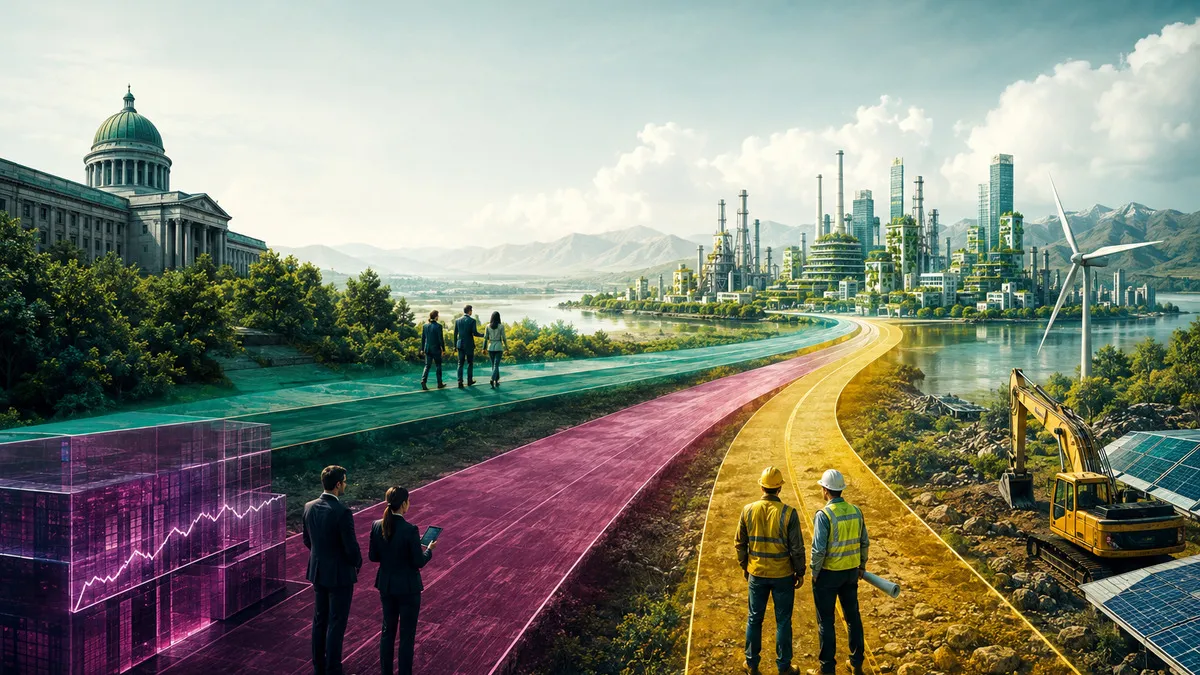
Greenhouse gas emissions have long been treated as a side effect that no one has to pay for, yet the losses from extreme heat, floods, damaged health and damaged infrastructure are still borne by society as a whole. The basic logic of carbon pricing is to bring the cost of emitting back into decision-making: the more you emit, the more you pay; the more efficiently you cut emissions, the more you save or earn.
A 2026 World Bank report shows that there are now 87 direct carbon pricing policies worldwide, covering slightly more than 29% of greenhouse gas emissions, and generating over USD 107 billion in government revenue in 2025. Carbon pricing is no longer an experiment run by a handful of countries; it is gradually becoming part of industrial and fiscal systems.
How do taxes, fees and trading schemes differ?
With a carbon tax or carbon fee, the government usually sets the price to be paid per tonne of emissions. Companies can estimate their costs in advance, but total emissions will vary depending on how they actually respond. An emissions trading scheme instead sets a cap on total emissions first, then allocates or auctions allowances; companies can trade them, and the carbon price is formed by the market.
Neither approach is inherently better. Design depends on industrial structure, administrative capacity and policy purpose, and a hybrid approach is also possible. What really matters is whether the price signal is strong enough to drive emission reductions, whether the coverage is reasonable, and how the revenue is used.
If carbon revenue simply flows into general government finances, the public may feel the cost without seeing any transition. If it is instead invested in energy efficiency, public transport, industrial upgrading, support for disadvantaged groups and worker retraining, carbon pricing becomes more than a penalty — it also becomes a way of sharing the resources of transition.
A carbon price does not guarantee enough reduction
Carbon prices vary widely around the world, and many emissions remain uncovered. If the price is too low, companies may simply treat it as an operating cost and leave their equipment and technology unchanged. If it rises too quickly without supporting measures, it may put pressure on household budgets and small and medium-sized enterprises.
Carbon pricing therefore cannot work alone. It needs energy policy, efficiency standards, research and development, financing and infrastructure to work alongside it. Governments also need to prevent companies from passing all of the cost on to consumers who have no alternatives.
For businesses, the important thing is not guessing what a tonne of carbon will cost next year, but building different carbon prices into investment appraisals: if future costs rise, is it still worth waiting before investing in energy-efficient equipment, low-carbon materials and product transition today?
Carbon pricing also has distributional effects. Households that spend a higher share of their income on energy usually find it harder to replace equipment or vehicles straight away. Without subsidies and public services, the same price signal can place very different burdens on different households.
What a carbon price is really meant to change is not just a bill, but the fact that “carrying on emitting” should no longer always be cheaper than “starting to change”.
References
-
World Bank, State and Trends of Carbon Pricing 2026, May 2026.
-
World Bank, official data from the Carbon Pricing Dashboard.