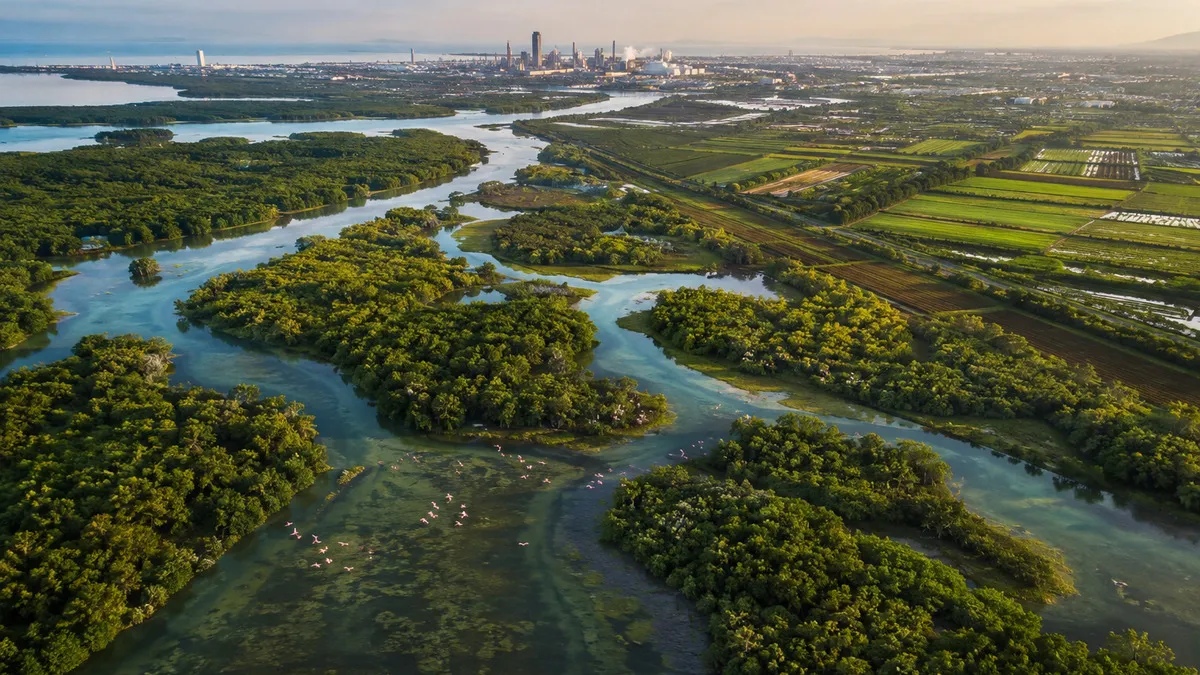
A beverage company needs water, a food company depends on soil and pollination, a semiconductor company needs a stable water supply and large land-based facilities, and a financial institution’s lending may flow into agriculture, mining, construction and energy. Companies may appear to be managing only factories, brands and capital, but in fact every business rests on natural systems.
In the past, nature was often treated as a free backdrop. Forests, rivers, soil and biodiversity did not appear on the balance sheet, yet their loss shows up in real terms in costs, output, insurance and asset values.
International sustainability discussions are moving from “carbon” towards “nature”
In February 2025, the resumed session of COP16 of the UN Convention on Biological Diversity concluded in Rome, where countries reached agreement on biodiversity finance, planning and monitoring, and global indicators, giving the Kunming-Montreal Global Biodiversity Framework adopted in 2022 a more complete set of tracking tools.
At the same time, the Taskforce on Nature-related Financial Disclosures (TNFD) has been encouraging companies to identify their dependencies on nature, along with their impacts, risks and opportunities. Its framework likewise uses four pillars: governance, strategy, risk and impact management, and metrics and targets. In 2025, the ISSB decided to advance work on nature-related standards, a sign that nature-related risk is gradually entering mainstream financial disclosure.
Planting trees is not the whole of biodiversity
When companies talk about nature, the most common action is tree planting. But if the aim is to build up tree counts quickly, planting a single species in unsuitable places, or even damaging existing grassland or wetland, the result may harm ecosystems instead.
Biodiversity is not only about “how many living things there are”; it also includes the relationships among species, genes and ecosystems. Protecting nature cannot be measured by counting activities alone. It has to come back to where a company operates, what resources it draws on, what pollution it releases, and how it changes land and water.
For companies, the first step is not to declare themselves “nature positive” straight away, but to map their dependencies: which sites are in water-scarce areas? Which raw materials come from forests or areas of high biodiversity? Does the supply chain involve habitat destruction?
Nature is also part of everyone’s daily life
When consumers choose a cup of coffee, a piece of clothing or a portion of seafood, each choice connects to land, water and species. Yet it is hard for an individual to judge on the basis of a single “environmentally friendly” phrase on the packaging. That is why governments need to set rules, companies need to provide traceable information, and the media and civil society need to keep verifying.
What the Vision Association means by “coexistence” is not placing nature in a protected area far from people, but recognising that our health, our work and our economy have always existed within nature.
When companies begin to count nature as a risk, it is not that nature has suddenly acquired value. It is that we are finally acknowledging it was never free.
References
-
UN Convention on Biological Diversity (CBD), outcomes of the resumed session of COP16 in Rome, 27 February 2025.
-
Taskforce on Nature-related Financial Disclosures (TNFD), TNFD Recommendations and 2025 Status Report.