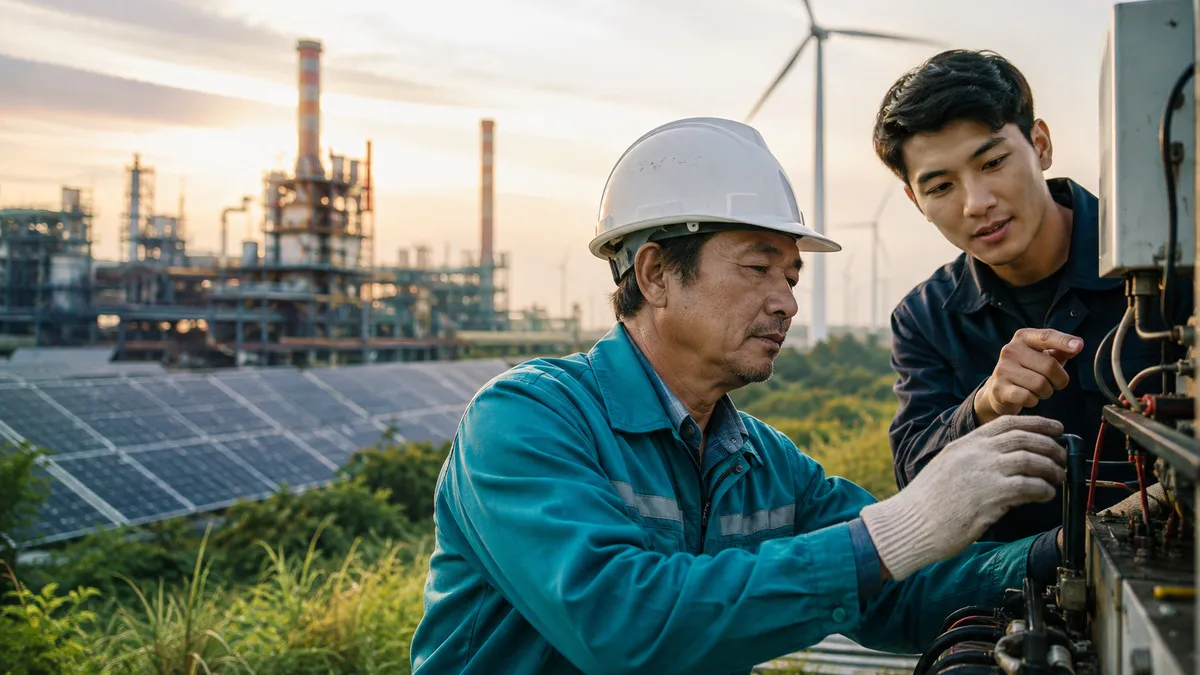
When a coal-fired power plant closes, the emissions figures show progress; but for the employees who worked there for twenty years, for nearby businesses, and for a local government that depends on its tax revenue, it can also mean a drastic change in household income and in the future of an entire town.
This is why international climate policy pays increasing attention to the “just transition.” The question it seeks to answer is not whether to make the transition, but who bears its costs and who gains its opportunities.
The International Labour Organization notes that a just transition should expand social and economic opportunities within an ecological transition, while securing decent work, social protection and dialogue. COP30 also placed labour, business and social inclusion on the transition agenda.
Green jobs do not automatically go to the people who held the old ones
The energy transition creates jobs in solar power, wind power, energy storage, grids, energy efficiency, the circular economy and environmental services. But “new jobs exist” is not the same as “existing workers can get them.” The locations may differ, the skills may not match, and the pay and working conditions may not be the same either.
If policy only announces how many green vacancies have been added, without addressing income during the period of job change, the quality of training, family care responsibilities and the transformation of local industry, then success on paper may be failure for certain people.
A just transition therefore has to begin before a plant closes or a policy takes effect. Government, business, unions, schools and communities must take stock together: which jobs will disappear? Which skills are transferable? After training, will there really be work? Can older workers and those in non-standard employment take part? Does the local economy have alternative industries?
Fairness is not an excuse to delay the transition
Some people invoke “protecting jobs” to oppose every carbon reduction policy. But climate change destroys jobs as well: extreme heat affects outdoor labour, drought hits agriculture, floods interrupt commerce, and rising sea levels reshape coastal industries. A just transition is not about maintaining the status quo; it is about refusing to let the cost of change fall only on those who are not at the negotiating table.
When companies put forward net zero pathways, they should also disclose the impact on their workforce. After equipment is upgraded, what skills will employees need? Are suppliers able to keep up? Of the costs saved, how much goes into training and safety?
Bring those affected into the room where decisions are made
The most important thing is not to decide on someone else’s behalf what counts as fair. Affected workers and communities must have information, time, and a genuine right to take part in decisions.
When the Vision Association speaks of “mobilisation,” it does not mean calling people in to go along with a plan that has already been decided; it means allowing scattered voices to enter the institutions that shape outcomes. A genuinely sustainable transition is measured not only by how far emissions fall, but also by whether people are properly supported through it.
Net zero is not about leaving one group of people behind in the past while another moves into the future. If it is to be called a transition, everyone should have a road they can walk along.
References
-
International Labour Organization (ILO), Just transition towards environmentally sustainable economies and societies.
-
Materials related to ILO at COP30 and Green Employment Diagnostics, 2025–2026.