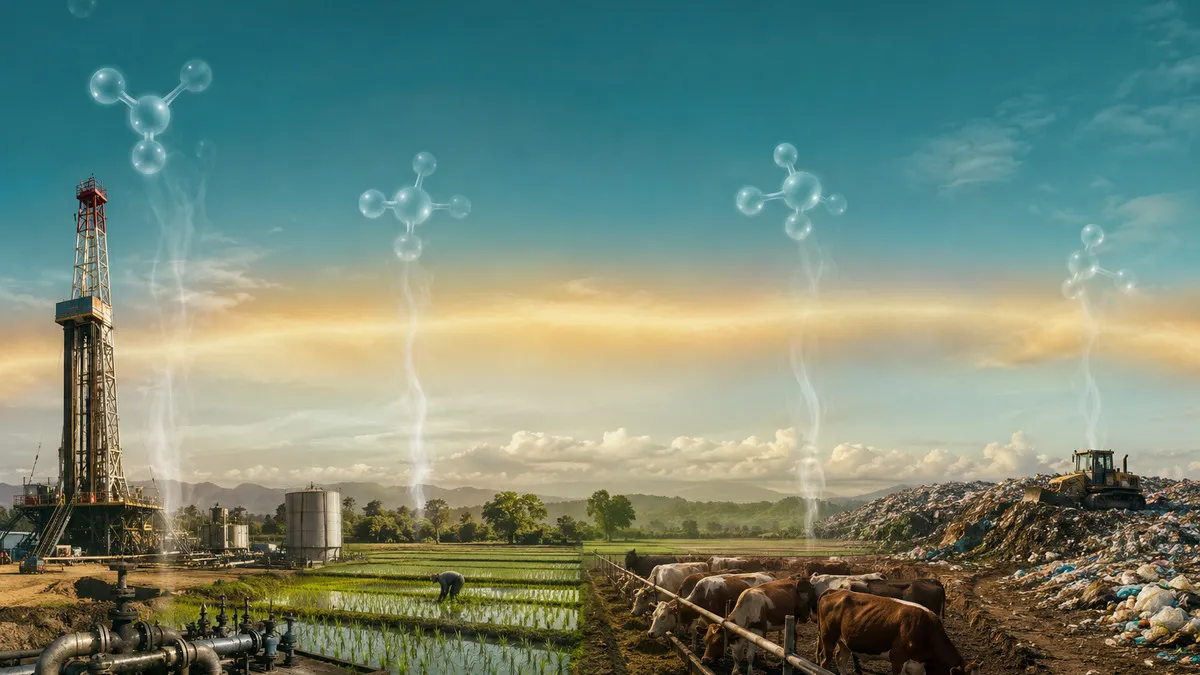
When climate change comes up, the first thing most people think of is carbon dioxide. It is indeed the most important greenhouse gas driving warming from human activity, and it lingers in the atmosphere for a long time: the carbon dioxide emitted today may have effects lasting for centuries. But if that leads us to assume that “cutting emissions” only means dealing with carbon dioxide, we miss another risk that is rising: methane.
The World Meteorological Organization’s Greenhouse Gas Bulletin, released in 2025, shows that in 2024 the global average concentration of carbon dioxide reached 423.9 ppm, methane 1,942 ppb, and nitrous oxide 338.0 ppb — all three at record highs. Compared with pre-industrial levels, the concentration of methane has increased by 166%.
Methane stays for less time, but warms more powerfully
Methane has a shorter atmospheric lifetime than carbon dioxide, but a stronger short-term warming effect. It comes from oil, gas and coal extraction, livestock farming, rice paddies, landfills and wastewater treatment. That also means methane is not only an issue for the energy industry: what we eat, how food is produced, and where our waste ends up are all connected to it.
Another feature of methane is that some emissions can be addressed relatively quickly. Leaks at oil and gas facilities can be monitored and repaired, landfills can capture biogas, and agriculture can reduce emissions through feed, manure and rice paddy management. Compared with energy systems that require a complete overhaul, some methane measures are not costly, and can even recover energy that would otherwise be wasted.
But “can be reduced more quickly” does not mean easily. Agriculture involves farmers’ livelihoods and food systems, while waste requires change from local governments, collection services, treatment facilities and consumer habits alike. If a single emissions figure is used to place the burden on those on the front line, it may well create another kind of unfairness.
The food left uneaten in the fridge also reaches the climate
When food is thrown in the bin, what we waste is not just that meal, but also the land and water used to grow it, the electricity for processing and refrigeration, and the fuel for transport. And if it ends up in an oxygen-poor landfill, it also produces methane.
What households can do is not to turn every leftover mouthful into a source of guilt, but to shop more accurately, understand expiry dates, eat food nearing its date first, and support surplus food sharing and food waste recycling systems. Businesses, for their part, need to redesign supply, inventory, packaging and distribution, rather than leaving “food saving” to consumers alone.
Cities can also bring methane into their governance: making landfill operations and food waste flows public, improving the sorting of organic waste, and using data to identify leak hotspots. When emissions are measured and responsibility is clearly assigned, reduction becomes more than a statement of intent.
Climate action needs the long-term transition on carbon dioxide, and it also needs rapid reductions in methane. Understanding the different gases does not make the problem more complicated; it tells us where genuinely effective action should begin.
References
-
World Meteorological Organization (WMO), Greenhouse Gas Bulletin No. 21, October 2025.
-
United Nations Environment Programme (UNEP), Global Methane Assessment and related materials on methane reduction.