After organizing ten households, the lists added up to five hundred and eighty bags: two hundred and nineteen bags of trash, one hundred and sixty-six bags of recycling, and one hundred and ninety-five bags to be passed on. Trash was about thirty-seven percent; the other items went toward material recycling or a next user.
These figures are not a sample statistic for households in general. The ten households differed in origin, family structure, and the scope of organizing. But they offer one important observation: items described as “accumulated” have not all lost their value, and they should not be understood only through the two options of “throw away” or “keep.”
Keeping something is not necessarily the same as cherishing it
If an item can still be used, yet for a long time it is not used, not passed on, and does not replace a later purchase, its value is in fact stopped in place. The costs of materials, manufacturing, and transport have already been incurred, yet after entering the household the item has not returned into living.
When flow first stops, the thing may still be in good condition. Left long enough, storage conditions, changes in specification, and material deterioration gradually shrink its options. Keeping it is not itself the problem. The problem is whether the item still has a clear context of use, or whether it has a chance to reach the next person who needs it.
So “keeping it is more environmentally friendly than throwing it away” holds only when the item will still be used. If something has not been opened again since the day it came through the door, keeping it may only postpone disposal.
Things in good condition can also be trapped
The household with the highest volume of items passed on was a long-term caregiver’s home. After the mother died, the homeowner cleared fifty-eight bags of items to be passed on, including a television, a TV cabinet, brand-new kitchenware, excess consumables, and small appliances unused for a long time. Many things had been kept very well; the household simply had had no outlet for a long time.
Another family with three children cleared fifty-four bags of items to be passed on, including large furniture and a basketball stand. There were twenty or thirty boxes of assembly toys, some still unopened. For these items, the difficulty was not that they were about to break. The original household need had already ended, and a new user had not yet appeared.
In a four-ping room, eighteen bags of items could be passed on, including six bags of clothing and fifty umbrellas. A family workshop closed for years handed stickers, printer paper, and a complete encyclopedia set to a nonprofit. In their original place they were clutter. Only when the context of use changed did they become resources again.
Leaving the original spot is not yet completed circulation
For belongings to flow again, at least a taker, a suitable channel, and enough time are needed. Missing any one of these, they may still be stuck in place.
One room sealed for years yielded fifty-one bags of trash, zero bags of recycling, and one bag to be passed on. The homeowner valued things highly; textbooks and workbooks were all kept. But after years of being sealed, plus limits that day on the scope of organizing and on moving things, most items were already hard to use again. Zero bags of recycling cannot be read directly as meaning the room had no recyclable materials, nor can a limited on-site record be expanded into a general conclusion.
In another case, two large bags of items were checked by relatives living in the same house and taken back into their own rooms. The list recorded them as passed on, but they had not in fact left the building. Changing location is not the same as completed circulation. An item needs to leave its original piled state and continue to be used in the next place.
Let judgment come before disposal
Household organizing often hands the last step to the garbage truck. That can clear space quickly, but it also easily puts items in different conditions under the same judgment. Furniture that can still be used, unopened supplies, clothing that can be passed on, and items that have already gone moldy or expired need different destinations.
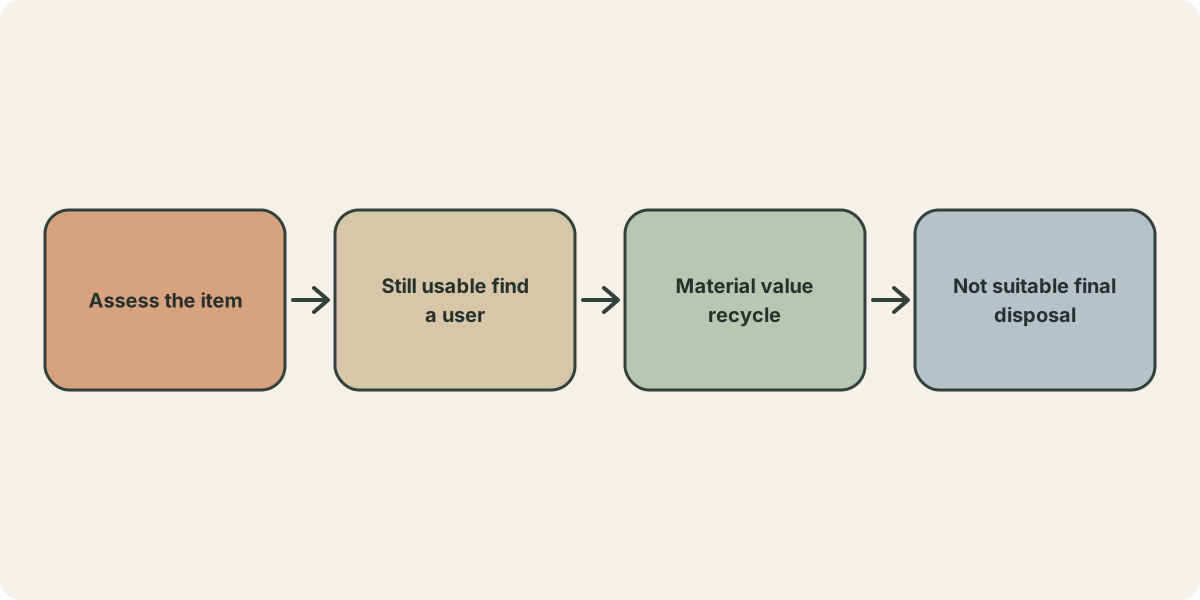
A more complete approach is to take stock first, then arrange paths according to condition: what is suitable for reuse, look for a taker; what has ended its original function but still has material value, enter the recycling system; what is not suitable to pass on, only then enter final disposal. This is not a demand that every item be kept. It is letting an item, before it leaves its original place, first receive the judgment that fits it.
Circular economy is not turning “don’t throw things away” into a new pressure. What it truly cares about is whether, while an item still has value, the household can see an outlet; and whether, after it has lost its use value, there is a responsible path for handling it.
Staying at home is not necessarily being cherished. Being used, passed on, or entering a suitable materials system while there is still time is how an item’s value continues to be seen.
Source: Liao Hsin-yun’s Facebook page (content compiled and adapted)