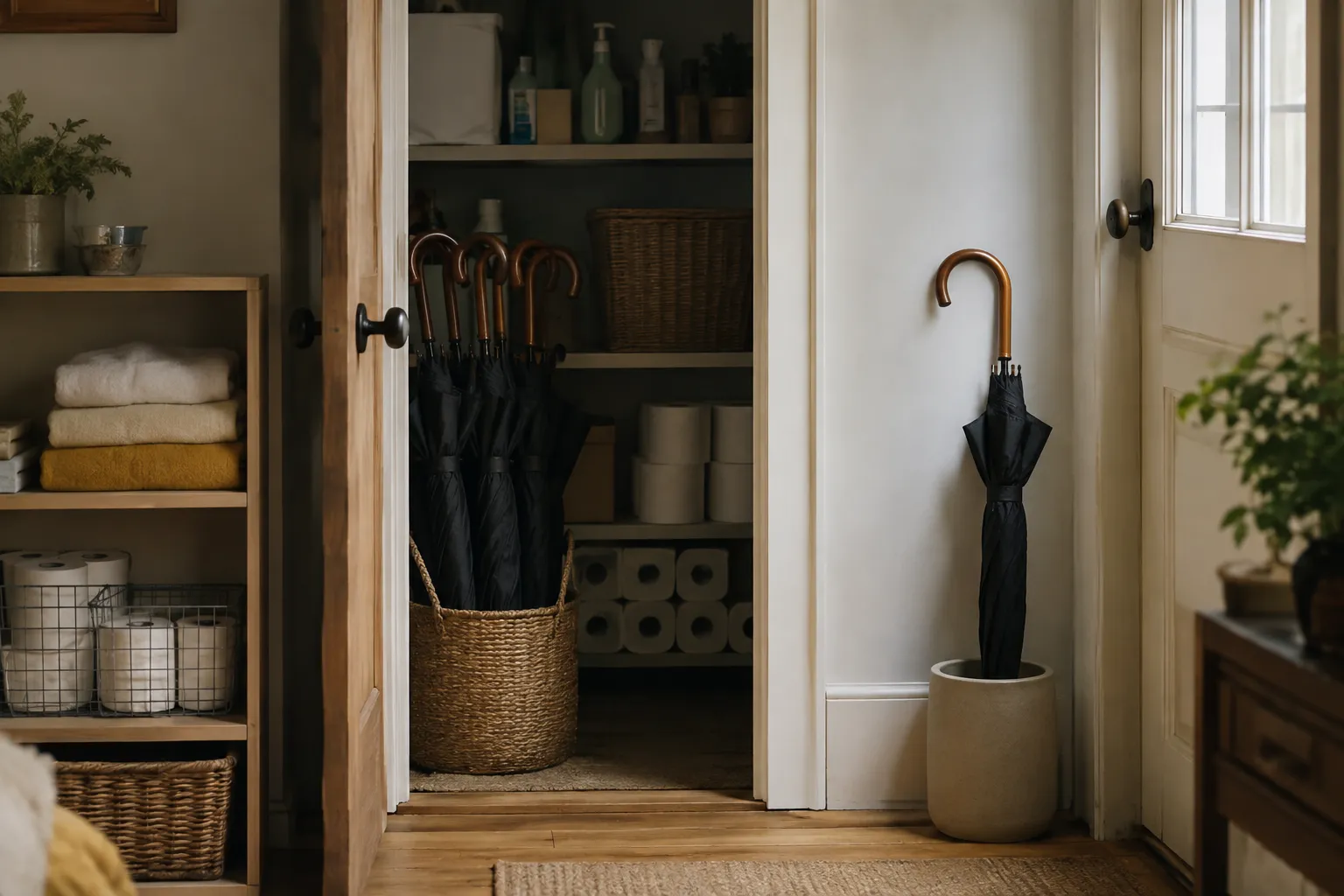
A professional organizer pulled fifty umbrellas from around a four-ping room.
That number does not by itself mean every umbrella was a repeat purchase; some may have been gifts, or several may have been bought at once. But the organizing record left one easily understood reason: when the homeowner needed an umbrella, they could not find one, so they bought another.
Repeat buying is often blamed on a lack of self-control. Organizing visits also show another possibility: when household inventory loses visibility, not being able to find something is, for the person using it, the same as not having it.
Owning and being able to reach it are two different things
Having an item at home, and being able to pick it up when you need it, are two different things. Remembering that you once bought it is not enough to produce an umbrella on a rainy day. Knowing where it is now is what counts as truly owning it.
In that same four-ping room, belongings were stacked in layers. The homeowner remembered having bought each thing, but not which layer it was buried in. The inventory was still there; information about the inventory had already disappeared.
This situation feeds on itself. Buy a new umbrella, and the household has one more item. As the total grows, visibility drops a little more. The chance of not finding one next time may rise, which leads to another purchase. What actually supports use is not quantity, but whether an item can be recognized, reached, and put back in place.
Repeat buying can have different starting points
A busy workplace manager had cabinets stacked with duplicate supplies. While organizing designer bags, they even turned up a limited edition they had almost forgotten buying. Here the duplication is tied to inventory that cannot be seen, and it may also overlap with stress shopping.
In a family with three children, whenever the parents agreed to buy a toy for one child, they usually bought one for the other two as well, in the name of fairness. There were twenty or thirty boxes of assembly toys, some still unopened. Here the duplication was not about being unable to find things; household rules had scaled one request into three.
In another household, a four-story townhouse, family members often could not find uniforms, water bottles, and stationery, and the children would search through an elder’s room. This case does not record whether they later bought replacements, but it clearly shows the conditions that come before inventory visibility declines.
Another household had just ended a long period of caregiving. Brand-new kitchenware and excess consumables remained. The older generation had lived through material scarcity and often said, “We’ll use it someday.” When items are inexpensive, small, and hard to count, cherishing things and letting duplicates pile up can happen at the same time.
These families’ circumstances differed, and so did the ways duplication began. What they shared was not a personality type, but having so many things that the household could no longer take a reliable inventory.
Deciding before you buy is also a form of resource management
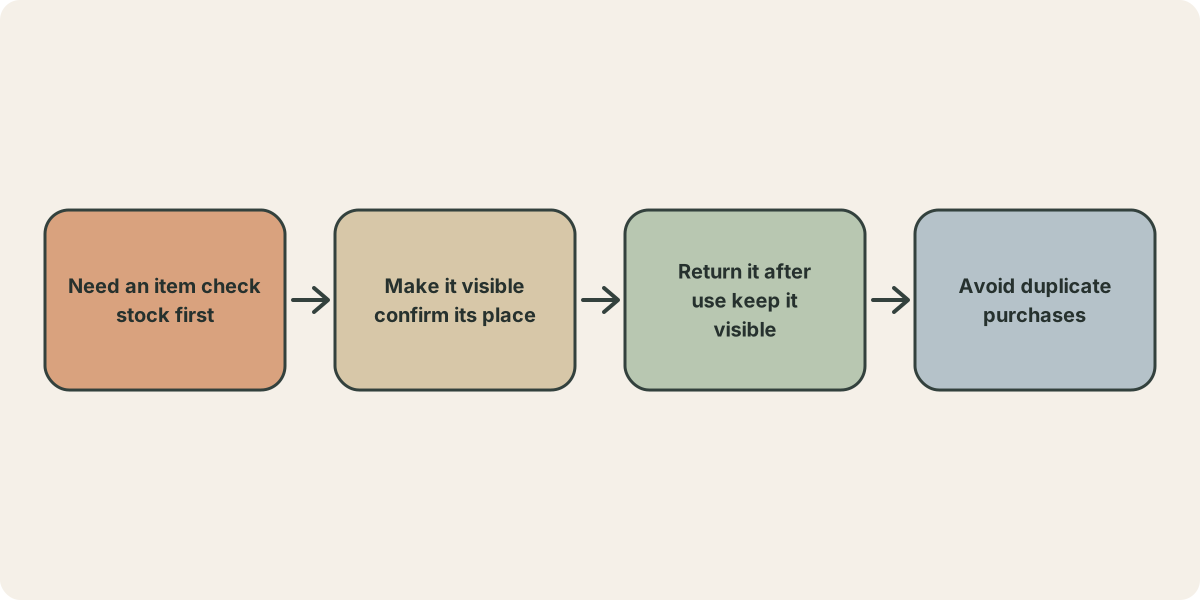
After organizing, households often set rules such as “put it back when you’re done” and “every item has a place.” These rules deal with things already in the home, and they need everyone to follow them every day.
Another rule is “do not buy another item that does the same job.” It deals with things that have not yet come through the door. The moment to apply it is in the store or the shopping cart, not the living room. Each time you check first, you add one fewer item to the inventory.
This is not a ban on buying, nor a demand that every household set up complicated tracking sheets. You can start with one question: do we already have one, and we just cannot find it right now? If the answer is uncertain, taking stock first or postponing the decision usually uses fewer resources than buying it and then looking for a place to put it.
Only what can be seen has a chance of being used
When household inventory becomes visible again, items have a chance to be used, passed on, or, once they have truly lost their function, enter an appropriate recycling system. Visibility is not a side effect of organizing. It is a basic condition that shapes consumption and the movement of belongings.
What fifty umbrellas remind us of is not that someone is especially fond of buying umbrellas, but how many household items have already grown past the point of being recognizable. When inventory can be seen, the next purchase need not be only a reaction to “I can’t find it.” Items also have a better chance of being used well at home, instead of sitting in a corner waiting for the next duplicate.
Source: Liao Hsin-yun’s Facebook page (content compiled and adapted)