Thirty packs of toilet paper, twenty laundry bags, and several bottles of hand soap. This was the inventory one household counted during an organizing visit. Every batch that came in had a reason that seemed sound: meeting the free-shipping threshold was a better deal, or buying three at once brought the unit price down. At checkout, those judgments could indeed calculate a difference; but years later, looking back, the question is no longer only how much money was spent, but where these items were put, whether they can still be found, and how many will actually be used up.
This is one individual case from an organizing visit, not a stock statistic for households in general. Yet it is very close to everyday experience: promotions turn the question from “how many do we need” into “how can we buy most economically.” The latter question has a clear number; the former requires opening cabinets, remembering where things are stored, and estimating how fast they will be used. When life is busy, the easier question usually wins.
Free-shipping thresholds change the question we ask
The original purchasing judgment was what the household was short of, how fast it was used, and when it needed restocking. After free-shipping thresholds appeared, the cart often gained one extra item that had not been intended. Its job was not to be used, but to make up the difference. Quantity discounts work in a similar way: the number bought used to follow need; later it became a condition for getting the discount.
A lower unit price does not necessarily mean a lower total cost. Extra items still have to be made, packaged, and delivered; once they enter the home, they also have to be stored, counted, and used. If they end up forgotten in a corner, bought again, or kept until they are no longer fit for use, the shipping fee that was saved is likely only a cost moved somewhere that cannot be seen.
This is not to say that all bulk purchasing is unreasonable. For consumables whose use is steady, that have a fixed place, and that will truly be used up, buying more at once can reduce the number of orders and deliveries. The key is whether the household actually knows how much it has now. If three questions cannot be answered — how many are in the home now? Where are they? How long does one last? — then “buying more is a better deal” in fact lacks a basis for judgment.
After overbuying, households often buy containers next
The household in the source case lived in a detached townhouse. Each floor was not large, and storage space was limited. Family members had put almost every available corner to use: a windowsill plant stand had become a storage area, boxes were stuffed under the sofa, the floor still looked reasonably tidy, but every drawer, once opened, was full. To make these items look orderly, the household then bought many storage boxes and sorting baskets.
This is the common second round of overbuying. The first round brings in items; the second buys containers to hold them. Storage products look like a solution, but they may also be an extended cost of the previous decision. When a household comes to rely more and more on new cabinets, baskets, and boxes to keep a tidy surface, the signal that the total is too high becomes even harder to see.
The effects of space being filled are not only about appearance. When items start to move toward the edges of walking paths, walking, cleaning, and taking things out all become more troublesome. For households with children, older people, or those with limited mobility, narrowed passages can also add everyday inconvenience and risk. These consequences rarely appear on a product page, but they are borne together by the people who live there.
Not finding things lets more of the same keep coming in
Overbuying does not always come from promotions. It can also start from “I can’t find it.” In a four-ping room, fifty umbrellas were cleared during organizing. Items were scattered and stacked on one another; when someone was in a hurry to leave and could not find the one they needed, a new umbrella came in. This is a single organizing case and cannot be used to infer that every household will accumulate the same number. But it shows the cycle when inventory is not visible: the item is still at home, the household thinks it does not have one, and so it buys again.
Another homeowner liked buying imported tableware, coffee mugs, and food-storage boxes. The cabinets were always stacked with duplicates, and organizing required re-zoning them by how often they were used. Collecting, promotions, gifts from relatives and friends, and not being able to find existing stock can all keep adding items that do the same job. Each had a reason at the moment of purchase; only after they accumulated did they become a total that was hard to manage.
This is also why household resources are more than a budget. Knowing what is at home, where it is, and who is using it is living information that has to be maintained together. If the information lives only in one person’s head, other family members are likely to keep buying the same items; if even the main shopper cannot find them, the items gradually become invisible inventory.
The shipping fee saved does not include the time that comes later
In the organizing records of ten households, five hundred and eighty bags of items were cleared, of which two hundred and nineteen bags were trash, nearly thirty-eight percent. These ten households were paid, organizer-led cases, not a random sample, and cannot be used to represent where household items go in general. They do, however, make visible that items accumulated at home will not necessarily all be used or passed on in the end; organizing, sorting, hauling, and handling also take time.
For an unopened item, manufacturing and delivery have already happened, but the benefit of use may never appear. Keeping these items at home looks like avoiding waste; if they are never opened, it is only postponing the judgment. When a large quantity of supplies is later cleared at once, whether secondhand channels, relatives and friends, or community organizations can take them on still depends on the type, condition, and timing. The flow of belongings cannot be completed by “don’t throw it away” alone.
So promotions are not the only thing to avoid; they are a useful place to practice checking. Whenever the cart is just short of free shipping, first look at whether the household already has items of the same kind. Whenever a multi-item discount appears, first confirm that there is a fixed place and a period of use. These small pauses will not eliminate all consumption, and they need not turn purchasing into pressure, but they can bring into the checkout calculation things that will actually happen in living.
Let “enough” become a shared standard that can be discussed
Some households, after organizing, set a very simple rule, such as not buying another item that does the same job. The rule deals with quantity, not moral judgment. It does not require everyone to live with less, and it does not deny the reassurance that spare items can bring. It simply lets spare items have a visible upper limit and a place.
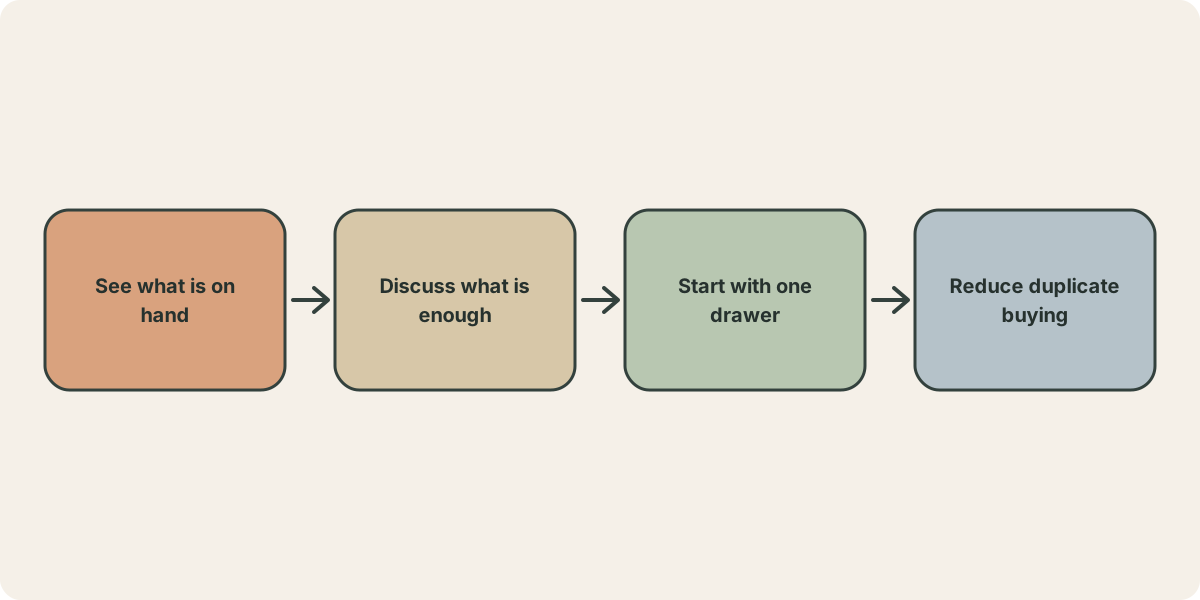
A household can start with one category, such as toilet paper, cleaning supplies, or food-storage boxes. Together they confirm the current stock, assign a place, and agree on when to restock. Children can also learn in the process that convenience is not buying more and more, but knowing whether what is needed is there, and whether it is enough. This everyday division of work can turn purchasing from one person’s instant decision into part of living together.
When we say “a better deal,” can we also count in the space at home, the time spent looking for things, and where the items will finally go? The question has no fixed answer, but it can help each household decide again: will the next item added to the cart for free shipping really make life easier?
Start with one drawer, and practice seeing the stock
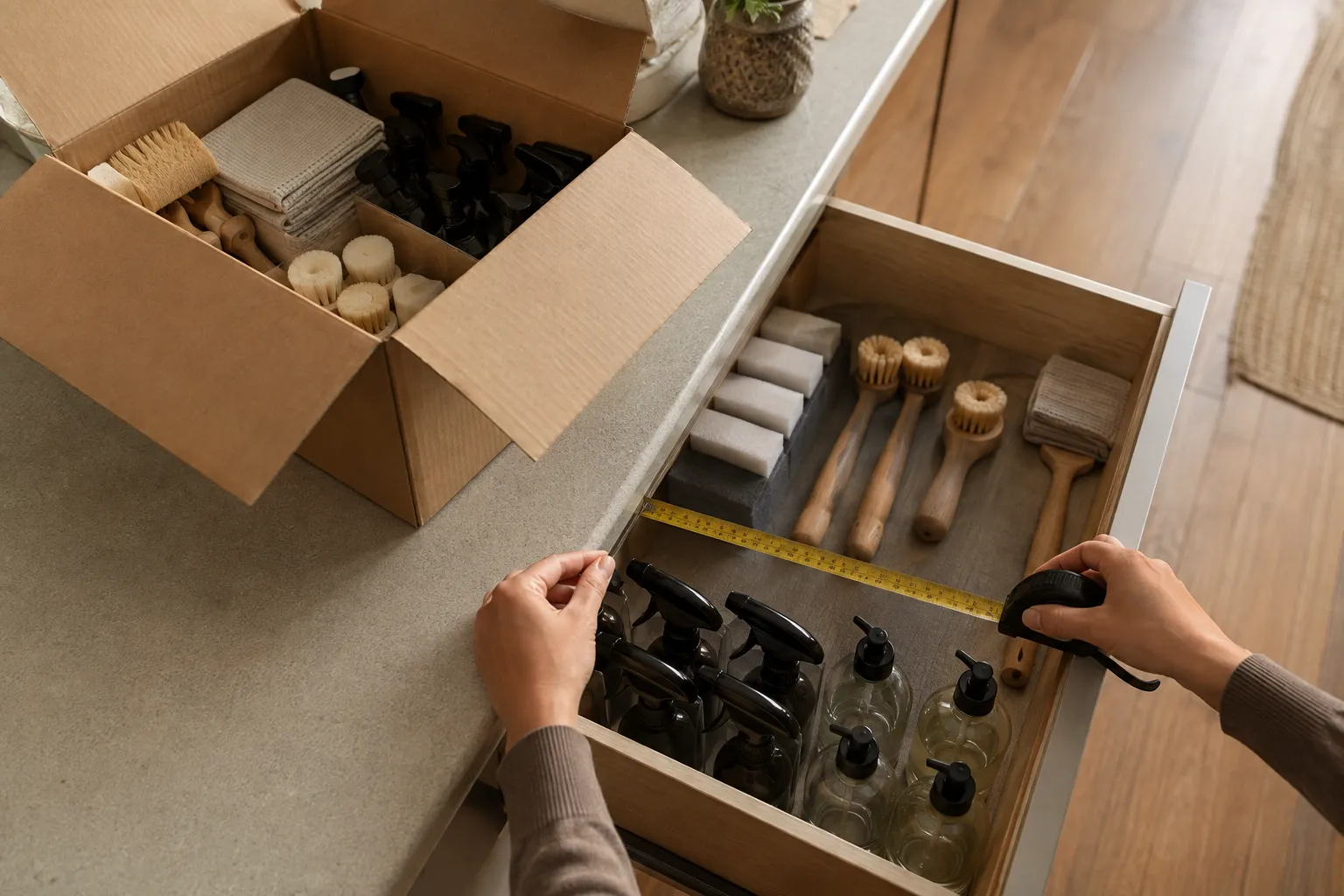
There is no need to inventory the whole home at the start. Choose the category most likely to be bought again, open the drawer or cabinet where it is, and first put items of the same kind together. That is enough to see a quantity that is usually hard to notice. Then decide on a fixed place, so that the next person who needs to buy knows where to look. The place need not be perfectly tidy; it only has to let someone quickly confirm whether there is still some left.
This practice also means purchasing need not depend on one person’s memory. When someone places an order, someone organizes, and someone uses the item, all of them can check the stock at a fixed place before deciding whether to restock. It looks like only a small adjustment in a drawer; in fact it reduces repeat buying caused by not knowing that something is already there, and makes it easier for family members to discuss what “enough” means.
Once the total of items is smaller, storage does not necessarily need more containers, and corners that were once packed may return to walking, cleaning, or rest. This change need not chase a look as tidy as a showroom. It simply means people do not have to turn up a pile of the same kind of item every time they look for something. When stock becomes visible, the extra item placed in the cart to cross a threshold also has a better chance of being reconsidered.
For the flow of belongings in a community, this is a very early step. One fewer item without a clear use coming through the door means one fewer item that later has to be stored, passed on, or handled. Each household’s practice may differ, but as long as people can answer how many they have, where they are, and when they will be used up, promotions need not make the decision for us. This is also a way of putting purchasing that looks private back into living together.
If a household has more than one shopper, they can stay in sync in simple ways: leave a note when something is nearly used up, mention it in a family conversation, or keep items that need restocking on the same list. What matters is not which tool is used, but that restocking not depend entirely on guessing. When information about household stock is more transparent, a free-shipping threshold is less likely to decide what extra item goes into the cart.
This practice can also help distinguish spare items from excess. Spare items have a clear use, a fixed place, and an expected period of use; excess often comes in each time for a different reason, and in the end no one knows where it is. The difference is not how many there are, but whether the household can say why the item is there and when it will be used up.
Source: Liao Hsin-yun’s Facebook page (content compiled and adapted)