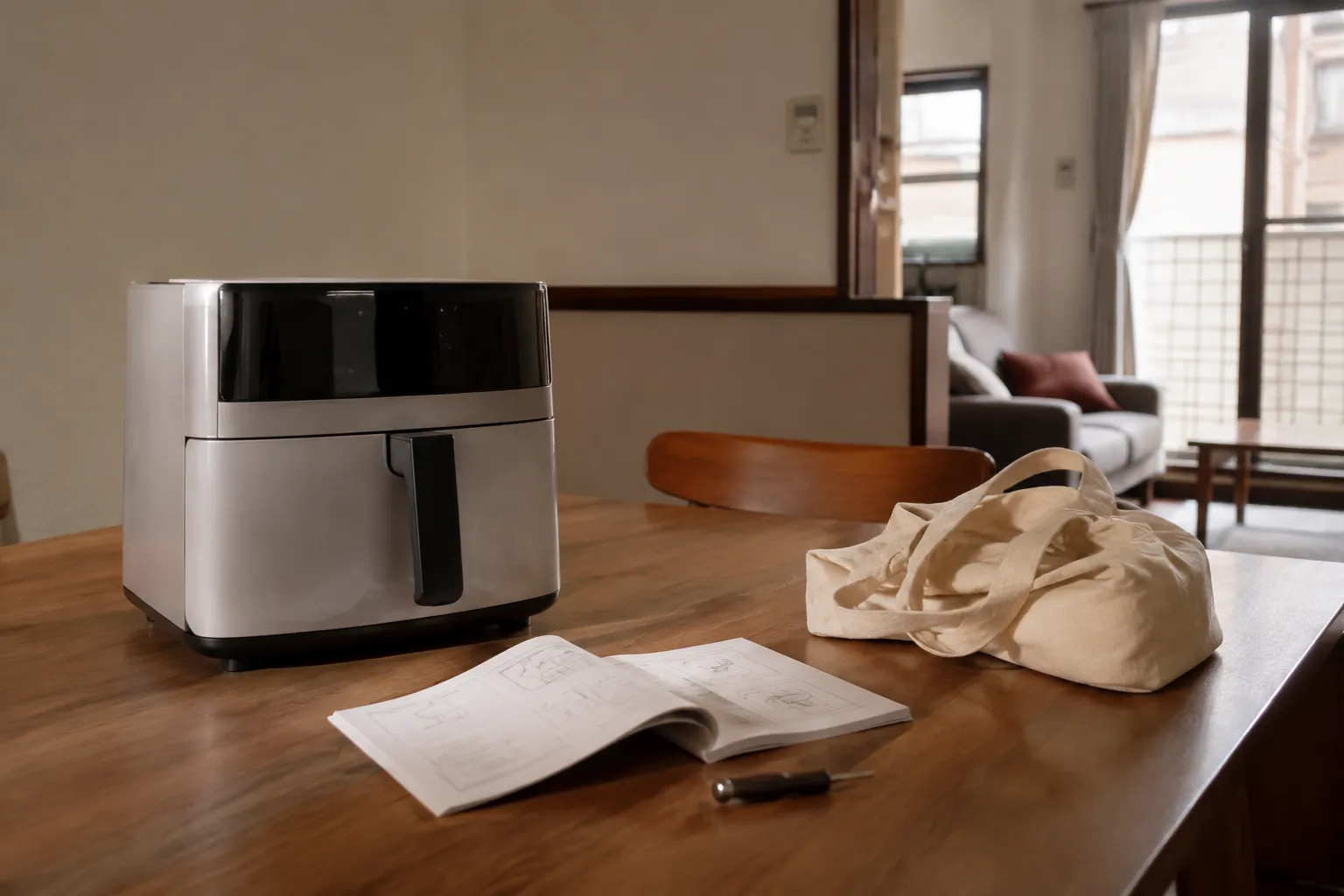
A professional organizer replaced the ironing equipment she used every day three times. The first machine had a lower purchase threshold, easily produced scale, and the heating knob failed after about a year. The second did not break, but the steam came in surges, and every use meant wrestling with the machine. In the end she went back to a professional model she had known from her former work and that could also be repaired. The first two each had different problems; added together, the three purchases already cost more than choosing the last machine from the start.
This is not a matter of turning one person’s experience into a consumption formula for every household. Budgets, needs, and available products differ. Still, this organizing-visit case raises an everyday question that is often overlooked: after a wrong purchase, we think we are fixing it, when in fact we are sometimes only extending an unsuitable choice for a while longer.
Being hard to use often has no clear endpoint
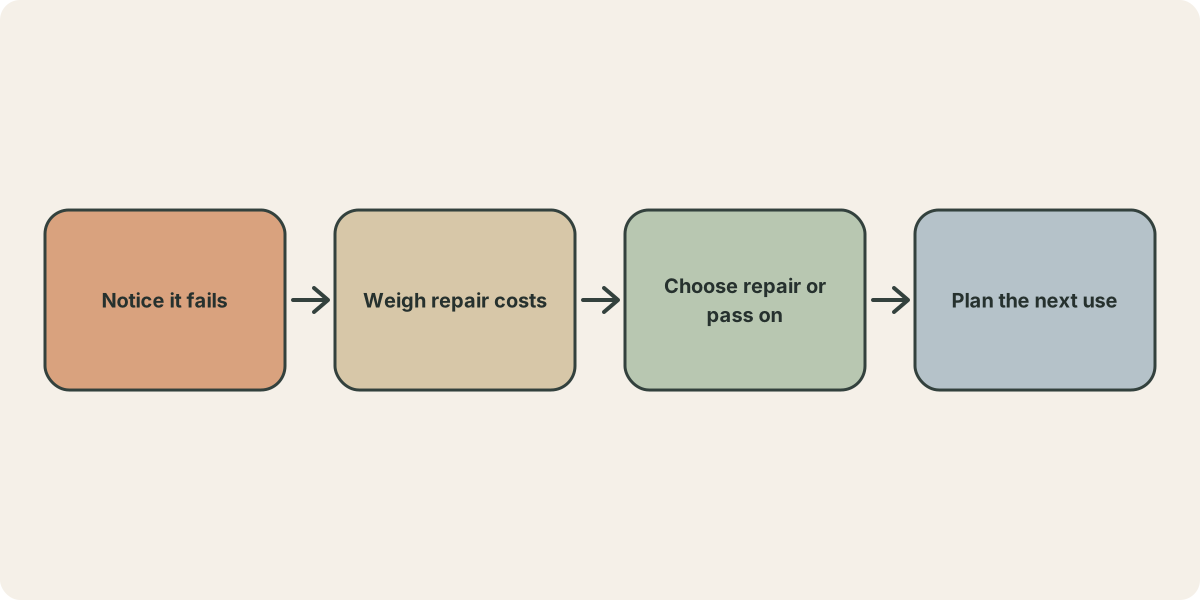
When an item breaks, decisions are usually easy. It cannot run, repair is not worthwhile, or it is no longer safe to use, and the signal to replace it is relatively clear. What truly holds people is items that “still work, they just don’t work well.”
It may cost you a few extra minutes every day, with repeated adjusting, cleaning, or putting away. It may also add a little irritation to housework that was once simple. This wear does not appear on a payment record, so it is hard to treat as a cost. People tell themselves to use it a while longer, to look into it when there is time, or to deal with it at the next move. Years pass, the item is still at home, and it has not truly supported living.
In that period we also rarely look back and ask: what exactly does it not fit? The material, the way it is operated, how hard it is to clean, or a mismatch of capacity with the household’s rhythm? If the problem is not stated clearly, the next time it is easy only to raise the budget a little and still buy the same kind of limit.
The same organizer met a similar situation with another kind of kitchen equipment. She first chose a cheaper model. The machine was not unable to run, but the processing order was wrong and materials stuck together easily. The second time she switched to a product one price step higher; the principle was still similar, and the problem remained. Only with the third machine could it actually handle the materials that appeared at home. The first two left the household not because they were worn out, but because from the start they had not met the actual need.
A fix is more than one sum of money
Wanting to remodel after a wrong purchase is a very natural response. The cabinet’s finish is poor, so people try wrapping, changing handles, adding wheels, or repainting. Equipment is hard to use, so they buy accessories, racks, and cleaning tools, hoping to smooth out the flaws. These practices can sometimes let an item continue in use, but there is a line that must first be seen clearly: can the fix deal with a surface problem, or with the item’s own conditions?
The original payment has already happened; later alterations, accessories, and time are new outlays. When structure, size, operating logic, or durability do not fit, one more accessory may still not turn it into a suitable item. If in the end it still has to be sent away, passed on, or disposed of, what the household bears is not only the resources of the first purchase, but also the materials, money, and attention later put in to save it.
From the viewpoint of sustainable living, this is not only a question of “whether to spend a little more at the start.” What truly needs to be recognized is whether an item can, in the present living environment, be used continuously and without extra strain. Lower spending is not necessarily waste; spending more does not guarantee a fit. But as long as the decision is reduced only to the number at the moment of payment, it is easy to miss the later costs of cleaning, repair, storage, use, and leaving after it comes through the door.
Being repairable is not the same as being repaired
One reason the ironing equipment was finally kept was that, after a fault, repair was still possible. But “can be repaired” cannot be only a word in promotion. Actual repair also needs parts, a repair channel, an affordable fee, and time the household is willing to spend sending it for handling.
At organizing visits, there are also households that keep broken appliances and parts, saying “we’ll fix it when we have time.” That sentence is often not a lack of care, but that the conditions for repair are not yet in place. The item has to be taken apart, the fault judged, parts found, and a repair trip arranged — extra work for a busy household. If years later there is still no progress, those items sit in a state of “perhaps it can be fixed,” neither used nor entered into a recyclable or handleable path.
So before buying, the questions can be made more specific: if it breaks, do I know whom to find? Can common consumables or parts be obtained? Is this item used often enough at home to be worth building a repair habit around it? These questions do not require everyone to become a product expert. They pull the period of use back into the moment of choice.
Replacing early pushes more items toward the next station
A high-frequency item replaced once a year may, over five years, send five pieces into passing on, recycling, or final disposal; in the same period, one durable and repairable item may still be in use. This is not a demand that everything be bought at the highest specification the first time. It is a reminder that what truly needs to be watched is how many times it will be replaced over the next few years, not whether the checkout moment looks cheap.
In the organizing records of ten households, five hundred and eighty bags of items were cleared, of which one hundred and ninety-five bags could still be passed on to a next user. These are ten paid, organizer-led cases, not a random sample, and cannot be taken as a proportion for households in general. Among them, homes cleared upright irons, vacuum cleaners, and brand-new dishes long unused, and in the end sent them out by passing them on. Most of these things were not broken; they had only lost their use in the original home.
The faster items are replaced, the more volume community and recycling systems have to take on. But taking them on does not happen automatically. Secondhand channels have capacity and conditions; appliances that are old in style, bulky, or hard to clean are especially difficult to circulate. For a household, an unused item does not become a problem only when it leaves. From the day an unsuitable choice is made, it may gradually move toward that result.
Let the user take part in the judgment
A common difficulty at home is that the person who buys is not necessarily the person who uses the item every day. Someone places the order, someone cleans, someone stores or carries. If these experiences are not put into the choice, the item easily fits only an imagined need. For example, the family may know a piece of equipment is used every day, yet not know that what the user cares about most is whether the steam is steady, how long cleaning takes, or whether putting it away will block the path.
A formal meeting is not needed before buying, but a few concrete questions can be exchanged first: who will use it most? Which step is most likely to get stuck? Is there already a similar item at home, and what is the problem? If a fault really appears, who has time to handle it? These questions can turn “it looks as if it has many functions” into “can our life actually take it on.”
For a community, this kind of judgment also has public meaning. If durable items are used longer and more fully, the quantity that later needs handling will be smaller. But this should not become a demand that everyone endure things that do not work well. A more suitable direction is, while an item can still be chosen, to let experience of use, conditions for repair, and the possibility of circulation be seen, rather than leaving every problem until the day of hauling things away.
Separate “trying it out” from “long-term use”
A more practical approach is not to require every purchase to complete all the research, but first to tell which kind of need this time actually is. If the need is still uncertain, borrowing, trying, or choosing a way that is easy to pass on may be more suitable than rushing to get it right in one go. If you already know you will use it every day, then cleaning, durability, repair, and ease of operation should be placed on the same level of importance as the burden of payment.
The source cases also remind us that spending and fitness must be kept apart. A massage device that cost a good deal may be of good quality and comfortable in use, yet because it takes space and is troublesome to take out, the frequency of use never rises, and in the end it can only be passed on. It is not necessarily a wrong product. It simply did not fit that household’s way of living at the time.
Consumption choices can hardly avoid mistakes entirely. What matters is not treating every wrong purchase as a defeat, but letting every item that leaves the house leave a usable judgment: the next time a similar need appears, do I need lower spending, convenience, repairability, easy storage, or something that can truly be used for a long time? When a household begins to state these experiences clearly, a fix need not become a series of more expensive chases.
For that reason, durability is not the same as holding on to the end. A truly durable state is one in which an item can be used steadily, and has a reasonable next step when it fails or the need changes. If the user feels frustrated every time they pick it up, or it needs too many extra operations to work at all, keeping it at home is not necessarily more economical. Stating clearly why it does not fit can keep the next change from being only a new look or an added accessory, repeating the same difficulty.
An item leaving need not be seen as failure. Equipment still usable, if passed on earlier, may be taken on by another household with a different need. Broken equipment, if it has clear conditions for repair, may have a chance to return to use. The difficulty is that people often wait until the home needs space and then handle everything at once. By then, whether it can be repaired, sent out, or taken on has already been limited by time and condition. Bringing the judgment forward a little gives the item more options. It is not a demand that people discard faster.
Source: Liao Hsin-yun’s Facebook page (content compiled and adapted)