During one ordinary cleanup, a professional organizer sent away more than ten items. She did not only write down “no longer needed,” but recorded, one by one, why each had been bought in the first place. Once it has already been decided that the items will leave, those reasons can look like an unnecessary review. But when more than ten reasons were placed side by side, she found that many of the purchases were not accidents; they had fallen repeatedly into a handful of situations.
When we organize, the question we ask most often is “Do I still need this?” That question matters, because it deals with belongings already in the home. But if we stop at keep or let go, we may clear out one batch, then let similar items come through the door at the next purchase. Looking back to ask “Why did I buy this in the first place?” is not for blaming ourselves. It is to give a household a chance to see the path by which items flow in.
Reasons for buying often repeat more than we think
In one source case, a pair of shoes was bought because a small size happened to be available at a sale. Only after they were brought home did it become clear that the soles were too hard, and they were worn only once. That the size was hard to find was a real condition, but in the moment it overrode comfort. A sense of scarcity makes people hurry to seize the chance, and also makes it easy to skip checking whether the item actually fits.
Another new bottle of makeup remover came from overestimating how often it would be used. The thought was that makeup would be worn often; in the end the old bottle had already been in use for a long time, and the new one was never opened. On the same list there were also a short-sleeved knit top and a high-neck vest. The season in which they could be worn was very narrow, and the days they were truly needed were fewer than imagined.
Some items, too, came from a one-time need created by an outside requirement. A child went to summer camp, the school asked that talcum powder be brought, the household had no habit of using it, and after the activity ended there was nowhere for it to go. Some information can also be known only after an item is bought and brought home: a hair-dryer rack, hung on a desk pole, would wobble; a leather desk mat, once installed, showed that the desktop was actually easier to clean without it.
These examples are not meant to prove that every purchase must be predicted with precision. Life changes as a matter of course. A move, children growing up, a change in the pattern of work — all may cause an item that was once reasonable to lose its place. Their value is in pointing out that some mistakes come from a change of situation, and some from the same pattern of judgment appearing again and again. Only when we can tell the difference do we know where, next time, to pause.
Break “I don’t use it” into more specific words
“I don’t use it” is the most common conclusion when organizing, yet it is hard for it to guide the next choice. It does not tell us whether the item was the wrong size, whether frequency of use was overestimated, whether it was limited by season, or whether it was bought only to meet a one-time requirement. When every reason is condensed into those few words, experience cannot accumulate.
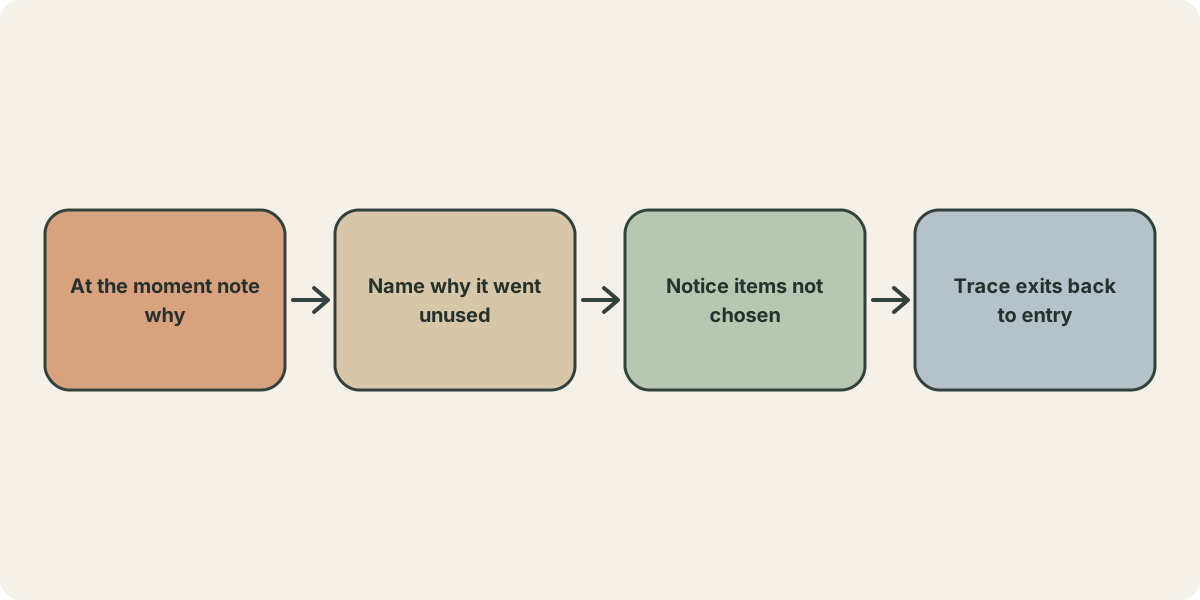
A more useful practice is, when an item is about to be sent away, passed on, or otherwise handled, to write down a few details: Where did I see it at the time? Was it because of a special price, scarcity, someone else’s recommendation, or a temporary need? After bringing it home, how long was it actually used? Which condition later changed? There is no need to write a full diary; one or two sentences are enough. The point is so that next time you stand in a similar situation, you can recognize that familiar reason.
For example, if you find that “the size happens to fit” often makes you overlook comfort, next time you can add a rule that belongs only to you: even for a size that is hard to find, walk a few steps to check the sole. If “I might use it often” often lets consumables pile up, the rule may be to finish one first, then buy the next. These rules are not universal precepts of consumption. They are reminders that grow out of the household’s own rhythm of living.
Keep the record close to the moment of handling
Why write it when the item is being sent away? Because while the item is still in your hands, the situation of the purchase comes back more easily. You may remember that you were rushing out the door, saw a sale, worried about missing it, or heard a recommendation from someone. A few days later, the memory often leaves only the sentence “Anyway, I wasn’t using it.”
The source material mentions a rhythm of “letting go of one item a day”: handle one item each day, and also leave one reason for a purchase each day. The point is not to empty the house quickly, but to keep judgment detailed enough. Rather than a once-a-year deep clean that leaves people tired in front of a heap of belongings, it is better to let handling a small amount become everyday observation. What accumulates is not only a clearer cabinet, but also a record of where the household knows it tends to buy too much.
This record can be very private, and need not become a tool for controlling others. In a household that lives together, it is more suitable as a starting point for conversation: Do we often buy duplicates in order to reach a discount? After a child’s activity supplies are no longer needed, who is responsible for checking whether they should still be kept? Who bought the kitchen item, who uses it, and who knows best whether it actually suits the person using it? Speaking these questions aloud can reduce the accusation that “someone is always buying at random,” and bring the conversation back to how a shared life divides judgment and care.
Some items were not bought by us at all
Looking back at purchases also has a boundary. Gifts, complimentary items, and items passed on by others did not go through one’s own buying decision, and writing down “why I bought it” cannot deal with them. One homeowner described their home as having too much coming in and a halt in what went out: relatives and friends kept sending old clothes and old toys, and the family felt too awkward to decline. What such a situation needs to discuss may be how to reply to relatives and friends, how to set conditions for receiving, and how to arrange for items to leave — not a review of whose shopping habits are at fault.
Likewise, items of which an elder says “we’ll use it someday” may not at once be classed as a wrong purchase. In a source case, a homeowner’s mother had lived through wartime years; complimentary items at home were sealed away box after box, and the habit had also been passed to the next generation. Items are tied not only to use, but also to a memory of shortage and to unease about the future. Faced with this kind of belonging, setting a date to look again may help more than asking someone to admit at once that the purchase was wrong.
From the way things leave, look back at how they came in
The least effortful step in reducing often happens before checkout. But no one can complete a complex analysis in front of every shelf, so what is needed even more is a short list, easy to remember, that comes from one’s own experience. It may be a note on a phone, or a slip of paper the household shares: For what reasons do I often buy something and then not use it?
When an item is about to leave, do not rush to ask only “What is the fastest way to clear it out?” You can also ask one more question: How did it come in, in the first place? If each household can recognize its own repeating pattern from a small number of items, the next purchase need not rely on willpower alone. This is one way to bring consumption closer to actual need, and also, before belongings become a burden, to reduce a little unnecessary inflow for the household and the community.
Do not let the record become another kind of pressure
The purpose of recording the reasons for a purchase is not to prove who is more restrained, nor to turn the home into a warehouse that must be inventoried at any moment. People’s lives change. Buying the wrong thing, buying too much, or needing something only for a short time are all ordinary. Some things were indeed reasonable at the moment of purchase, and only later, because of work, the body, the season, or a change in household members, no longer fit. What these items leave behind need not be self-blame, but a recognition closer to actual living.
If a household is willing to share this recognition with one another, it becomes easier to avoid using belongings as a way to blame people. When a child grows up and no longer needs a small desk lamp, or a tool has no place after a move, what has changed is not that someone did something wrong, but that the situation of use has ended. Stating the reason clearly can let the item flow earlier toward a suitable next station, and also let family members understand that reassessment is part of living together.
Over the longer term, these scattered records can also let us see how the consumption environment shapes choice. Sales, time limits, scarce sizes, and activity requirements are not problems of individual will. They compress the time for thinking, and make people treat the chance in front of them as a need. Understanding these conditions will not remove every temptation, but it can let a household, the next time a similar situation appears, keep a little more room to choose.
A record can also help a household adjust how items leave. If a certain kind of thing is always left idle after being used once, next time it may not be necessary to rush to own it; one can look for a way to borrow, share, or pass it on after the activity ends. If some supplies are always forgotten because their season is short, a review can be done first when the season ends. These practices all start from the observation that “the situation of use will change,” not from a demand that every item stay the same.
When the way items come in and the way they leave can be imagined together, organizing is no longer only moving things out of a cabinet. It becomes a household capacity that can be practiced again and again: knowing what easily sways you, knowing which needs are in fact very brief, and knowing, when a need has ended, how to let an item leave in a more suitable way. For the public environment, this capacity can reduce the cases in which items sit at home long after they have lost their function, and are only then handled all at once.
The next time you send an item away, you might keep a short stretch of time to write down the original reason and how it differs now. This note need not be explained to anyone, yet the next time you face the same situation, it may help you ask one more question: Do I truly need it, or am I again being pushed along by a familiar reason? This small pause is also a way of keeping a choice for the next purchase.
This looking-back need not aim at completeness. As long as it can give the next choice one more basis, that is already enough.
Source: Liao Hsin-yun’s Facebook page (content compiled and adapted)