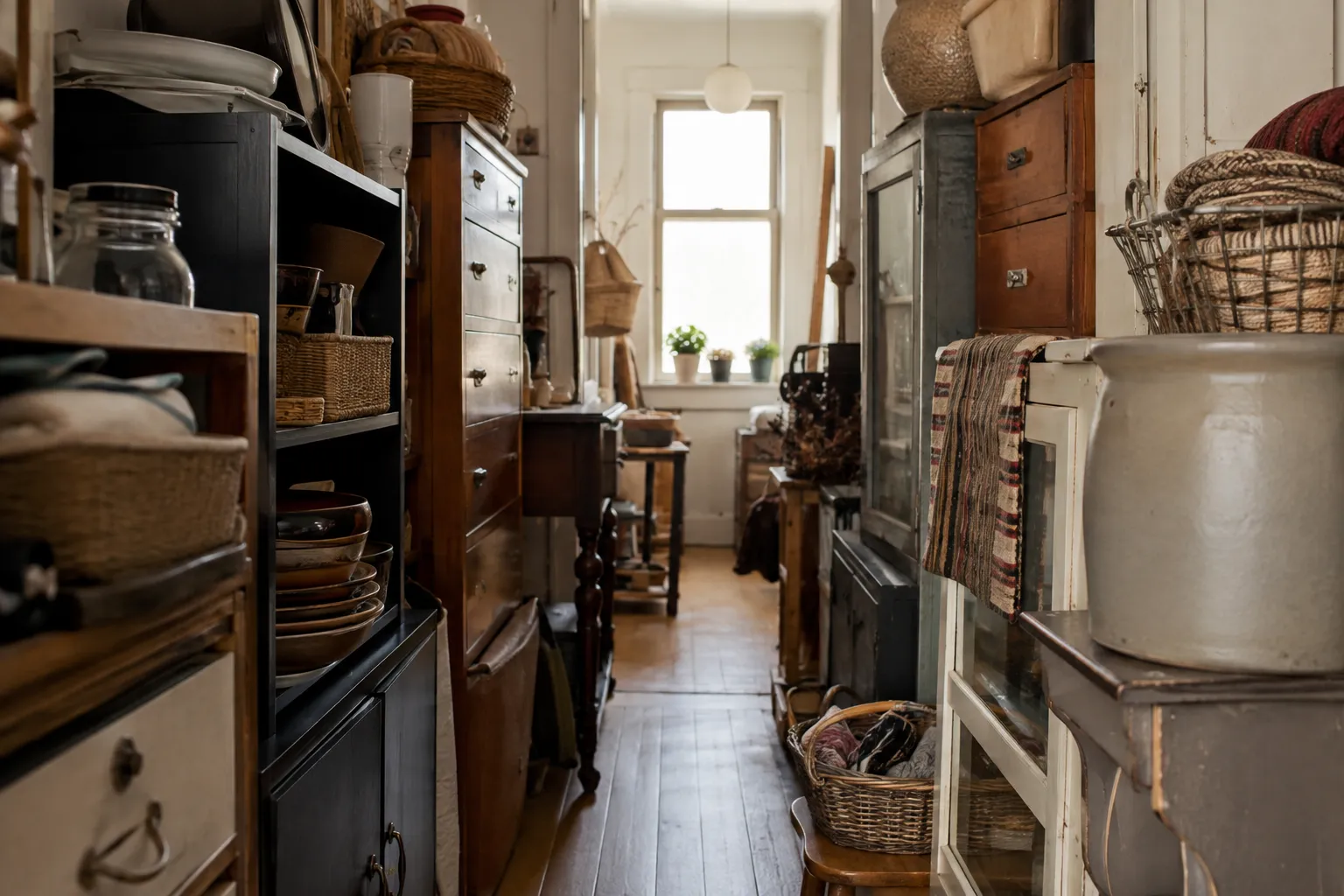
A home with many cabinets does not necessarily mean things have been put away well. Sometimes a cabinet only gives the problem one more place to pause for a while.
At an organizing visit, there was a father living in a four-story townhouse. He had bought more than ten books on storage, had truly followed the methods, and had even stayed up organizing through a whole night. The house had quite a few rooms, and the family was willing to help, yet the next day it still “didn’t seem to have improved much.” Later a professional organizing team came in over several visits before the floor taken over by belongings could be cleared.
This case does not prove that storage knowledge is useless, but it reminds us that when a home becomes hard to live in, the problem is not necessarily only a lack of method. When the quantity of belongings exceeds what the space can bear, adding containers, adding floor area, or even adding organizing time may only push the problem further down the line.
Space is not only the number of rooms
When people see clutter, they usually first think “things have not been put away.” So we buy storage boxes, add shelves, or relearn a way of folding clothes. When belongings have not yet exceeded what the space can bear, these practices can indeed make daily life smoother.
But storage products themselves also need space. Once a shelf enters a room, the room loses some of the area that can be walked through, cleaned, and used. If the total quantity of belongings does not fall, the original problem becomes “things still don’t fit, and now there is one more cabinet.”
Households with more rooms only meet this limit later. An extra room offers more corners in which to “put it for now,” but it does not automatically make belongings fewer. When things are scattered across different floors, family members may find it even harder to remember where each item belongs, and when they cannot find it they open another new pile.
Piles multiply on their own
Once belongings exceed capacity, a household often forms a very stable way of patching things over. The wardrobe is full, so clothes hang on the doorknob; the doorway is stacked, so what is needed soonest moves to the bedside; the bedside fills again, so a chest of drawers is bought, and stacking continues onto the top of the cabinet.
In one four-ping room, the bed, wardrobe, chest of drawers, and three-tier cabinets were stacked nearly to the ceiling. The door was blocked by the cabinets behind it, so people could only turn sideways to go in or out. Documents sat on bags, towels covered the documents, and clothes were stacked on top. Each placement looked like a serious attempt to organize; taken together, they made the room lose the function it was meant to have.
This is not a matter of someone not trying. The organizing action only dealt with the spot in front of them, not the total quantity of belongings or the next inflow. When a home must keep looking for new corners, space is no longer support for living. It starts to become a temporary holding system for objects.
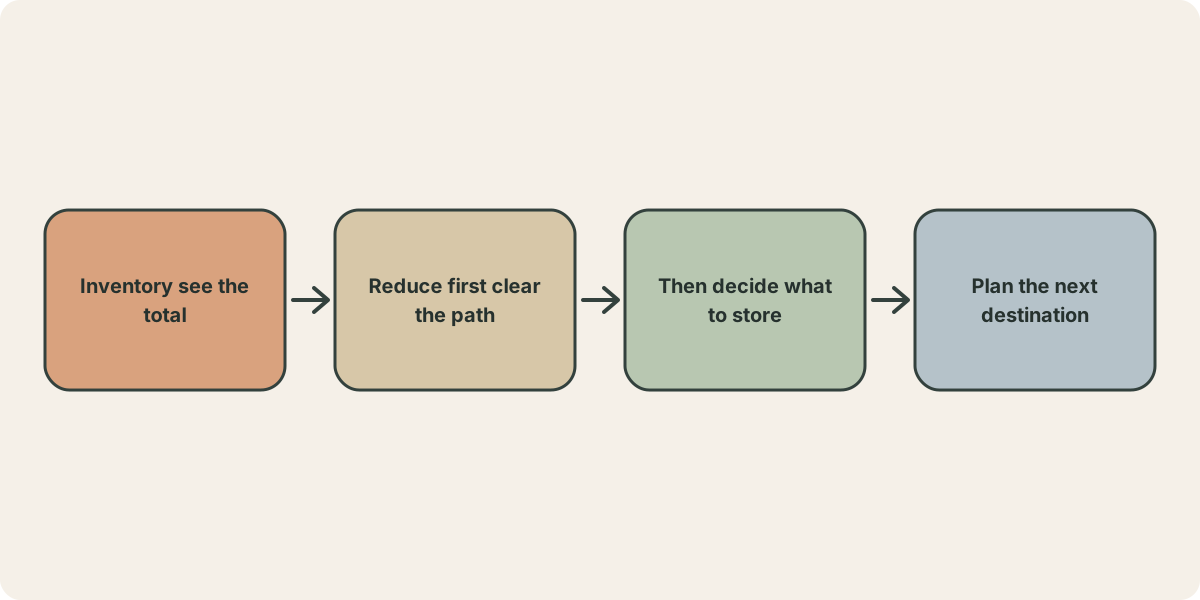
Let the quantity fall first, then decide what is needed
In another family workshop that had been closed for years, the organizing team did add four metal racks in the end. But the racks were not the first step. First they cleared a large amount of bulky furniture and reworked the circulation path. Over four days they cleared twenty-three bags of trash and eleven pieces of bulky furniture. Had the order been reversed, the racks would likely have become only new places to pile things.
There was also a homeowner who, after long-term caregiving had ended and while the body was still recovering, found after clearing a large quantity of belongings that the study’s original two sets of shelves were no longer needed, and so took them down without rushing to fill the wall with new storage products. When the total quantity of belongings falls, the need for containers may fall with it.
These are individual organizing cases and cannot be treated as statistics for households in general. But they point to a sequence that can be practiced: first take stock and reduce, then judge which things to keep, repair, pass on, or return to the materials stream, and only then decide what storage tools are still needed.
Letting things leave is also a form of organizing
Organizing is not hiding every item deeper. Things that stay need a clear use; things that leave need a suitable destination. For a household, that may be reuse, passing on, recycling, or responsible final disposal.
The starting point of circular economy in daily life is not turning the home into a display space. It is keeping belongings from remaining trapped in place after they are no longer used. Storage deals with location; reduction and circulation begin to deal with what happens to an item next.
A truly usable home is not one in which everything is hidden away, but one in which people can walk, can find what they need, and can, at the right time, let unused items leave. Cabinets can assist living. They cannot complete the judgment for us.
Source: Liao Hsin-yun’s Facebook page (content compiled and adapted)