We often put the things we cannot do down to a lack of self-discipline. We want to study but cannot sit for long; we want to cook but always order takeout; we want to put things back where they belong but fail every night. These frustrations certainly have to do with time, physical and mental condition, and the pressures of daily life. But there is another very concrete, and often overlooked, condition: the kind of space we move through every day.
Space is not a silent backdrop. Which way a table faces, how many steps it takes to reach a pot, whether a door can open fully—these make some actions easy and others cumbersome. From the perspective of sustainable living, this is not merely home aesthetics. When a space leads people to keep buying more, give up using what they have, or find it hard to maintain, belongings and resources continue to be consumed.
Sitting still may not mean a lack of focus
One homeowner placed a desk in what looked like the most beautiful spot in the room, and kept the surface tidy; a year after moving in, they still rarely sat there in any settled way. Later they simply moved the bookcase against the wall, so the desk faced the doorway instead of the wall, with a wall of books behind it. The same desk then began to be used. This is a single organizing experience and cannot explain everyone’s problems with focus, but it raises a direction worth checking: the body may respond to the environment before consciousness does.
In another household, the desk stood beside the living-room entrance. The parents worried that the child could not concentrate, but that spot sat close to the path of people coming and going and of meals. Anyone sitting there had to keep dealing with sound, sightlines, and other people’s movement. Taking it as a personal shortcoming easily leads to more self-demand; taking it as a cost of location makes it possible to adjust the desktop, the chair, and the circulation first.
A kitchen can add friction to everyday choices
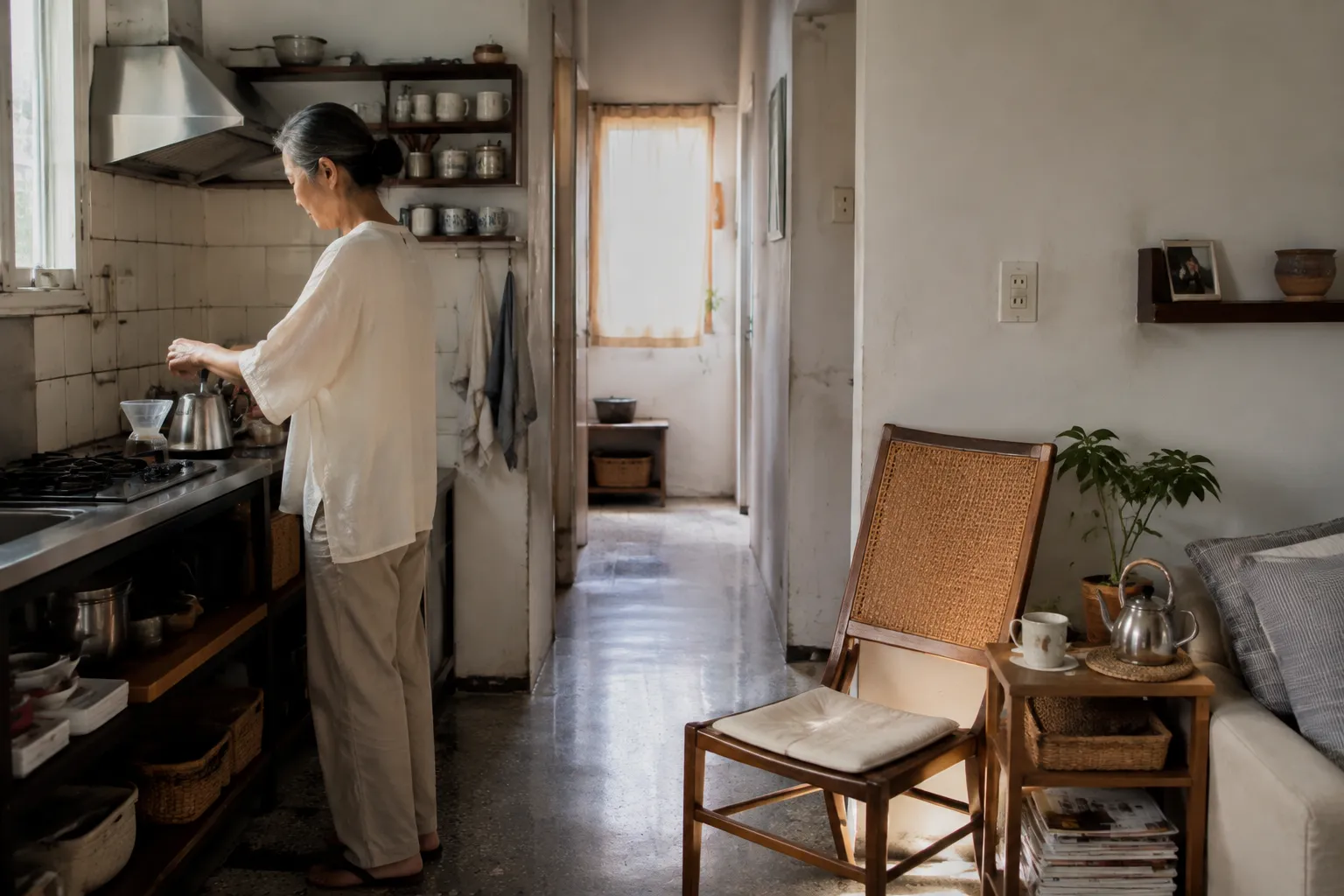
The kitchen is especially where the effect of layout on behavior becomes easy to see. If the counter is piled with clutter, things have to be moved before cooking can start; if there is nowhere to set chopped ingredients, and pots and seasonings are scattered far away, preparing a meal is like completing a chain of extra tasks. If boxes and bags occupy the floor, you also have to cook while weaving around them. In that situation, choosing not to turn on the stove does not mean a person does not care about food; the space may have pushed the threshold of cooking too high.
The source uses a small pan-fried dumpling shop as a contrast: the kitchen was small, yet it could hold three or four people dividing the work, because frequently used items were within easy reach and quantities did not exceed what the work required. A commercial space has staffing and training that cannot be applied directly to a home; this example can only remind us that ping is not the only factor. The volume of items, their positional relationships, and the order of reaching for them also determine whether a place is usable.
Clear the relationships first, then rearrange
Layout is not solved by simply turning a piece of furniture. In both organizing sites described in the source, accumulated belongings were dealt with first, and only then was there room to rearrange. One household zoned the kitchen by frequency of use, putting everyday tableware in easy-to-reach drawers, grouping baking tools together, and moving seasonal items higher up or into storage; the children’s room distinguished study from sleep, and the desktop kept only stationery and books currently in use.
Another four-story home cleared out more than ninety bags of belongings during organizing, then gathered each family member’s items back onto the floor they mainly used, and readjusted the positions of beds, cabinets, and desks. These are case records and cannot stand as an average for ordinary homes; together they show that when the volume of things has not come down, layout usually has too little room to work. Only after unused items are passed on, recycled, or properly disposed of does it become possible to see the circulation that had been blocked.
Do not let the remedy become a new purchase
When daily life gets stuck, buying a larger table, a set of cabinets, or a new timer is often the answer that surfaces first. These objects are not necessarily unhelpful, but if the location itself is the problem, the new item may only join the existing crowding. One more storage product means one more share of materials, manufacturing, and future disposal; buying before confirming the need can also add another item to the organizing list.
Some adjustments need almost no new resources: move frequently used items closer to the point of use, send items that do not belong in the room back to where they are mainly used, and keep the space behind doors and along walkways clear. Renting, the plumbing of an old house, or family members’ views may also make large-scale change unfeasible; in that case, existing small partitions, screens, or furniture placement can first give sightlines and circulation a more stable boundary. The point is not to pursue a standard floor plan, but to reduce the friction paid over and over every day.
Let space be support, not a scorecard
Adjusting space should not become another form of blame. Simply moving a table will not address exhaustion, caregiving pressure, or income limits; nor does everyone need the same quiet, order, and storage. A more fitting question is: at which step do I most often give up? Can that step involve one less bend, one less door to open, one less thing to move, or one less search?
When space makes walking, cooking, reading, and rest a little less effortful, people have more room to attend to what actually matters in life. That is why adjusting layout can be part of consuming less: first let the furniture and belongings already owned be properly used, then decide whether something new is truly needed. The next time you feel you have fallen short again, perhaps look first at the chair, the counter, and the walkway, rather than placing all the responsibility on yourself at once.
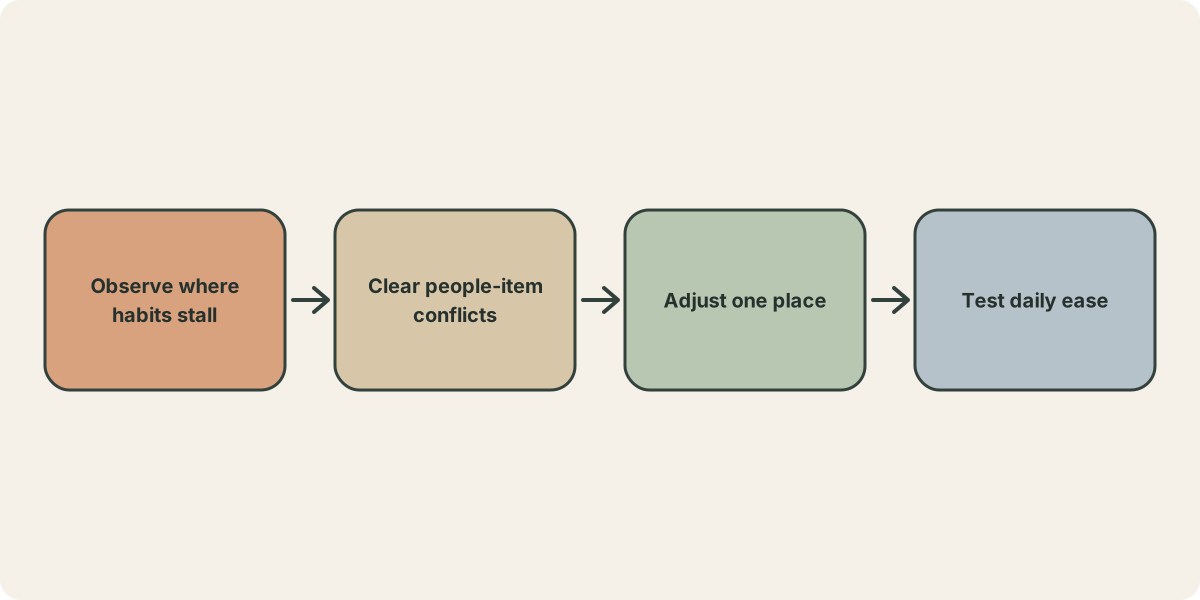
Start observing from one place
When you want to adjust a space, you need not turn the whole home over first. You can pick one point you complain about most every day: the dining table, the desk, the entryway, or a short stretch of kitchen counter. For several days in a row, notice what happens there. Where do things come from? Where does the person using them have to stand? What has to be moved before they can start? Why do things not go back after use? These observations are not for finding who did something wrong, but for seeing clearly the friction that had become habitual.
For example, if backpacks always land on the dining table, it may not mean a child is unwilling to put them away. It may be that after coming home they first have a snack and write down school notes at the table, the room is far away, or putting the backpack in its place requires opening a cabinet door first. Rather than immediately setting stricter rules, you might first try a drop-off point along the path of movement, and at a set time bring the backpack back to its main place together. If shoes at the entryway always spread out, you can also first distinguish: is the shoe cabinet too small, or is there no temporary place to set shoes while putting them on and taking them off that does not block walking? Small-scale trials bring the adjustment back to the real cause, instead of immediately buying more products.
When observing, also notice the power relations in the space. Tables, cabinets, and walkways are often shared, but the person who arranges them may not be all of the users. Someone needs a quiet corner; someone needs caregiving supplies within easy reach; someone works shifts and can use the kitchen only at certain hours. If only one person defines what “tidy” means, others may feel excluded, and positions that were hard-won become hard to maintain. Speaking the situations of use out loud is more helpful than asking everyone to accept the same aesthetic.
Spatial adjustment should also keep reversibility. First move a chair, a small cabinet, or a frequently used tray; after a week of use, judge whether it truly reduced the time spent looking for things, taking detours, or cleaning. If it does not work, you can change again; if it does, then consider a longer-term arrangement. This approach lowers the pressure of impulse buying and of a one-time overhaul, and also gives family members a chance to take part in the test.
Finally, empty space is not waste. A floor you can walk through, a door that can open fully, a counter where you can set down ingredients just chopped—these are spatial resources that keep daily life running. When we reserve places for these functions, we also reduce the repeat consumption that comes from not finding things, not being able to use them smoothly, or not having time to tidy. Layout will not live life for anyone, but it can make every intended action easier to start. It is also worth keeping a record of how the adjustment feels: is it easier to sit down, more willing to cook, or simply that cleaning takes a little less time? These small changes may not be quantifiable, yet they are evidence of whether the space truly supports life. If an adjustment does not improve things, you can also return to observation and see whether the volume of belongings, the caregiving load, or shared-use rules still need attention. Treat the result as information, not as success or failure, and space will keep changing with the people in it.
A space need not become ideal in a single day. First holding on to a small stretch where you can walk, sit, and get something done is already creating new possibility for daily life. Once that small range is stable, slowly extend it to other areas; you need not measure yourself by finishing everything at once, nor sacrifice rest and relationships for the sake of organizing.
Source: Liao Hsin-yun’s Facebook page (content compiled and adapted)