After ten households finished organizing, five hundred and eighty bags of belongings were hauled away in total. The number is striking, but it cannot directly answer “why it piled up this much.” Some came from family factories that had been closed for years; some were belongings left by the previous generation; there were also families who, only after long-term caregiving had ended, finally had the energy to deal at once with what had accumulated over a long time. Each household had different reasons, but every organizing visit faced the same thing: what was cleared out was the visible stock at hand; what often decides whether the space will fill up again is the inflow that is hard to see from day to day.
Getting a home in order is often thought of as a problem of storage technique. In fact, it is also about how a family makes decisions: who can bring things in, and who is responsible for finding a place, cleaning, moving, and finally dealing with them. When the entrance is not seen together, even the most refined organizing may only be finding a temporary place for things.
Organizing Deals with Stock; the Entrance Decides the Days Ahead
The total amount of belongings in a home can be understood in a simple way: what has come in over time, minus what has already left, is the stock that now needs to be looked after. Cabinets, sorting methods, and organizing days mainly deal with this stock; what is bought, taken in, or moved in from elsewhere every day is changing the flow.
A homeowner in her twenties called in organizing services twice within six months. When the first visit ended, the professional organizer on site expected she might have trouble keeping it up; in less than six months, the room did slowly return to how it had been. A follow-up visit one month after the second organizing found the space well maintained. These were two different outcomes, one after the other, in the same household. The on-site records did not measure how much she bought or sent away each day, so they cannot be used to estimate how quickly households in general fall back into clutter; but this individual case reminds us that clutter returning is not an unchangeable fate, and that change does not happen only inside the cabinets.
In another household, a family factory that had been closed for years, the elder in charge of organizing would immediately fill newly cleared space with food, stationery, and gifts that family members had found elsewhere. Things did not necessarily come through the front door; they might only have been moved from another part of the house. For the floor and walkways that had just been cleared, the effect was no different. This is not proof that someone was unwilling to try, but that as long as a space keeps taking in inflow, it will need another place.
Why Inflow Often Goes Uncounted
A large-scale organizing session easily leaves a strong impression: dozens of bags carried away, the floor visible again, a door that can finally open. By contrast, things coming through the door are usually small matters. A pen, a free gift, a box of toys a child wants—none of them, in the moment, feels as if it will change how the home looks. They are scattered across everyday shopping, social exchanges, and “keep it for now,” so they are rarely entered on the same ledger.
One four-story townhouse was home to a couple and three children. The homeowner mentioned that after the children were born, more and more things were bought, and the household formed an unspoken understanding: whenever one child clamored for a toy, the other two were bought one as well. Assembly toys alone came to twenty or thirty boxes, some still brand-new and unopened. Another four-story townhouse was different: before and after the children were born, relatives and friends kept sending used clothes and used toys; the husband, being thrifty and finding it hard to refuse, sometimes even accepted used adult clothing. The homeowner herself did not have many belongings, but described the home as “too much coming in” and “outflow at a standstill.”
These two are individual families from organizing visits; they cannot be written up as general statistics for households raising children. What they show are two common kinds of entrance: one is a shared decision at the point of purchase; the other is social pressure at the point of receiving. For the space, whether the source is a new purchase, a gift, or a move from elsewhere in the house, as long as things come in faster than they are organized, used, and sent out, the problem will accumulate.
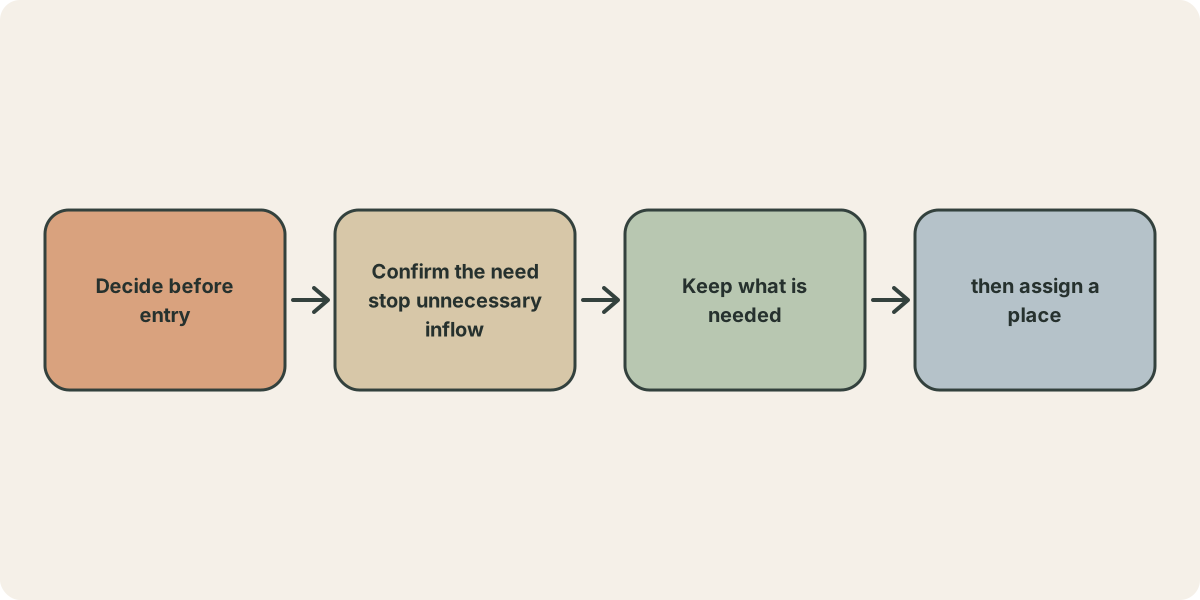
Put the Rules in Place Before Things Come Through the Door
A forty-year-old manager, before moving into the family home, told the professional organizer she wanted to get it right from the start, so that moving boxes would not become long-term residents. After the organizing was finished, she set three principles: put things back after use, give every item its own place, and stop buying duplicates that serve the same function. The first two ask every member to cooperate every day after things have already entered the home; the third moves the judgment forward to before a purchase or a gift is accepted.
These ten households have no follow-up records covering more than six months, so one cannot claim that these three principles necessarily work. What they offer is a comparison: a requirement to act and a limit on quantity are not the same thing. “Put it back after use” can keep existing items from occupying the tabletop, but will not stop more of the same from continuing to increase; “keep only one of each function” runs directly into the inflow. For a family, the latter may not need greater willpower so much as a judgment everyone can accept.
In practice, there is no need to start with a comprehensive inventory. If a surface is piled high for the second time within three months, one can first look back at what came in over those three months, rather than immediately buying new containers. Rules can also be written more specifically, for example by setting a limit by function or by quantity, rather than only saying “keep things organized.” If new items are first gathered at a fixed receiving point, things whose use has not yet been decided will not immediately scatter into every corner. The point of these practices is not to monitor family members, but to give accumulation that was once invisible a chance to be discussed together.
Some Entrances Call for Negotiation, Not a Ban
Not every entrance is controlled by the person mainly in charge of organizing. Used items sent by relatives and friends, things an elder brings back, belongings the previous generation left in the family home—behind these may be thrift, social obligation, fear of shortage, or life experiences that are hard to process. In the family factory case, items that had just been cleared were picked up again by the elder, and furniture moved to improve circulation was moved back the next day. If this is reduced to “not cooperating,” organizing only becomes a scene of family members blaming one another.
For a household with limited income, keeping items that can still be used may also be a form of risk preparation, not a behavior that must be corrected. What usually needs to be discussed is not who is better at throwing things away, but which items must be decided by whom, how long they can stay temporarily, when they will be reviewed again, and whether shared walkways, sleeping spaces, and cooking spaces can be kept for living.
Controlling the entrance is not a ban on buying, still less taking away a person’s sense of security. It only asks that every item, before it comes through the door, pass through one more conscious decision. When a family can change “take it first and decide later” into “first think together about where it will live, who will use it, and when it will leave,” organizing is no longer only one person’s weekend labor, but a way of maintaining living space together.
Make Seeing the Inflow Something a Family Can Share
If the entrance rules live only in one person’s mind, it easily ends up being that person who has to remind, refuse, tidy up, and absorb the conflict. A more sustainable approach is to turn the rules into a shared language every user can understand. For example, where new items go first, whether a gift needs to have its use asked about first, how long to wait before deciding on something a child wants, and how to deal with the old ones once there are too many of the same kind—all of these can be talked about while the problem is still small.
This does not mean every item has to go through an elaborate vote. Autonomy and surprise remain just as important in a family. The difference is that when an item will occupy shared space, change how others clean and move, or need others to help store it over the long term, it is no longer only a personal choice. Giving things one more stopping point before they come through the door is, in fact, an acknowledgment that space is a resource used in common.
Rules also need to be adjusted as life changes. When a family moves, cares for a newborn, loses a family member, or changes how it works, the need for belongings may all be different; reviewing the entrance is not overturning past arrangements, but letting those arrangements keep up with life as it is now.
The inflow can also be seen as a complete process, not only the moment of purchase. Is anyone using a gift afterward? Is a still-unopened box of toys still right for the child? Does a temporarily stored item have a date for review? These questions do not have to demand an answer at once, but they can keep “temporary” from becoming stock that is only discovered years later. When belongings can be seen, discussed, and given a destination, a family has a chance to turn organizing from one round of catch-up after another into a more balanced everyday practice.
The next time the tabletop is full again, perhaps do not first ask “what should we buy to store this,” but ask the family: of the things that came through the door this season, how many were truly kept only after they had been discussed?
Source: Liao Hsin-yun’s Facebook page (content compiled and adapted)