This article draws on a professional organizer’s observations across several organizing jobs. It is practical experience, not long-term statistics or a general conclusion.
There is a kind of home you could not really call messy. Everything is put away and everything has a place, yet the people living there keep feeling that something is off. Tidying never quite works, and not long after a clear-out things are cluttered again. This is often blamed on a lack of storage skills, so another batch of storage boxes gets bought, or another set of cabinets is ordered. In several similar cases, the organizer found the cause had nothing to do with skill: sometimes the layout of the space was wrong, sometimes the volume of belongings needed trimming a little, sometimes the flow of movement needed rearranging.
Why more tidying makes it feel more stuck
People who get stuck have usually already tried very hard. They tend to deal with whatever is messiest in front of them: a cluttered desk gets cleared, toys scattered across the floor get put away. Each round produces a result, but the source of the mess is never touched. When the volume of toys exceeds what that floor of the house can hold, no matter how neatly they are stored, they will spill out again within days.
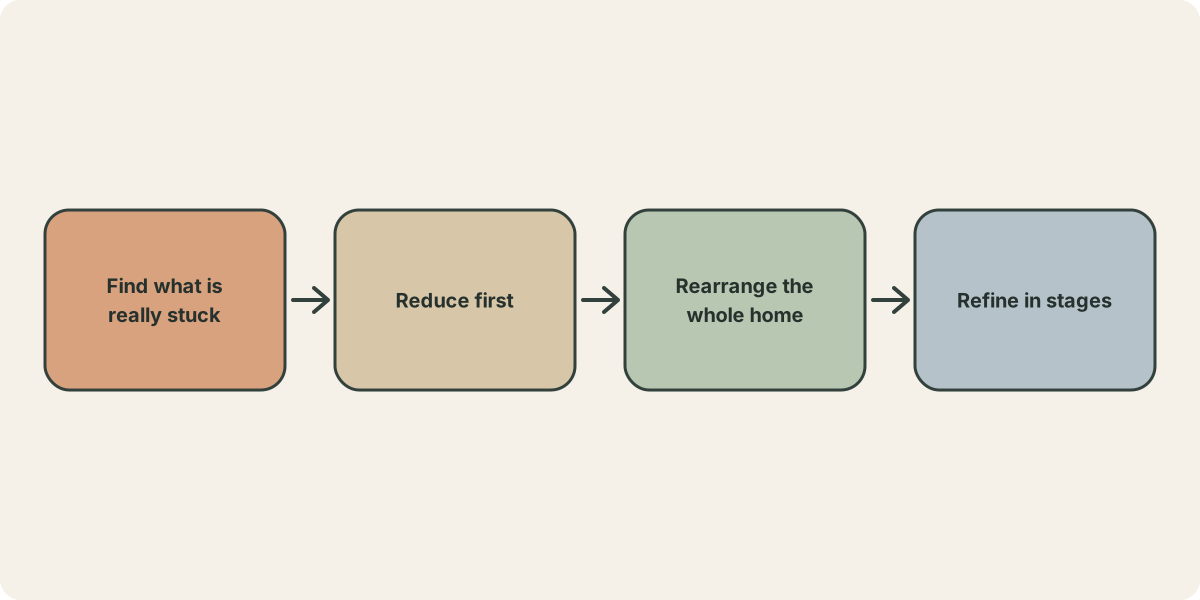
When the problem lies in the layout, tidying one spot at a time will keep failing. Seeing themselves fail over and over, the residents tend to blame themselves for not knowing how to tidy. What they actually need is to reduce first, then redistribute the space.
Step back and look at the whole home
The organizer describes her own approach as standing at a higher vantage point and looking at the whole space, finding the real cause first and then reconfiguring the entire home. A four-storey townhouse job shows what this looks like.
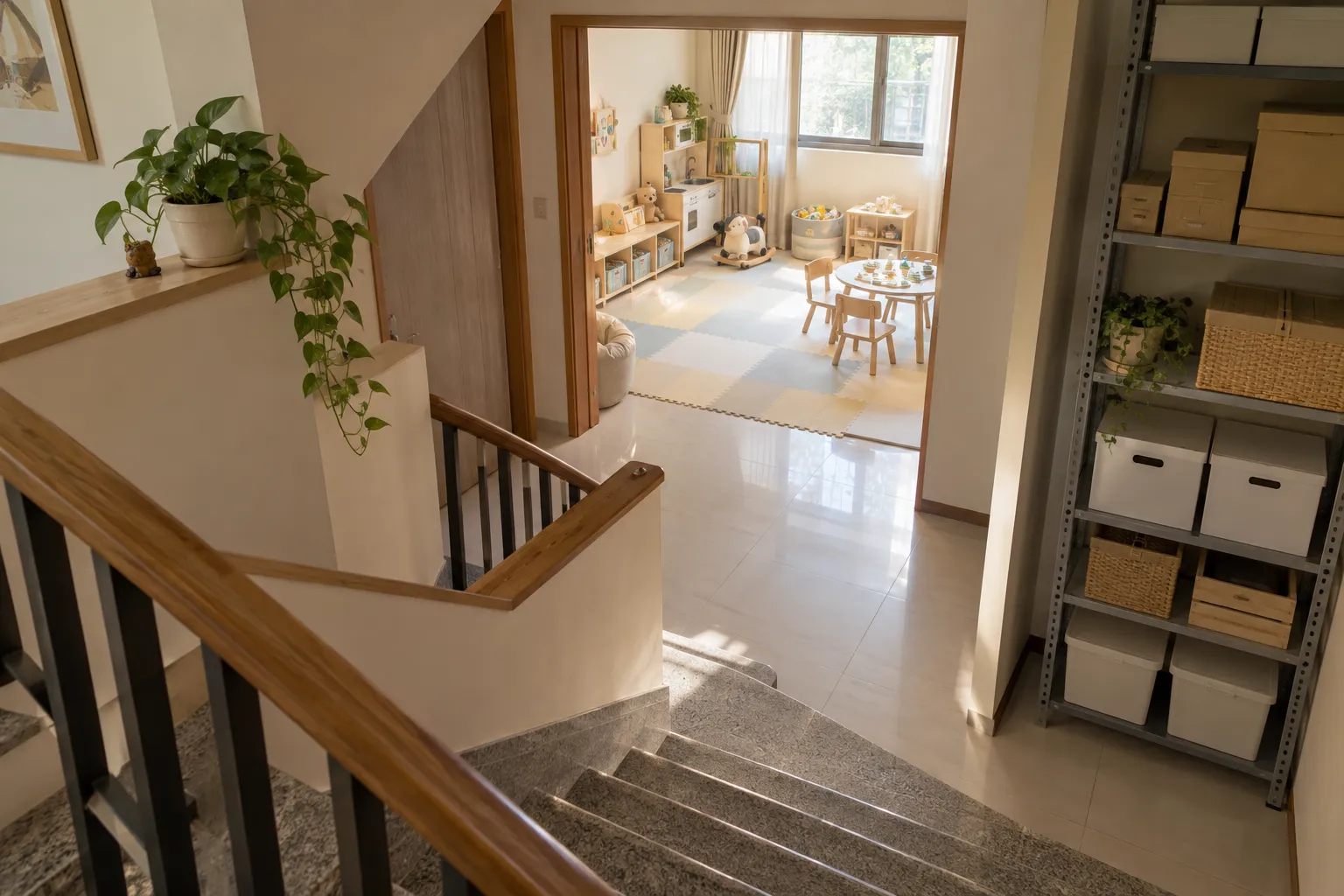
On the first floor there was a bedroom, which was turned directly into a playroom; the storage in the living room, and the angle-steel shelving in the kitchen and the fridge area at the back, were all reorganized too. The second floor had a lot of toys; once some of them moved down to the first floor, the floor with the main bedroom was no longer permanently half-messy, and the walk-in closet, desktops and bathroom were adjusted along with it. The third floor held the husband’s workroom and two guest rooms, where the baby’s clothing and all the maternity and baby supplies were re-sorted and given new places. The whole fourth floor became a storeroom, with L-shaped angle-steel shelving added so that an entire wall could be used for storage. The spaces between the stairs, the laundry-drying area and the transitional zones on every floor were all worked through one by one.
The point of this list is the order. Only because the first floor gained a playroom did the toys on the second floor have somewhere to go; only because the fourth floor became a storeroom could the other floors breathe. Each floor’s change depended on adjustments elsewhere, and handling any single floor on its own could not have achieved the same result.
Not much less stuff, but a much clearer space
After the work, there was not actually much less stuff, yet the whole space became clear. The residents know why an item is where it is and where to go when they need it. The organizer describes it this way: you can feel it the moment you walk in, because the space tells you what it is for.
The effect is not limited to that moment. When items are in the right places and the storage products in the cupboards and drawers have been planned to match, the residents often have a breakthrough: they know how to put things away and how to maintain it, they can find what they want by association, and the rest of the family finds it easier to remember where things belong. Whether a home’s order lasts depends on whether the whole family can read it; it is not enough for only the main tidier to remember.
Buying one less batch of storage products is also a saving
From a resource point of view, this route costs less. When tidying gets stuck, the most instinctive reaction is to buy: more boxes, more shelves, bigger cabinets. But if the layout has not been adjusted, new storage products only move the pile somewhere else. Reduce first, then redistribute the space according to how the family actually lives now, and the existing rooms, cabinets and shelves will usually be enough. Far fewer storage products will be needed, and the ones you do buy will be the right ones.
Think in stages; do not demand full marks all at once
Every home starts from a different place. Some are at around thirty points, completely stuck, with no idea where to begin; here the first aim is simply to make the space usable again. Some are already at sixty points and stuck on one particular thing; another day of fine-tuning can lift them further. In this case the client was willing to book an extra day so the organizer could work the space in finer detail, and that is exactly why.
Working in stages has two benefits: you do not have to lay out every problem at once, and the residents can check at each stage whether the changes suit their lives.
One thing to take away
If everything is put away and your home still feels stuck, do not rush to buy storage products. Step back and look at the layout of the whole building; that is usually where the problem is.
Source: Liao Hsin-yun’s Facebook page (content compiled and adapted)