A homeowner had bought more than ten organizing books and had followed the methods, yet still needed eight professional organizers to come in over six visits. The site ultimately yielded thirteen bags of trash, twenty-two bags of recyclables, and fifty-four bags of items to be passed on. The homeowner said they had once stayed up all night tidying, but there was simply too much stuff; the next day no improvement could be seen, and sleeping poorly only made the mood worse. These are the organizing records of a single household; they do not mean that organizing books or storage products have no value. They are more like a reminder: when the total volume of belongings has already exceeded what the space and the people can bear, adding containers does not necessarily make the problem smaller.
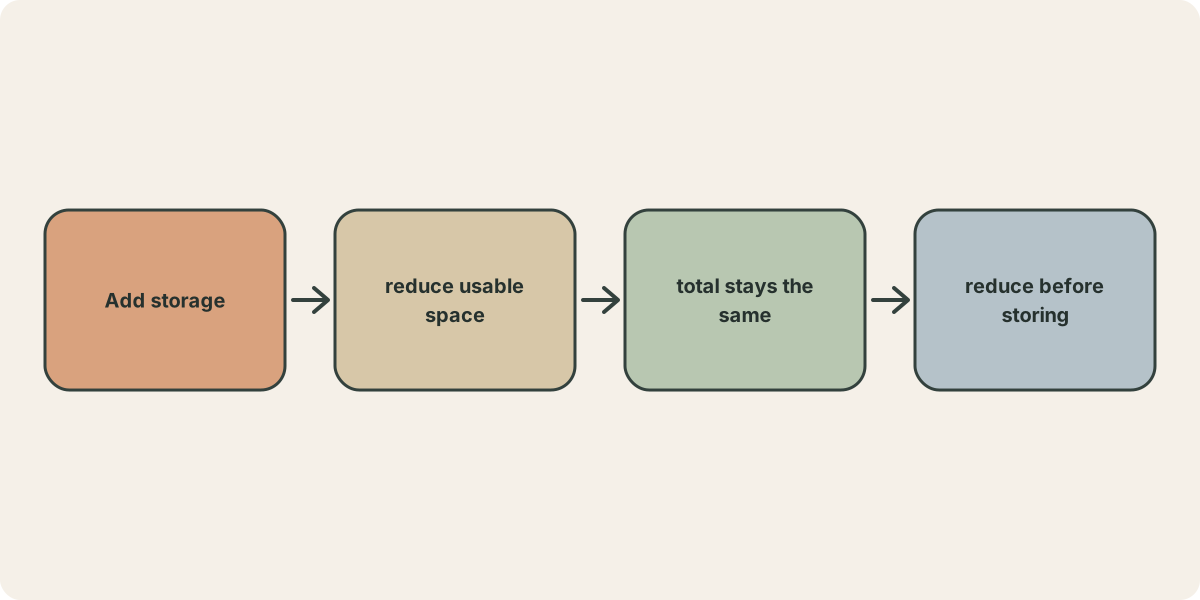
Storage products so easily become the first choice because they offer an action that can be completed at once. Faced with a pile of belongings that are hard to keep or let go, buying boxes, adding shelves, or replacing drawers is far easier than deciding what should leave. Yet every box and every cabinet also occupies space, needs cleaning, has to be moved, and requires someone to remember what is inside. If organizing only adds containers, it may recast a belongings problem as still more containers that have to be managed.
Before containers come in, first see whether belongings already exceed capacity
A four-ping room showed how containers multiply under pressure. Once the wardrobe was full, clothes were hung on the door handles first; clutter piled up in front of the wardrobe so the doors would not open, and frequently worn clothes were moved to the bedside; when the bedside could no longer hold them, a chest of drawers was bought, and things were then stacked on top of the cabinet. Before organizing, the room already had one chest of drawers and two three-tier cabinets, with belongings stacked nearly to the ceiling. Professional organizers call this process continually reopening the battlefield.
In another room, storage boxes stuffed with things, discarded packaging, and shoeboxes were scattered on the floor; the wardrobe was so full that its doors would no longer close. On the surface, the home seemed to lack a larger storage system; in fact, the containers themselves had already become items awaiting handling. This situation is not a matter of the homeowner being lazy, but of every “pack it away first” delaying the next round of deciding what stays and what goes.
The opposite picture appeared in an apartment. After organizing was finished, the homeowner looked at the study’s two existing sets of shelves, realized they were no longer needed, and took them down, without filling the wall back in with new furniture. This too is an individual case and cannot be used to infer that every organizing project will reduce shelves; but it makes visible a checkpoint that is often overlooked: if the total volume of belongings falls, the need for containers may fall with it.
Looking messy is not always the same problem
The difficulty of storage has at least two layers. The first is quantity: when there is too much stuff, even the nicest containers cannot hide the crowding. The second is visual order and classification rules. In the four-ping room mentioned above, bits of stationery, medicine, and accessories were packed in cardboard boxes and placed on the tabletop; containers of different colors, materials, and heights appeared at once, so the eye had to re-identify them every time, and “hard to find” and “very messy” were amplified.
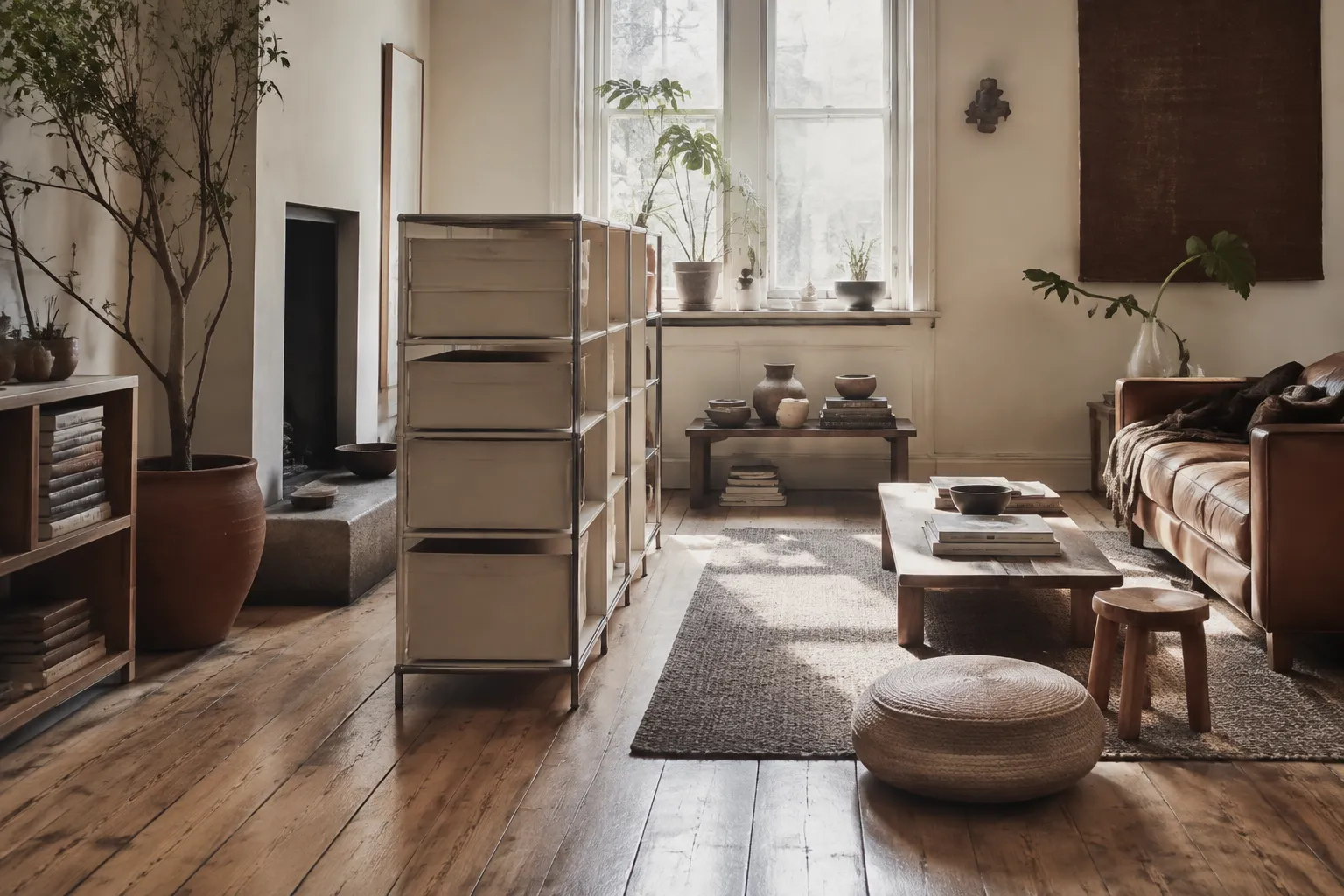
Visual irregularity, however, does not mean the total volume of belongings is necessarily too high. In that room, the two problems were stacked on top of each other and could not be solved merely by unifying the cardboard boxes. After organizing, the team removed the wardrobe doors and formed a storage wall of small drawers of consistent size; a family factory that had been closed for years first cleared out a batch of large furniture and adjusted circulation over the first two days, and only then added four chrome racks of the same specification. The racks were not a substitute for reducing volume, but a tool that appeared only after reduction and re-placement.
For everyday households, this sequence matters. First decide what stays and what goes, then decide where things go, and only last measure dimensions and buy containers; that can keep “not enough containers” from being mistaken as the only problem. Leaving empty space does not mean organizing has failed; sometimes that is precisely the room needed for people to walk, clean, see their belongings, and adjust how they live.
A system people will use cannot have too many steps
Storage is not a floor-plan contest, but a system of whether people will use it every day. How many actions it takes to put one item back in place directly affects whether it stays on the table or returns to its spot. Open a cabinet door, pull out a drawer, lift a lid, put it in: four actions, when one is busy, easily lose to “I’ll put it away later.”
In a child’s room, toys were placed in clear storage boxes with labels, so the child would have a chance to find them and put them away. An older family member in the family factory, by contrast, was used to “things have to be visible”; her memory was not good, and items she had put away herself were forgotten the moment she turned around. The professional organizers did not ask her to remember a complicated classification, but placed important items in the bag she carried with her and in the places she considered safe. The users in the two situations were different, yet the approaches pointed to the same principle: shorten the steps of putting things back to a degree that daily life can bear.
This also explains why the same cabinet may not suit everyone. In a four-story townhouse, a couple’s organizing logic differed: one valued the overall direction, the other excelled at details; after pulling in opposite directions, belongings lacked a shared classification and were scattered across different floors. Cleaning staff can help gather things together, but they may not be able to decide classification or what stays and what goes for the household. Storage design needs to return to users’ memory, circulation, and division of roles, rather than asking only how many ping the house has.
Start by buying one fewer, so that choosing no longer adds to the burden
Wanting to choose lower-burden containers can also run into practical barriers. The source case notes that packaging and containers made of recycled materials often follow mass-production logic and set a relatively high minimum order quantity, which small-scale buyers may not reach. This observation cannot represent supply conditions across the whole market, yet it reminds us that an environmentally friendly intention does not necessarily come with immediately accessible options.
Within the range of what can be chosen, the most direct approach is still to cut unnecessary additions first. Buying three fewer storage boxes lowers the later organizing burden more than buying three first and then hoping they will solve the total volume. When a purchase is truly needed, use the size, frequency of use, and location of the belongings that have already been kept to decide; only then does a container have a clear task, rather than becoming another place to park anxiety for the moment.
The life of a container also needs to be arranged
Storage products are seldom treated as belongings that need to flow. Once a box is bought and brought home, it is often assumed it should stay in the house forever; even if it has already warped, no longer fits, or holds things that are no longer used, it may still sit in a corner. Organizing supplies then accumulate as another layer of stock, making it even harder to see whether what really needs handling is the contents, the container, or both that have already lost their use.
Including containers in the inventory is not a pursuit of a house with nothing in it. Boxes of different materials and sizes may indeed come in handy when moving, raising children, or storing seasonal items. The key is that every container kept should be able to answer a concrete question: what category of belongings it serves, where it goes, who can open it and restore it, and whether it still has a next use if this category of belongings shrinks. A container that cannot answer is also worth treating as something pending a decision, not as a natural solution.
This kind of inventory can also prevent another form of waste: buying a similar one because the original container cannot be found. Looking separately at empty boxes, spares, and containers actually in use makes it easier for a household to know whether what it lacks is a storage tool, or information and location. Even if no contents are handled for the moment, first making containers clearly identifiable can also reduce duplicate purchases and the time spent rummaging.
If family members share the same storage, labels and openings should also be intuitive enough that the next user does not have to guess again. A container is not a place to hide responsibility, but a tool that makes belongings and the division of household work easier to take over, so that everyday organizing need not depend on one person remembering every detail.
For the use of resources, this sequence also has meaning. A container is bought, brought home, wiped down, used for storage again, and may finally be discarded or handed on; reducing unnecessary containers is not a rejection of storage, but a way of avoiding shifting the burden one hoped to lower onto more materials and more housework. When a storage tool truly serves the user, rather than requiring the user to rearrange life around it, organizing has a chance to last.
Whether a round of organizing is closer to something that can be sustained does not have to be judged by how much the scene resembles a show home. One can ask a plainer question: after organizing is finished, does this household need more new containers, or fewer? The answer may let us shift the focus from what storage products to buy back to the living space we actually want to keep.
Source: Liao Hsin-yun’s Facebook page (content compiled and adapted).