A small fire broke out on a home’s rear balcony. After an outlet short-circuited, the flames reached a pile of plastic bins. The homeowner later said the fire frightened her, and that it was the first time she realized having too many things stacked at home was not merely unsightly. In another household, a four-story townhouse, a latex mattress sat at the landing where the stairs led from the second floor to the third; family members had to step over it every time they went up or down. When the organizing team came through the door, the first reminder was to watch out for one another, so no one would trip.
These incidents are easily called accidents after the fact. But before an accident happens, whether the space still leaves a passageway, whether outlets are hemmed in by piled-up items, and whether a door can open fully are conditions that can be seen and changed. Talking about the safety cost of clutter is not about labeling anyone as someone who does not care about tidiness. It is about acknowledging that a home has to hold sleep, caregiving, movement, cooking, and a way out of danger at the same time. When belongings occupy it, what is often lost first is the extra room.
The cost of safety does not usually appear on the bill
Appearance is easier to notice. A cluttered tabletop, nowhere to sit before guests arrive—these are inconveniences felt at once. The safety cost is different. It may go a long time without a visible incident, and so it is treated as part of everyday habit. Only when someone falls, a passageway is blocked, or piled-up items appear near a fire source does the cost suddenly come into view.
The source records also include an accident while removing an air conditioner: while work was under way on the first floor, the entire unit fell, the stairs toppled, and the young worker holding up the machine could barely keep hold. The homeowner’s husband rushed forward to help. This incident should not be attributed to clutter, because the record does not say that; it belongs to the removal work itself. Still, it points to another layer of risk: dealing with large amounts of piled-up belongings is not work without cost. If the places inside the house where a person can stand, carry, and turn have already been squeezed down, the people doing the clearing will also find it harder to work safely.
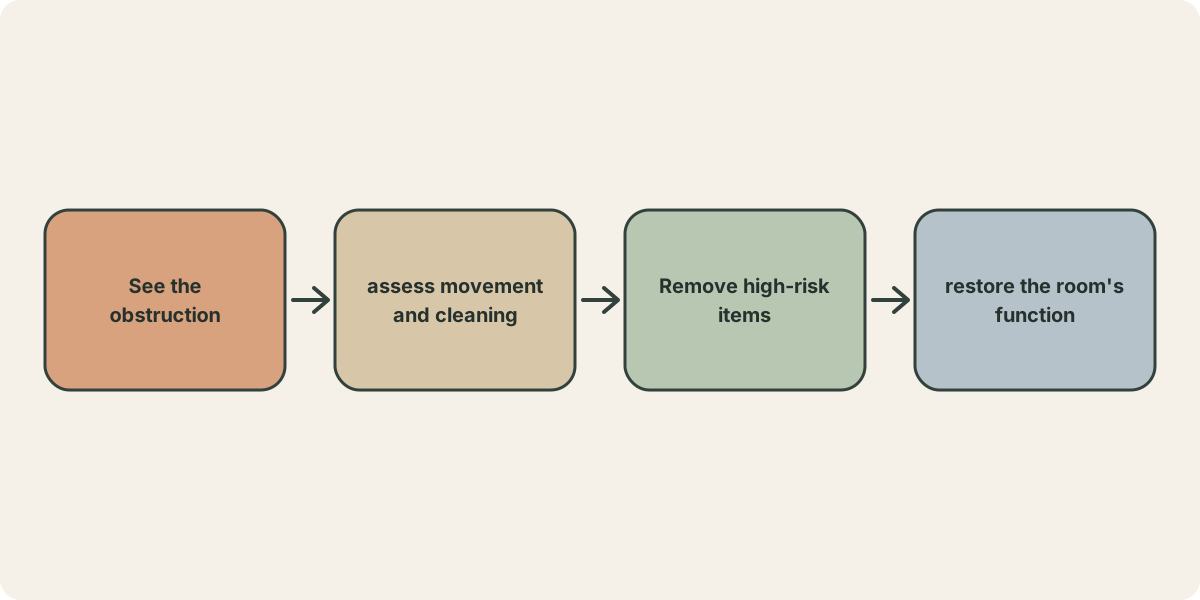
Organizing, then, should not be understood only as whether someone ought to be more diligent. It also involves whether a household keeps hallways, doorways, the area around outlets, and similar places as shared space that everyone can use.
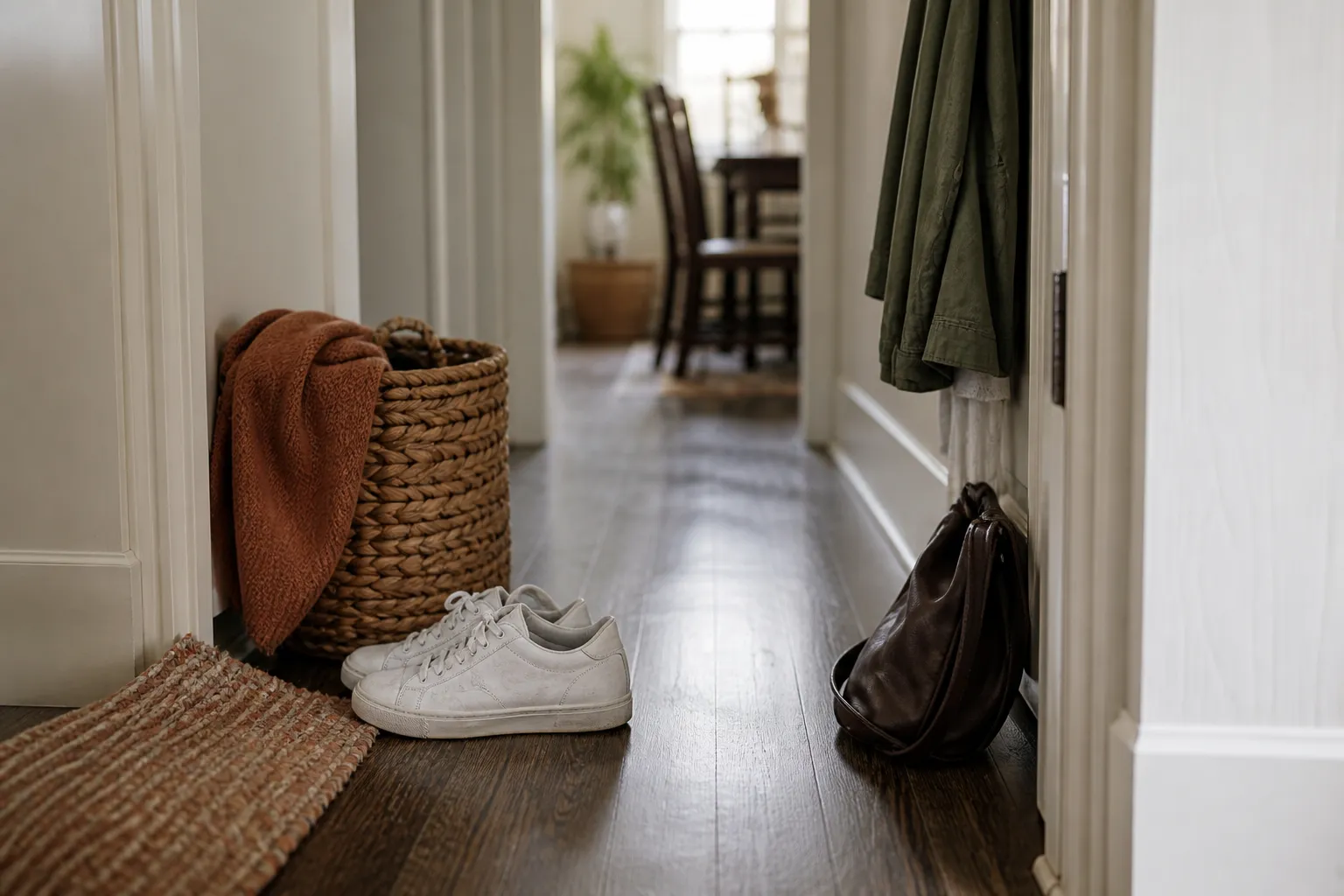
Hallways and doorways are a safety line shared across ages
In a family workshop that had been closed for years, the common areas were filled with clutter, leaving only a narrow walkway. The family member who commissioned the organizing said children played there and adults also came and went through that space; every time an elder walked through carrying hot soup, she tensed up. The house also had an attic used for storage, reachable only by climbing a narrow, steep staircase. If the elders in their sixties needed something, they had to go up and down again and again. The homeowner’s son, thinking of his parents having to climb with such effort, felt worried as well.
In another four-ping room, a cabinet was jammed behind the door, so the door could not open fully and the person living there had to enter and leave sideways. Window light was also blocked by layer upon layer of cabinets and belongings; the room stayed dim, and the person using it was already seventy. In yet another apartment, an elder in their nineties was in rehabilitation after a stroke and had fallen repeatedly. In the same home, the living room and balcony had almost no space to walk; one could only take three steps into the study, and cabinet doors were blocked by belongings as well. The record does not say that any of the falls was caused directly by clutter, so that causal judgment cannot be made. But the experience of falling and the restricted path of movement existed at the same time, and that alone is already enough for the family to take seriously.
These are on-site situations in individual households, not statistics for ordinary homes. What they point to, however, is a shared problem: for an able-bodied adult, going around a box may be only a nuisance; for a small child, an elder carrying hot soup, someone in rehabilitation, or someone getting up at night, limits on space can change the risk of a single movement. Safety is not only about what equipment is installed. It also includes not letting the paths people must take every day be forced into an obstacle course.
Piling things up can change the air, cleaning, and how hard caregiving becomes
In an old apartment, clutter was piled to thigh height on both sides of the hallway. When the daughters lived there, they often had allergies, dermatitis, and asthma; there were also cockroaches and mice in the house. In another household, the younger generation noticed that their daughter became allergic every time she went back to the family home, and that she could not find a quiet place to nap. These records cannot prove that piled-up belongings were the only cause of the symptoms, and a person’s health should not be reduced to a space problem.
Still, the surface area that collects dust, the state of ventilation, and the amount of piled-up belongings are environmental conditions that can be observed, cleaned, and adjusted. If every discomfort is treated only as “constitution,” a household may overlook the parts it can improve. For caregivers, this matters especially: when hallways are packed, the area by the window is blocked, and no usable surface can be found on a table, everyday cleaning, fetching medicine, settling someone to sleep, and keeping company all take more effort.
Space problems can also become relationship problems. When someone is responsible for carrying, searching, wiping, and reminding, while others are only responsible for putting things down, inequality in maintaining safety easily builds up. Seen this way, reducing clutter is not only about clearing a nice-looking living room. It is about reducing the invisible labor some family members take on every day.
Start with a safety check that does not require blame
Hoarding often intertwines with poverty, loss, illness, or generational experience. A father with schizophrenia brought home large amounts of building materials, door panels, and tiles; a mother in her nineties who had lived through wartime often said, “We’ll use it someday.” Describing these families as people who do not like cleanliness or who lack self-discipline is neither accurate nor helpful in making anyone safer.
Rather than beginning by demanding that large amounts be thrown away, a household can first check a few questions that do not have to humiliate anyone: Can two people pass each other in the main hallway? Can a door open fully? Within half a meter of an outlet, is there piled-up combustible material? Do everyday items have to be reached by climbing, turning sideways, or stepping over things? These questions do not require judging the value of an object first, and they can still turn safety from abstract anxiety into conditions that can be discussed.
Among the ten households in the source, at least one was three generations living together, with elders and young children sharing the same hallway. This set of material cannot answer how common that situation is in society. Yet in any home, once passageways, doorways, and the area around fire sources are squeezed by belongings, the problem no longer belongs only to the homeowner’s taste. It concerns whether children can run freely, whether elders can walk steadily, and whether a caregiver can get close quickly when needed.
Keep the shared space first, then talk about what stays and what goes
In a household, many belongings have an owner, but hallways, the space to move around the dining table, doorways, and balconies are often used by everyone. When these places are quietly taken for temporary storage, the people affected are not necessarily those who put the items there; they may be the ones who most need a stable path of movement. That is also why a safety check is well suited to start from shared areas: it does not have to judge whose belongings matter more. It first confirms that everyone can still enter, leave, turn around, and use the space safely.
If a household does have items that cannot be dealt with for the time being, their effect on daily life can be reduced first—for example, by not leaving them on the stairs, behind a door, beside an outlet, or in the only passageway. This is not a substitute for a full organizing process, but it can turn “we’ll deal with it when we have time” into a lower-risk temporary arrangement. After that, the household can gradually discuss what to keep, pass on, or clear out, according to how often something is used, the conditions needed to store it, whether someone can take it on, and how much effort handling it would take—without having to decide the fate of every item in a single conversation.
For objects that need someone else’s help to carry or take apart, the work space should be included in the plan as well. Clearing is not simply moving things away. It is making sure every person involved has enough room to stand, turn, and see what is ahead, and keeping a path they can exit safely.
Home safety also needs to be brought into caregiving conversations. When elders, young children, people with limited mobility, and caregivers share a home, whether the space can be used is not a private aesthetic choice. It is a living condition everyone can take part in. Clearing the most dangerous spots first may not resolve everything that has accumulated, but it can keep later organizing from beginning only in pressure and blame. If those spots can be listed as a shared agreement, reminders need not always fall on the same caregiver, and safety is more likely to become part of daily life rather than something remembered only after something goes wrong.
Perhaps it can begin with the path walked most often today: does it really let every person in the house pass through safely, without turning sideways, without stepping over things, and without being on edge?
Source: Liao Hsin-yun’s Facebook page (content compiled and adapted).