This article draws on one organizing professional’s travel experience. It is a personal record, not a long-term statistic or a general conclusion.
Whether a storage method works well depends on the situation it is placed in. One professional organizer keeps her own home in good order and organizes her clients’ homes well too, yet the moment she goes on a business trip or travels abroad, her belongings turn into a mess. Before setting out on a five-day, four-night trip covering three places and three talks, she admitted that the most tiring part was not the talks, nor the travel itself, but packing. The same person, the same method, and yet it stops working when the situation changes. That contrast is worth unpacking.
Organized before departure, scattered the moment she moves
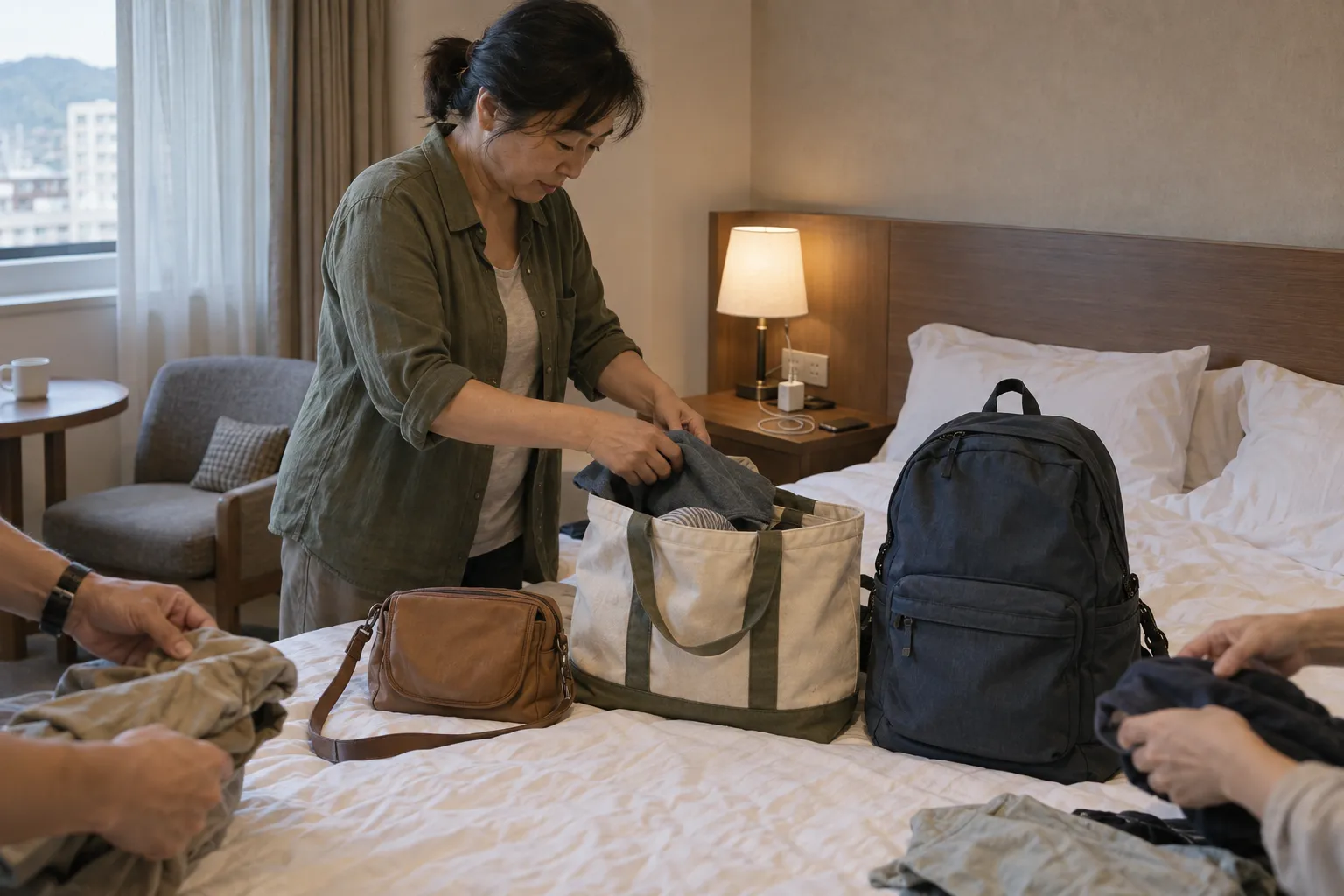
She recalled a group trip overseas. She carried three bags: a small one for her passport and money, a tote for things she would need on the plane, and a backpack for everything else. Everything was sorted before departure and she was well prepared, but as soon as she started moving, she fell apart. Every security check left her flustered, and whenever she panicked she stuffed things into whichever bag was closest. The next time she needed something, she had to dig through them all.
On the first day, the guide announced that the group would not be taking that bus again, so everything had to come off with them. In her rush to get off, she had tucked her neck warmer into the mesh pocket on the seat in front of her. By the time she remembered, it was the third day and the group was already far away. The guide eventually passed it along through a series of different drivers until it made its way back to her. She got it back, but that was thanks to other people’s relay, not to her own storage method.
A fixed place only works if the space is fixed
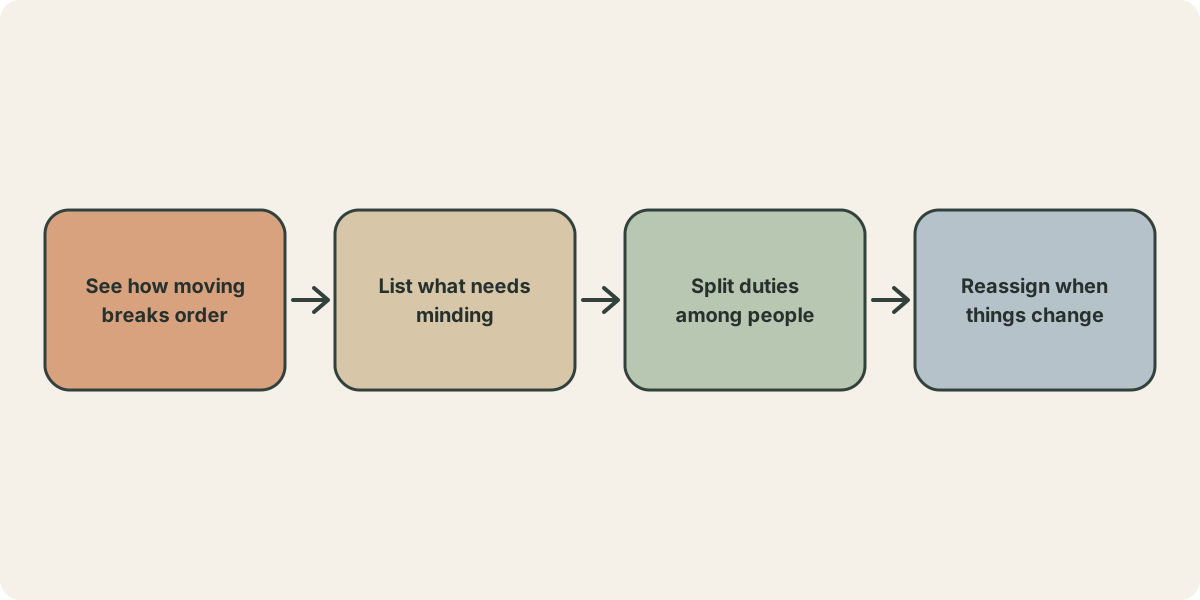
Her conclusion afterwards was that the cause was movement. When things stay put in a suitcase, she can tell them apart and knows exactly where each one is. Travel items, however, do not stay put. Tonight you stay in this hotel and take everything out; tomorrow you leave and pack it all back in; a new city, a new hotel, and everything comes out again. Every room is different. The charger sits on the nightstand today, on the desk tomorrow, and maybe beside the television the day after; it goes in this bag today and gets stuffed into another one on the bus tomorrow.
A home does not move, and neither does a client’s home. There, all you have to do is assign each item a place and put things away by habit, and afterwards they are easy to find and easy to reach. The fixed-place method quietly depends on one premise: that the space itself is stable. Travel removes that premise. Places are rearranged daily, and memory cannot keep up with the pace of rearrangement. Blaming that kind of disorder on “not being careful enough” means charging changes in the environment to the individual’s account.
Why she stopped losing things in the second half
In the second half of the same trip she moved on to another country, and everything went smoothly. She did not lose a single item. What changed was very concrete: three companions who also work as organizers were travelling with her, and each took on one area of responsibility.
One handled the money. The cash was split among three people, and she herself carried only what she needed for restrooms. Any time she wanted to spend money, she had to request it from that companion first, and as a result she bought almost nothing during that stretch. Another was good at foreign languages and handled interpretation; whenever something was hard to understand or needed to be communicated, it was passed to her. A third shared a room with her each day and looked after safety and daily needs.
In her own words, she had not suddenly become more capable; three organizers were looking after her. All three companions understood storage, but what made the difference this time was the division of labour: the judgment that had rested on one person was split into three. Where the money was, how to say things, whether daily routines were keeping up—each had someone watching over it. However often they moved, the range each person had to keep track of was still small enough to remember.
When the situation changes, redistribute responsibility first
This experience can be carried back into everyday life. Order at home also rests largely on stable premises: a fixed routine, fixed helping hands, a fixed space. Move house, change jobs, or add a family member who needs care, and once the situation shifts, the approach of having one person remember every location and every task comes loose in exactly the same way.
The common reaction at that point is to ask that person to be more attentive, more disciplined. The experience on the road points to another path: first ask which tasks can be handed over, to whom, and how far each person’s responsibility extends. Managing money, communicating with the outside world, and handling daily needs are different kinds of work to begin with. Once they are separated, the amount of change each person has to absorb becomes smaller. A division of labour does not have to be a formal arrangement either; saying “could you keep track of this for me” is enough to start.
Do not treat disorder as personal failure
To others with the same difficulty, she said: if your home is well organized and things start falling apart the moment you step out, do not doubt yourself. That thought can be taken one step further. When a method that has only been tested in stable situations fails in the face of change, it means the method has reached the limits of where it applies. The person using it has not failed.
When taking stock of order at home, it is worth asking one more question: if this home started moving tomorrow, or the person in charge were temporarily away, who else could pick it up?
Source: Liao Hsin-yun’s Facebook page (content compiled and adapted)