Someone spends an entire weekend organizing, clearing out several bags of items, only to find a few days later that the house has gone back to how it was. This kind of frustration is often blamed on a poor method, not enough storage tools, or a lack of self-discipline. But in a household that lives together, organizing is rarely a one-person job. As long as someone keeps bringing things in, putting them in places that were never agreed on, or judging “can this still be used” differently, one person’s effort will slowly be undone by daily life.
One household once found itself in this situation: the daughter put two large bags of items she had cleared from her room outside, and her mother checked bag by bag, bringing anything she still considered usable back into her own room. Those items never really left the house; they only changed location. This was not a matter of who tried less hard, but of the two of them having no shared rules about what stays and what goes.
Whether organizing can be sustained depends on how a family divides responsibility, and on whether each person can live well in the space. A few organizing cases offer not general statistics, but reminders worth considering: talking through “who is responsible” first, and only then discussing how to put things away, is often more useful than buying more containers.
The Total Volume at Home Is Everyone’s Daily Accumulation
A space shared by people living together has one very direct characteristic: anything anyone brings in can affect how others use the space. When one person keeps clearing things out while another keeps stuffing temporarily unused items back into corners, the total volume naturally has a hard time going down. When organizing results disappear, it is not necessarily that the organizer did something wrong, but that the directions were never aligned.
That was exactly the case with the mother and daughter mentioned above. The daughter valued things and, when she was unsure about an item, would first move it outside the room for her mother to check; the mother was equally reluctant to throw things away and wanted to keep anything that was not broken. Both were working hard to avoid waste, but because they had not first decided “who will use it,” “where it will stay,” and “if it goes unused for how long, we reassess,” the items could only keep being moved around.
In another four-story home, the husband had bought more than ten books on storage and even stayed up all night organizing, yet the next day things looked almost unchanged. Items were scattered across different floors, and the couple’s storage habits differed: one focused on the overall direction, the other was good at handling details, but they never formed a shared system of categories. These are individual family experiences, but they illustrate a simple principle: as long as things coming in and going out have no shared rhythm, a space will have a hard time recovering its function.
When One Person Keeps Putting Things Away, Emotions Get Concentrated There Too
Having only one “person in charge of organizing” at home is not only an uneven distribution of labor; it also easily strains relationships. One homeowner once said she used to do all the organizing herself, felt under great pressure, and would get angry as soon as family members left things lying around. Her emotions were not entirely about a particular bag or a pair of shoes, but about the fact that every instance of things being left out would eventually come back to her to handle.
Another homeowner, who had long been caring for her ill mother, felt she had no time to organize and also worried that even if she finished, things would quickly become messy again if the family did not maintain it together. That expectation made it hard for her to start. What is worth noting is that she actually had very few personal belongings; what trapped her was not her own consumption, but that the household as a whole had never formed a way of sharing the load.
Leaving organizing to only one person often leads other family members to assume that order simply exists on its own. Clothes will find their way back to the closet, items will find their own places, and things bought in duplicate will disappear by themselves. Only when the main organizer is exhausted or angry do people see that this maintenance work has been getting done all along. Naming the labor is not about holding anyone to account for doing less; it is so that everyone can take part in maintaining it.
Rules Should Be Simple, and Set Together by the People Who Use Them
Sustainable rules do not have to be many. One homeowner later stopped putting things away alone, and instead set three principles together with her family: put things back when you finish using them, every item has a fixed place, and do not buy duplicates of things that serve the same function. These principles were not new, but because the whole family confirmed them together, the children started putting away toys, and her partner also tried putting things back on their own.
The point of rules is not to manage the home like a warehouse, but to let everyone know what the next step is after finishing something. For families with children, you can start with toys, stationery, or tableware; for multigenerational households, you can first agree that walkways, the dining table, and the entryway in shared areas will not serve as long-term storage. The closer the rules are to daily life, the easier they are to follow.
For rules to actually enter daily life, it is best to answer three questions at the same time: Where does this item usually go? Who takes it out, and under what circumstances? After using it, at which step is it most likely to get stuck? For example, if umbrellas always end up by the door, the problem is not necessarily that family members are lazy; it may be that rain gear has no place that can drip, ventilate, and still be easy to grab. Duplicate purchases of cleaning supplies may not be mere impulse buying either, but the result of stock being scattered across different cabinets, so that no one knows how much is left at home. Correcting from the actual sticking points is more effective than writing the rules more strictly.
A family can do a shared check in a very short time. Each week, take ten minutes to look at the entryway, the dining table, or one shared cabinet, and confirm whether items have gone back to their fixed places, whether there are new things awaiting a decision, and who can handle which small task next week. This is not a supervision meeting; it is turning a reminder that used to live in one person’s head into something visible in everyone’s daily life. If someone does not follow through, first find out whether the rule is too hard or the location is inconvenient, rather than immediately labeling the other person as uncooperative.
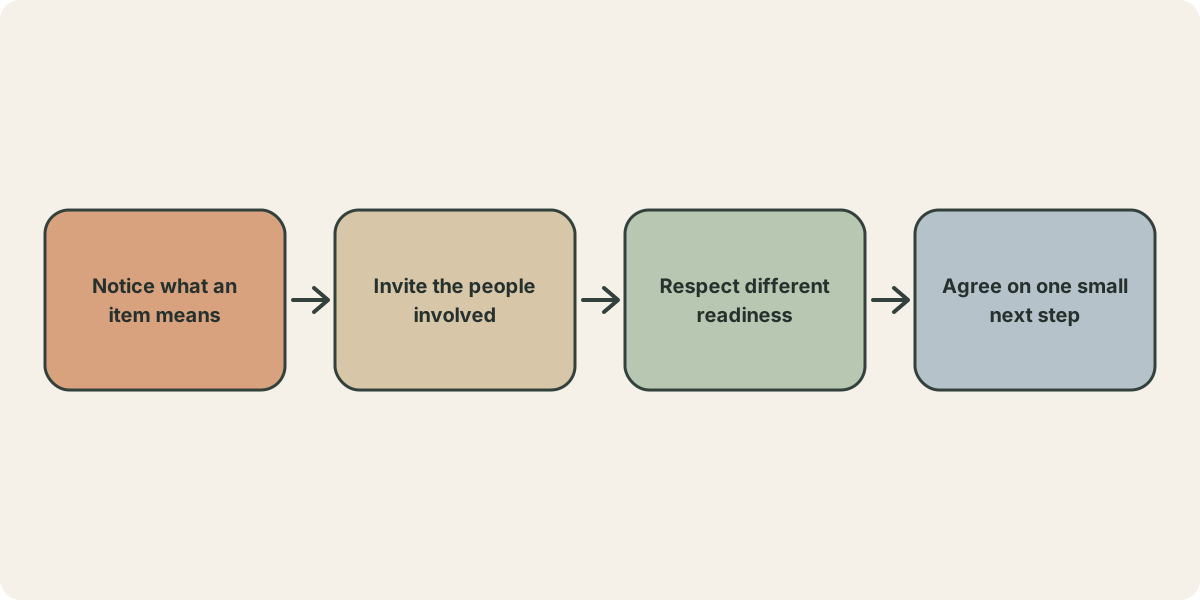
It also has to be acknowledged that family members’ abilities and willingness may not be the same. Someone may only be able to take charge of washing their own cup; someone else can handle checking stock before shopping; someone else may be suited to arranging recycling or passing things on. Consensus does not mean everyone does the same amount, but that each person has a clear, doable part, and that the invisible finishing work is not all pushed onto the same person.
Even Without Agreement on Handling Things, You Can Still Draw Clear Boundaries First
Family consensus does not have to start with everyone being willing to throw things away. One husband was unwilling to spend money on handling items, so during organizing his belongings were gathered into his personal area on the third floor, placed neatly, but not processed further. Later he too felt that the shared spaces had become more comfortable. This case is not an argument for pushing the problem onto one person; it shows that when complete agreement cannot be reached right away, first clarifying ownership of items and the scope of use can still reduce how much people get in each other’s way.
You can first discuss shared areas and personal areas separately. Shared areas need to protect movement, cleaning, dining, and basic safety; personal areas give the user more decision-making power, but should still avoid affecting others or creating risk. When items have a clear owner and place, family members are less likely to treat all clutter as “someone else’s problem,” and it becomes easier to discuss which things can continue to be used, which can be passed on, and which need to go into appropriate recycling or final disposal.
This process must avoid humiliation. Piling one person’s belongings into a corner and treating them as evidence for everyone to blame will only make that person more defensive. The purpose of drawing a range is to let each person see their own volume of items and their responsibility, not to find a scapegoat for the family.
When family members have different ages, work rhythms, or physical conditions, the division of labor can also adjust with life. Someone takes charge of checking stock before shopping, someone handles passing on items that can still be used, someone only takes charge of holding the line on tabletops and walkways used every day. What matters is not that the chore chart looks even, but that no necessary task sits for a long time in the vague zone of “someone will do it.” If a task requires particular ability or physical strength, it should also be discussed early whether relatives, friends, or suitable support can be sought, rather than waiting until the main caregiver is exhausted before discovering that no one is taking over.
The division of labor can be written very simply—for example, putting a small slip of paper in a shared area, noting this week’s items to check and who is responsible; or spending just a few minutes at mealtime reminding one another. The point is not the form, but that everyone can see that between an item coming through the door and leaving the house, someone needs to make a choice, put it back in place, and arrange where it goes. When this work is seen together, the organizer no longer has to use anger to prove they are already too tired.
Find the Key People First, Then Arrange the Next Action
When someone at home is still resistant to organizing, the easiest mistake is to skip the conversation and directly demand that they cooperate. In a family factory that had been closed for many years, the first person who wanted to organize was a younger family member who had married in. She did not directly press the elders to deal with the items; she first talked with her partner about the living environment. Only after her partner was willing to share the load did they spend nearly a year communicating with the parents, and organizing was able to begin.
This experience does not mean every family has to wait a year, nor that one family member must persuade everyone. It reminds us to identify who uses the space most often, who most often brings things in, who is responsible for daily maintenance, and who can best accompany the main user. If the main organizer is an elder, new arrangements especially need to fit their habits of use; otherwise, no matter how neat the scene looks, it will be hard to sustain in daily life.
The next time you want to start over, try counting first: how many people in this household consider maintaining order their own business? Then pick a small area, agree on one action for each person, and how you will check together in two weeks. Organizing is not a one-time haul-away; it is a family’s practice of redistributing space, time, and responsibility. When more people are willing to treat where things go as their own concern, sustainable living will no longer rest only on the most exhausted person.
Source: Liao Hsin-yun’s Facebook page (content compiled and adapted).