When belongings at home pile higher and higher, adult children often start with a sentence: “They’re just too stubborn.” The words come easily, and they just as easily stop the conversation where it is. Once the problem is assigned to personality, the next step is usually only persuasion, argument, or quietly giving up.
At organizing visits, two households both spent nearly a year before organizing truly began. In one, a daughter talked repeatedly with her seventy-year-old mother; in the other, a son coordinated back and forth between his wife and his parents. These experiences are not meant to say all elders are the same, and still less to treat a few families as statistics. They only remind us that what looks like refusal may be mixed with depleted energy, changes in memory, fear of losing control, or uncertainty about who will be there to do it together.
If we only see “won’t throw things away,” we may miss the conditions that actually need care. Organizing belongings has never been only about clearing space. It is also about recognizing how a person keeps up daily life, how they hold onto relationships, and whether the family can face change together in a less wounding way.
Calling the difficulty stubbornness often makes it harder for family to come close
“Stubborn” sounds like a conclusion: the other person will not change, so there is no use saying more. Yet not having the capacity and not having the will are not the same. One mother had agreed several times to organize her room, but nothing moved forward. The family at first took this as repeated stalling; only after looking more closely did they learn that she and the relatives living with her all found it exhausting, and had not found a way to begin.
Clearing one drawer may be half an hour’s work for a younger person. For someone whose physical condition has changed, it may include squatting, standing up, lifting, sorting, walking to another room, and coming back to choose. Still more draining is the judging. Every item involves “will I use this later,” “will I regret throwing it away,” and “who should it go to.” Making dozens of decisions in a row is itself a large outlay of mental energy.
So if family members only keep reminding them, “You need to organize,” what the elder may receive is not care, but a hard problem handed back for them to handle alone. Changing the question into something more specific is usually more helpful: which spot is most inconvenient for you? Which things are hardest to lift? Whom would you like to sit with you to look at which small area first? When the problem gets smaller, a person has a chance to begin.
Before starting, you can also do an observation without touching anything. Walk together through the entryway, the bedside, or the dining table, and ask the elder to point out what they actually use every day, and the places where things are most often missing, easiest to trip over, or hardest to clean. This step looks as if it produces no organizing result, but it can turn the family’s focus from “how much should be thrown away” back to “how to make daily life easier.” If you walk in holding garbage bags from the start, it is easy for someone to feel they are about to lose the whole room. If you begin from the troubles of daily life, there is a chance to find together what is worth changing.
Caregivers also need to watch their own pace. Rushing to resolve years of accumulation in a single afternoon often exhausts someone with less physical energy, and makes every hesitation read as stalling. Breaking the work into short stretches, completing only one small task each time — for example, moving everyday items to a place that is easy to reach, or confirming one bag of supplies that are clearly no longer used — can leave room around the choice. This is not lowering the goal. It is making the goal something a person can actually do.
Doing it alongside someone, and requiring them to do it themselves, are two different things
In a family workshop that had been closed for years, a little-used treadmill sat by the door. The father had long believed it could still be used. The family had brought it up many times, and nothing changed. Later, the son took it apart himself and drove it to recycling; the father not only did not strongly object, but went along. The reason the object finally left may not have been that the father suddenly changed his mind, but that he no longer had to face the whole process alone.
This case does not mean companionship can unlock every instance of resistance, nor that the same method suits everyone. But it points to a difference that is often overlooked: many families assign organizing as a task, yet rarely put themselves into the task. Doing it together is not the same as deciding for the elder. It is, when lifting, judging, and finding a destination are needed, letting them know they are not the person left behind to clear up.
A more stable starting point is to set a short period of time and deal with only one clear range. For example, look together at two boxes of supplies by the entryway, and first separate what is still in use, what needs to be asked about, and what is no longer suitable to use. Do not start by requiring the whole room to be emptied, and do not treat the result as a test of whether they are cooperating. Being able to keep the relationship after one small organizing session matters more than forcing out a large pile of things.
Being able to see things may be filling in for memory and a sense of safety
Some behavior that looks like “piling it back again” need not be read at once as not cooperating. One household’s main organizer was quite willing to clear things out, yet often refilled the newly cleared spots with food, stationery, and gifts. Only after a deeper conversation did it become clear that her memory had declined; once items went into a cabinet, she easily forgot where they were. Spreading things out in sight was a way she used the environment to prompt herself.
For her, fully hidden storage was not necessarily an improvement; it might instead increase the chance of not finding things, buying duplicates, or feeling anxious. The visit later did not ask her to change according to a pretty storage style. Instead, important items were gathered in the bag she used often and in places she considered safe, so that what she needed remained easy to see.
This also reminds caregivers that organizing need not chase surface neatness alone. Arrangements that can be kept usually follow the user’s physical condition, habits, and way of recognizing things. Clear containers, low shallow boxes, fixed places, and fewer layers of sorting may all suit better than adding more cabinet doors. If a space makes it hard to find things, it can hardly be a space that supports living.
Some boundaries have to be respected first
Some situations do involve a strong need for control. An elder in their nineties who had lived through an era of scarcity kept unopened gifts for years and would not allow family to touch them. Another elder would pick up items the family had thrown out and bring them back. The reasons behind these behaviors differ, and a description at a distance is not enough to diagnose someone. What they share is that quietly clearing things away while the person is out usually only lowers trust.
In situations like these, first drawing a clear personal range is often more workable than trying to finish everything in one go. Which areas are shared hallways and emergency exits, which are private zones that can stay untouched for now, and which items must be decided by the owner — all of this is worth stating clearly. If safety risks have already appeared, what the family needs to handle first is passage, cleaning, and necessary help, not using “you’re being unreasonable” to force the other person to give up all decision-making.
When talking about boundaries, you can also separate reversible actions from irreversible ones. First moving items to a single place that can still be reviewed, photographing how they were originally arranged, and keeping a few days to think usually builds trust more easily than hauling them away at once. Conversely, throwing things away in secret, hiding items, or using threats to force agreement may briefly empty the space, but often makes the next conversation harder. If organizing is to become long-term support, it cannot be measured only by how much left the house that day.
Respecting boundaries is not letting the problem keep growing. It is acknowledging that change needs a starting point where cooperation is possible. The usability of shared areas, the family’s basic safety, and a person’s sense of control are all real needs. Only by talking about them separately is there a chance of finding the next step.
If family members disagree about how to organize, they can also first agree on a shared bottom line: do not handle personal belongings without the person’s knowledge, do not measure a person’s worth by how many things they have, and do not treat a moment of not being able to do it as a refusal to improve. These bottom lines cannot replace actual organizing, but they can keep the next invitation from having to start from defense. Once a caregiving relationship still has room to talk, the arrangement of belongings has a chance to change slowly.
Change a sentence of blame into an invitation someone can join
The accumulation of belongings at home often has a long history behind it. It may be tied to habits of thrift, to roles someone once lived, to powerlessness after the body has declined, or to a sense of autonomy a person still wants to keep. These reasons do not mean every item must stay, but they do affect how we discuss letting things go.
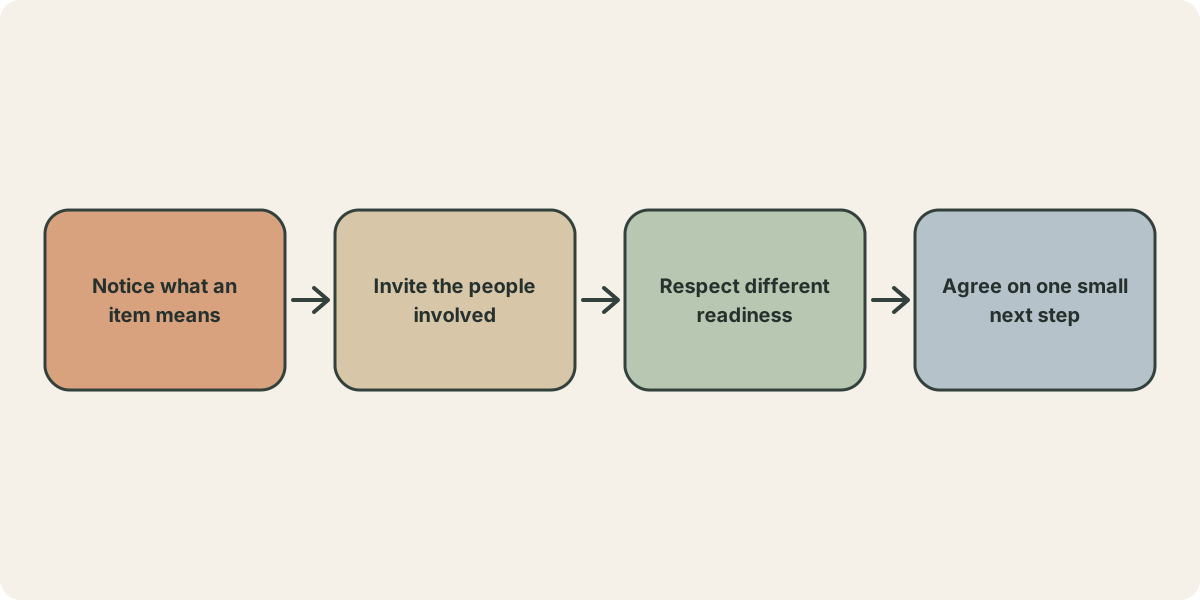
You can start by changing the question from “When are you finally going to throw this away?” to “What about this spot bothers you most?” Change the responsibility from “organize it yourself” to “this week I can sit with you and look through one box.” You can also agree that any personal item to be dealt with will first be seen by the person themselves; anything that cannot be decided for the moment goes into a dated pending area, to be opened together when the agreed time comes.
Sustainable living does not require every household to empty itself at once. It is about letting the resources that remain at home be used more clearly, and giving items that no longer fit a chance to be arranged properly. For older people, this path needs more than storage techniques. It also needs understanding, company, and a pace they can choose. When family members no longer rush to define the other person as stubborn, organizing has a chance to become a beginning of caring for one another again.
Source: Liao Hsin-yun’s Facebook page (content compiled and adapted)