At home, we are used to giving everything a fixed place: clothes in the closet, cables in a drawer, skincare on the counter. The method is reliable because the house stays roughly the same each day. Travel is not like that. Today at the airport, tomorrow on a tour bus, by evening in a hotel—where things sit, and when you need them, both keep moving.
A professional organizer in the source is skilled at sorting and routing things at home, yet on an overseas group tour could not find sunscreen, a power bank, or wet wipes day after day. Going through customs meant holding luggage in one hand and rummaging through the electronics bag with the other. This was not a decline in ability. It was a storage logic built around place, which lost its footing once the situations kept changing. This is one trip’s personal experience; it does not mean every traveler will meet the same difficulty. It is, however, a fitting place to begin rethinking.
A fixed place needs a stable setting
A fixed place does not only mean an item has a home. It also means the person using it can return to that same setting again and again. At a residence, the closet will still be there tomorrow, and toiletries will still be in the same bathroom. In travel, checking bags, boarding, transferring, checking in, and going out each change which items you can reach and how much time you have.
So the more useful question on the road is often not “What category is this?” but “In the next stretch, where will I be, and what will I need?” The same charging cable can go with electronics at home, yet at customs it has to sit with other electronic devices in a bag you can pull out. The item has not changed. What has changed is its role in the task at hand.
Pack by itinerary, not by stacking product names
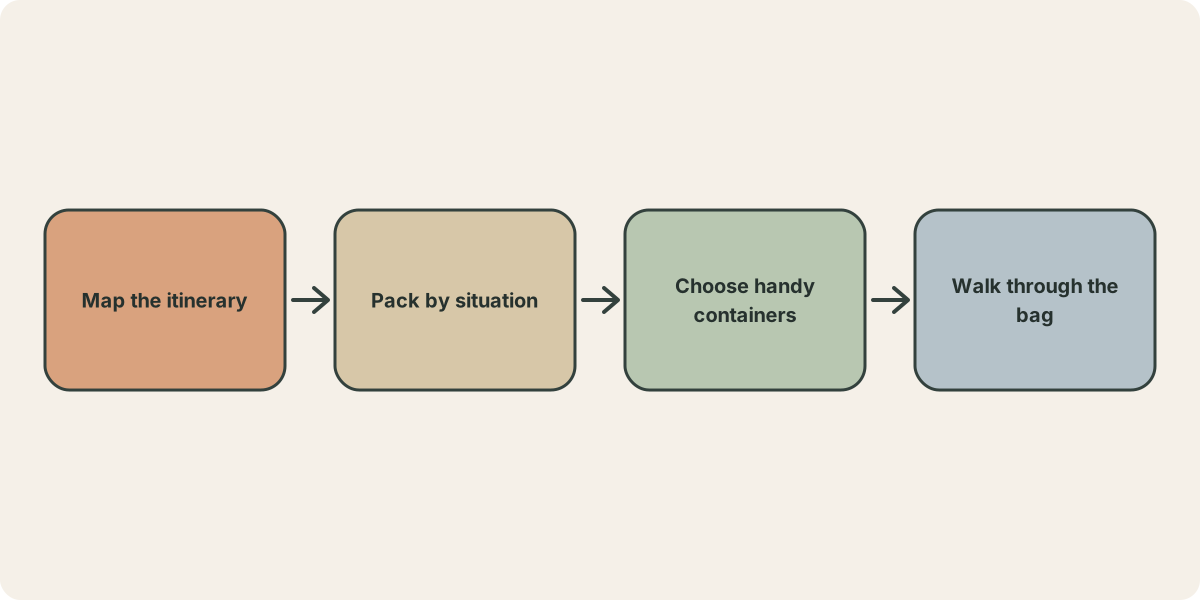
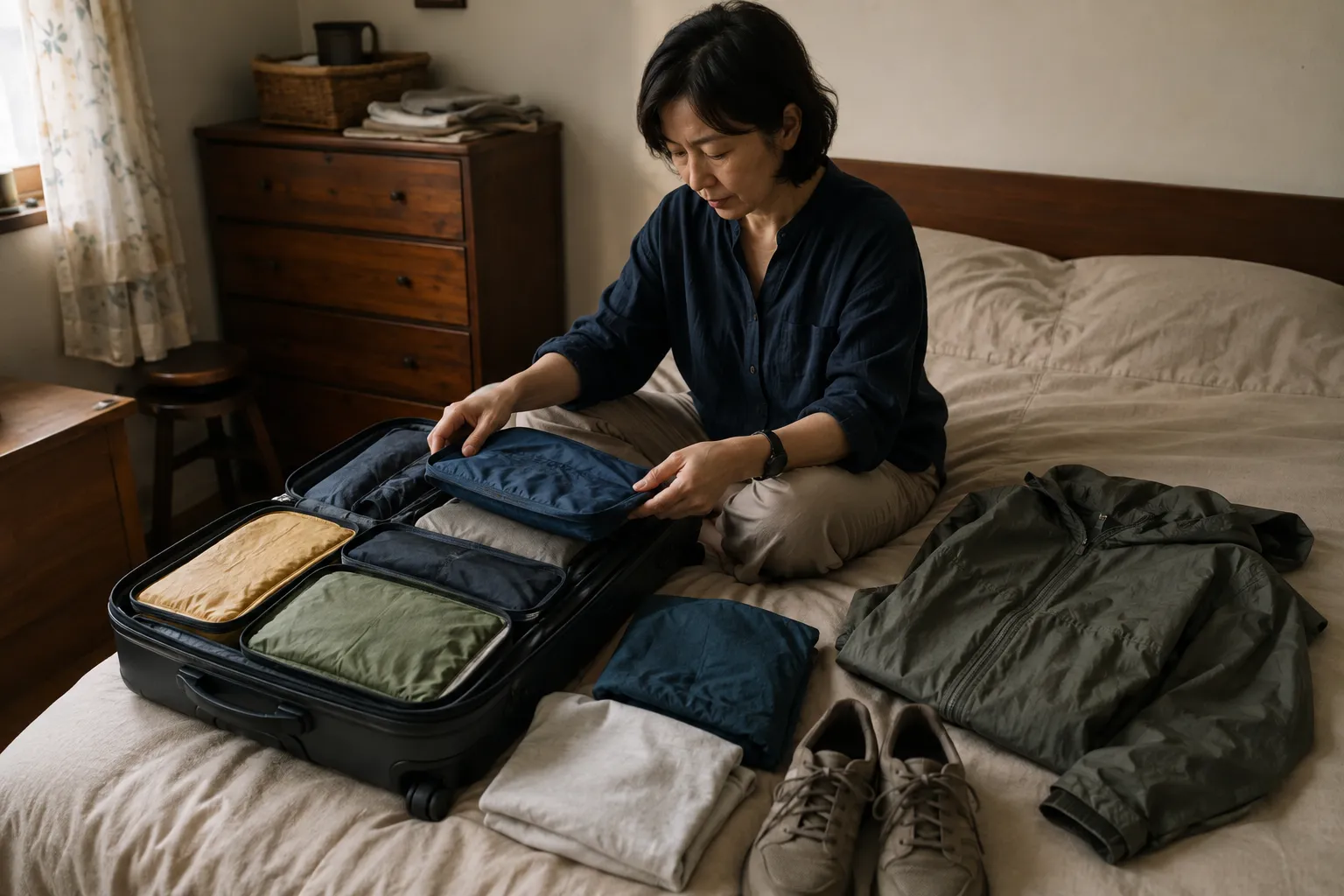
The source offers several ways of packing by situation. Checked bags can hold bulky clothes, spare supplies, shoes, and toiletries you will not need for a while. Electronics can go in one pouch, taken out as a set at customs. Passport, phone, and wallet go in a small valuables pouch you keep on you. On a long-haul flight, you can also prepare an overnight pouch—glasses, eye mask, medication, eye drops, and small toiletries together—so you do not have to rummage through the overhead bin at midnight for a single item.
On a tour bus or a walking itinerary, you can also split items into “leave on the bus as backup” and “must take when you get off.” After check-in, first find temporary places for a change of clothes, toiletries, bedtime skincare, and charging gear. These are not the only correct categories. They are a way of thinking: let items follow the action that is about to happen, so you rummage less when you are in a hurry. Health needs, travel companions, and transport rules differ for everyone, so the contents should still be adjusted to the actual situation.
A container that fits the hand matters more than packing one extra bag
Sorting by situation cannot be finished with a list alone. The traveler in the source brought a backpack someone had given them. The compartments did not match how they used things, and the pockets were deep and high, so every time they had to reach all the way to the bottom. On a tight itinerary, items were stuffed back in a hurry and ended up in a jumble. A small pouch, a phone lanyard, and a tour-guide device hanging on the body at the same time also added interference while moving.
Faced with this, the instinct is often to buy another bag. But the problem is sometimes not how many bags you have. It is whether the openings, compartments, and order of grabbing things fit the hand. Before you leave, you can put the things you plan to carry into the containers you already have and simulate going through customs, taking medication, picking up a charging cable. If every step means rummaging, first adjust the inner divisions or try an existing small pouch. That is more likely to prevent idle extras than rushing out to buy something new. When you truly need a replacement, you will also be better able to choose a container with a clear use that can last.
Sorting by situation can come home too
The idea does not belong only to travel. Shift work, frequent business trips, shared living, or a child’s rapidly changing growth stage can also make the home’s old fixed places no longer work. The source mentions one household whose closet is not stacked purely by clothing type, but layered by living situation: work, home, and exercise each have a place. Another household puts going-out clothes where they can be hung as soon as you take off your shoes coming home, so putting things away follows a daily motion.
The value of sorting by situation is that it turns the abstract “put it away” into a concrete next step. What you do first after coming home, what you need before going out, what you use most before sleep—all of these can become clues for sorting. This does not have to replace every fixed place. It fills in the parts of life that change more.
Pack a little less so you can use things better
When you pack by category, it is easy to take more and more because “anything in this type might be needed.” A list by situation forces you to answer: on this stretch of the trip, in this weather, for this activity, will I actually use it? What you cannot answer for may not need to come. That kind of trade-off does not only make luggage lighter. It also lowers the chance of losing things, buying duplicates, and adding single-use items.
Travel, of course, does not have to be bound by organizing rules. Some people need spare medication, caregiving supplies, or work equipment; safety and necessity should come first. When the itinerary changes, leave room to adjust. Sorting by situation is not a contest in packing less. It is about being able to find what you truly need when you need it.
Leaving a familiar home is a reminder: storage is not putting things into a place. It is letting them support life at the right moment. Before the next departure, try writing the list as stretches of itinerary rather than a long string of product names.
Before you leave, walk through the luggage
The simplest way to start sorting by situation is to divide the itinerary into stretches before you leave, instead of first spreading every possibly useful item across the floor. You can write, in order: leaving home to the airport, customs and waiting, in transit, the first night after arrival, daytime activities, and the return. For each stretch, ask only two things: What must stay with me? What happens if I cannot find it for a short time? Passport, medication, charging gear, and a change of clothes will then naturally land in different places.
Once things are in the bags, it is worth running a simulation. Can you reach the eye mask or medication while seated? Standing at the counter, can you quickly take out electronics that need to be checked? When you get off, can you take only one necessary small pouch? After check-in, do you have to dump out all the luggage to find toiletries? These questions have no standard answers, but they can show in advance which pocket is too deep, which bag is too heavy, and which things will not be used at all. Compared with buying on the fly during the trip, a rehearsal beforehand usually saves resources and also reduces anxiety.
When traveling with companions, shared items also need attention. Chargers, rain gear, everyday supplies, and caregiving needs do not have to be duplicated by everyone, and they should not fall silently on one person. A short confirmation before departure—who is bringing what, which bag it is in, and how to reach each other if something is needed on the spot—can reduce duplicate purchases and waiting on one another. If there are children, older people, or anyone who needs assistance, safety and easy access should come first. Do not treat traveling light as pressure.
After the trip, sorting by situation still has a stretch of work. Spread out the unused items and look: was it overpacking, or did the itinerary change at the last minute? Which small pouches were truly easy to grab, and which only added layers? You can write these experiences into the next list, so the list gradually becomes your own travel memory rather than a long string of suggestions copied from the internet. Travel containers that still work do not need to be replaced for novelty. Only when they are worn beyond use should they be handled according to material and local rules.
Situations keep changing; storage does not have to be rigid. What is truly worth taking away is not a perfect packing method, but the ability to adjust where things sit according to the action. When each item has a clear task, luggage can have a little less chaos and a little more room to feel the scenery and the company along the way. That room also means that when the itinerary is delayed at the last minute or the weather changes, you know where the most important items are, and you do not have to buy again in a panic or lose what you already had. The value of storage is not in controlling a trip so that nothing unexpected happens. It is in still being able to adjust calmly when the unexpected arrives.
If a few items on the list are always packed and never used, there is no need to blame yourself. They may be carrying a sense of ease, not merely a function. Before the next departure, you can check again whether that ease still needs to come from a physical object, then choose in a way that fits your own situation.
Before the next stretch of travel begins, let every small pouch answer one clear question: which situation does it serve? If you cannot answer, putting it back where it was is fine. This is not a pursuit of minimalism. It only asks that every act of carrying have a reason.
Source: Liao Hsin-yun’s Facebook page (content compiled and adapted)