The same storage box can stay easy to use for years for one person, while another will have things sitting outside it within a few days. Faced with this difference, we easily decide who is more patient, or who is better at keeping things up. It may also be that the system does not match how the user finds things and puts them away.
Storage is often treated as a problem of space and containers: if something does not fit, add a cabinet; if things look messy, buy a set of boxes in matching sizes. These arrangements can work, provided they do not ask the user to go against their own habits every day. When sustainability is discussed as a public issue, the demand should not stop at buying less. Existing belongings and containers also need to remain usable for the long term, rather than quickly becoming new unused items.
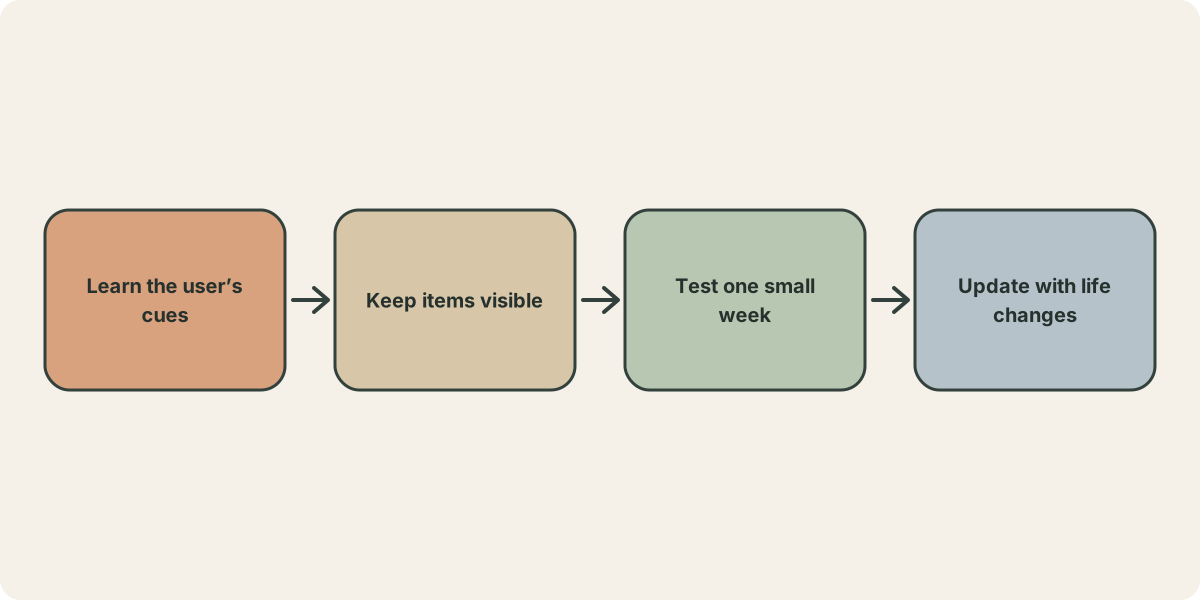
Everyone looks for things by different cues
Some people remember which drawer and which compartment; others remember the last picture of where an item appeared—on the left side of the desk, next to a particular basket. The first group may accept opaque drawers and fine-grained sorting. The second, if they cannot see an item, may feel uneasy, or simply buy another one when they need it. Neither way is better or worse; they simply rely on different cues.
In the source account, one homeowner had conscientiously bought many storage products and already sorted her belongings, yet the house still looked messy. The organizing process first noticed the visual layer: the colors of various boxes mixed with the cabinet materials, leaving the space without a sense of calm. More critically, the homeowner tended to find things by visual picture, yet was using closed storage that required many steps. To take out one item, she had to open a cabinet door, pull a drawer, and lift a lid; putting it back meant repeating the sequence. A few extra steps each day look small, but over time they are enough to turn the countertop into a temporary landing place.
Being able to see things is not the same as leaving a mess
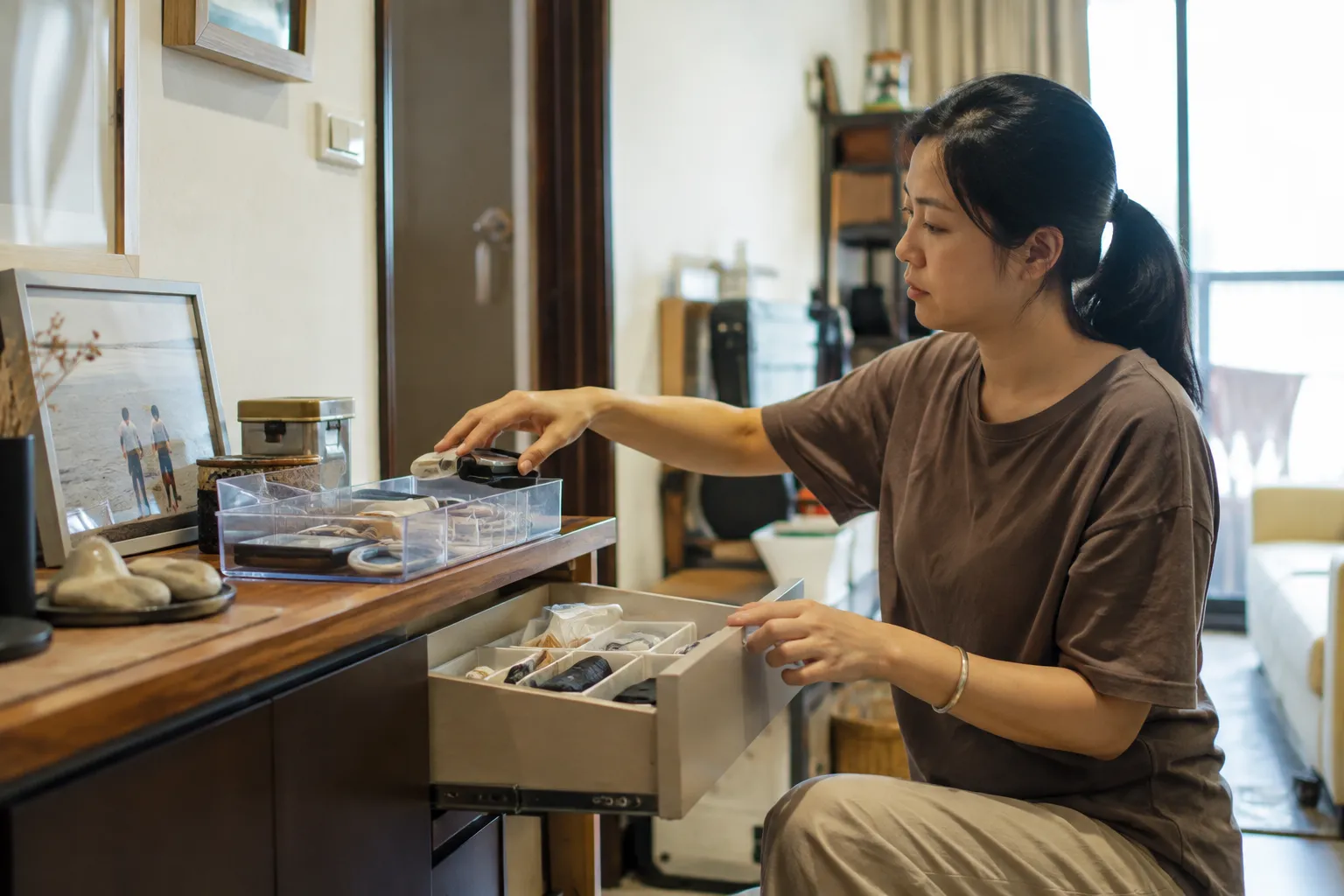
At one talk, someone said dental floss, ear picks, and coasters had to stay in sight, or they would be forgotten. The suggestion was not that he clear the desktop, but that he put everyday items into transparent containers and keep them together on the table. This keeps the visual cue while giving the objects a clear boundary. For some people, transparency, openness, and fewer steps are not a second-best option; they are what the system needs in order to last.
The source also mentions an older person who, because of her memory and habits, would often forget things the moment she put them away, so a newly organized place would quickly fall into disorder again. On site, the approach shifted to something easier to see and closer to her daily movement: important items went into a bag she carried with her, and into places she considered safe. This was an adjustment for one user, and should not be stretched into a general rule for care or memory needs. It does remind us that good storage does not start from appearance, but from how this person finds the thing.
A general method still has conditions of use
Gather, select, sort, and put away is a sequence many people know. One four-step method arranges items from small to large and does not rely on labels, expecting the user to recall location by size order. For people willing to follow that cue, it can be very clear. For those who need visual prompts, who forget easily, or whose household members are still changing, it may not be enough.
This is not a rejection of organizing methods; it is a way of putting a method back into its conditions. When a system fails, the first question is not “Why can’t I do this?” but “What does it assume about how I look, take, and put things away?” If the answer does not match daily habits, buying more of the same containers usually will not solve the problem. It will only add material use and household stock.
The system needs to change with life stages
A good fit does not mean it will last forever. The homeowner in the source had children of five and eight, but the household storage was still set to the needs of when they were two or three. Clothes, books, and school supplies had increased, and a once-workable classification gradually stopped working. Work patterns, height, physical condition, and people living together all change. If storage does not change with them, a design that once worked well can become an obstacle.
Updating does not have to mean a large-scale redo every time. Start with one surface that keeps filling up, and notice what appears on it: things used every day that need a closer place? Or things no longer used, that have never had an exit? Try a short test with existing boxes or trays first, and only decide whether a new container is needed after it feels easy to use. This is usually more restrained than buying a whole set at once.
Put the person before the container
Storage products are objects, not abstract answers. When a system forces a person to complete too many steps every day, it will gradually be abandoned. The boxes, labels, and cabinets remain, but they no longer serve a function. Conversely, if the system answers how a person remembers and how the body moves through the day, a small number of well-chosen containers can be enough to support daily life.
Shared family space needs another layer of negotiation. Some people want to see things; others want a visually clean look. Daily essentials can be gathered in transparent boxes or open trays, while less-used items keep closed storage. Not everyone has to use the same method, but shared walkways and tabletops need boundaries that can be understood. The point is not a perfect display, but that different people can take part in keeping it going.
Before buying new storage products next time, it may help to ask: is this system fitting the look of the house, or the person who uses it? Storage that can be used for a long time is what actually reduces waste.
Start with a one-week small test
To find a storage method that fits, start with the category that fails most often, rather than organizing an entire room at once. Choose objects you encounter every day—keys, medicine, charging cables, a child’s school supplies, or cooking tools—and notice where they always end up. That place may not be “correct,” but it may already show the user’s most natural path of movement.
Then, run a one-week test with existing boxes, baskets, or trays. People who need to see things can try transparent or open containers. People who do not want to see scattered objects can try drawers with clear categories but fewer opening and closing steps. After each use, there is no need to chase immediate perfection; just note one thing: is putting it back easier than leaving it out? If a system only works through reminders, guilt, or a long to-do list, it may not fit the present rhythm of life.
For shared items, make things clear before the test. Household members may understand “being able to find it” differently: one person is used to leaving scissors on the work desk; another thinks they should go back to the tool drawer. Decide first the most common situation of use, who is responsible for restocking or cleaning, and where to look when something cannot be found for a while. This is not about turning everything into a rule; it is to keep one person from silently carrying the work of organizing and searching. A system that all users can understand will not work only when the organizer is present.
Item quantity has to be counted in as well. A transparent box can ease the anxiety of not seeing things, but it will not let a desktop carry an unlimited number of daily goods. Sorted drawers can make the surface look tidy, but they will not make repeat purchases disappear. If during the test a container fills up quickly, first tell apart whether the location is wrong, there are too many items, or some things are simply not used often. This order helps keep “buy another box” from becoming the only answer.
When a system fails, previous effort does not have to be treated as wasted. A change in life stage will change the prompts, containers, and locations that are needed. Being willing to check regularly, keeping a small amount of adjustable space, and letting storage products that no longer fit be used for another purpose or passed on to someone who needs them is usually more economical than insisting on an old method. Storage has never served the cabinet; it serves the person who uses it. If someone in the household needs a special arrangement because of vision, mobility, or memory, their experience of using the space should be heard first, and appropriate professional help sought if needed—rather than requiring them to match a single organizing standard. A system that lets people keep their autonomy and reduces repeated searching and frustration is also more likely to last.
Whether a storage arrangement is suitable need not be decided by how tidy it looks to others. A more important measure is whether the user can independently find, take, and put items back. As long as shared space remains safe and clean, and other people’s needs are cared for, different ways of living can be allowed, and they deserve respect.
If a system can reduce the feeling of “I didn’t get it right again” and make it easier to do what one meant to do, it is already a good design. Organizing is not for proving who is more capable. It is so that the resources of daily life do not have to be spent on repeated repair.
Source: Liao Hsin-yun’s Facebook page (content compiled and adapted).