Some things never get started, not necessarily because they are not taken seriously, but because one person has defined them as something that “only I can finish.” Caring for family members, sorting through belongings left behind, and dealing with items that have piled up at home for years often carry this unspoken rule: if it is a family matter, you should not trouble others; if it is your own responsibility, you must do it well.
This way of thinking sounds responsible, yet it easily leaves a person stuck in place. When the scale of a task already exceeds the time, physical energy, or judgment available, continuing to treat asking for help as failure only lets the work and the pressure pile up together. Admitting you cannot do it is not giving up responsibility; it is first recognizing, honestly, that the resources on hand are not enough to sustain this task.
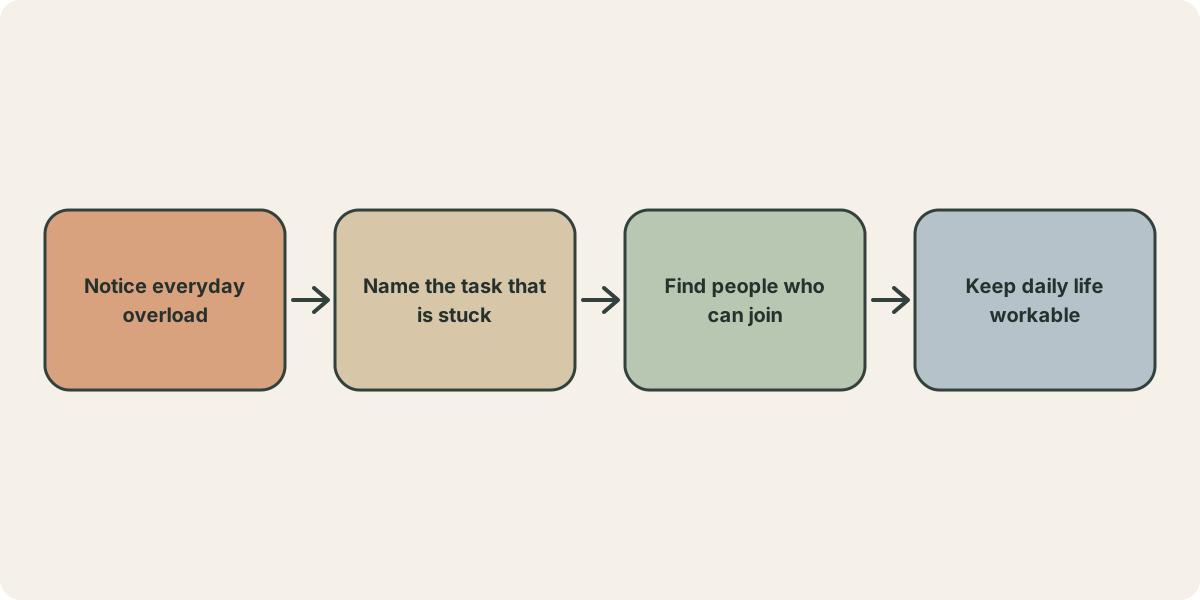
The cases below come from organizing sites. They present choices made by individual families in particular situations and cannot be used to infer everyone else’s circumstances. What they offer is a question worth practicing: have we come to value bearing things alone more than seeing the matter actually handled well?
“Duty” Can Sometimes Lock Responsibility Too Tight
A homeowner who had lived with her mother, who has bipolar disorder, for thirteen years had long faced the growth of household items and the pressure of caregiving. She had not originally planned to ask anyone into the home to help. Cost was one consideration, but what stopped her even more was another thought: this was clearly something she could do herself, her own duty; if she could not do it well, it would mean she had not lived up to her responsibility.
Her older sister saw how hard she had worked over the years and volunteered to cover the cost of help with organizing. She did not accept at once, because letting someone else spend the money made her uneasy. Later, looking back over those years, she reached a plain conclusion: since she had never been able to do it, perhaps she truly could not—so she would admit it.
This is not a statement that denies the self. On the contrary, it is a capacity to put experience back into judgment. If something has been delayed for years, repeatedly intended yet never started, the reason may not be insufficient will, but a mismatch between how the task is designed and the person’s own resources. As long as it is still called “next time I will definitely manage,” a person easily repeats self-blame without any new conditions that would make the work feasible.
Stagnation Is Not Laziness; Decision-Making Has Stalled
Standing before the piled-up items, this homeowner often did not know whether to put things away first or throw them out. She described herself as someone who thinks a great deal; the more she thought, the less she could move, until her mind went blank. At the same time, old clothes, toys, and items left from the children’s growing years kept coming into the home; her husband was frugal and found it hard to refuse gifts from others. Things never stopped coming in, yet a way out never opened, so of course the items kept increasing.
Calling this state laziness is not accurate. When every item requires a judgment, and every decision carries the fear of getting it wrong, organizing becomes high-cost work. Especially when caregiving, child-rearing, and housework already take up most of a person’s mental energy, deciding what stays and what goes is easily left until last. Over time, tabletops, floors, and drawers hold not only things, but also every unfinished decision.
Asking for help can lower these decision costs. Sorting together with someone else is not the same as handing over the right to judge; breaking the work into a smaller scope is not the same as lowering standards. What matters is that a person who has been stuck for a long time does not have to face every option alone. For some families, outside help is extra hands; for others, it may mean family members sitting down again to talk the rules through clearly.
Asking for Help Is Not Pushing Responsibility onto Others
Another homeowner was diagnosed with breast cancer not long after her marriage ended. She first organized a round on her own, and the parts she could handle were already done; but when she opened her child’s drawer, anxiety surged up at once. She closed the drawer and said she truly could not do it. Because treatment was about to begin, she judged that if she delayed further, the matter might drag on even longer, and so she decided to seek help.
Even after just having surgery and finding it hard to get around, she still took part on site every day. This experience shows that accepting help and giving up are not the same thing. She did not set aside her concern for the family, nor did she throw all the work onto others; she only handed a stretch of work that exceeded her capacity at that moment over to more people to complete together.
In public discussion, we easily bind “doing it yourself” together with “being capable.” But truly responsible action is not taking every task onto oneself; it is knowing which tasks need resources to be allocated. When a person is undergoing treatment, under the pressure of caregiving, or facing years of sorting through belongings left behind, help may not be a shortcut, but a necessary condition so that life does not come to a halt.
Calculate the Scale of the Task First, Then Talk About Willpower
A father had once bought more than ten books on storage and organizing, had actually followed the methods, and had even stayed up all night organizing. The home still showed little improvement, and he began to feel that the situation might be beyond recovery. Another homeowner in their twenties also said they did not know how to organize; organizing and not organizing seemed much the same, and in the end they simply gave up.
These experiences do not mean the methods are useless; they remind us that when the scale of a task differs, the resources needed differ as well. The number of items, living space, household members, available time, and physical condition all change how hard organizing is. When a person has already tried for a long time and still cannot bring the environment back to a usable state, the most reasonable next step need not be trying harder, but re-estimating how much support is needed.
Support may mean shrinking the goal to one drawer, one dining table, or one pathway; it may mean asking relatives or friends to take over a particular task on a regular basis; it may also mean agreeing together not to bring items with overlapping functions into the home. Different families have different conditions; no single approach can be applied directly. What can be said with certainty is that if willpower alone is used to explain all stagnation, the structures that can actually be adjusted will keep being overlooked.
Treat Asking for Help as a Basic Skill of Living Together
Sustainable living does not ask everyone to finish every task through stronger self-control; it is about making everyday use of resources last. Time, physical energy, and emotion in a family are also finite resources; when they are overdrawn by one person over a long period, even if the belongings are neatly arranged, life may still not be sustainable.
Admitting limits can turn a person from “I am not good enough” toward “what is missing now.” If what is missing is time, adjust the schedule; if it is hands, find people to do it together; if it is room for decisions, narrow the choices; if it is rest, first spare the person from making major judgments while exhausted. None of this is a failure of duty; it is what gives responsibility a chance to actually be completed.
Perhaps it can begin with a question that carries no blame: How long have I already tried this on my own? If the answer is several years, that answer itself deserves to be respected. Asking for help is not admitting that you have failed; it is admitting that one person need not bear, alone, all the work that keeps a home running.
The cases in the source also let us see that asking for help is usually not a single brave instant, but a process of recalculating. Some people first try to organize on their own; some begin to loosen only because a relative offers support; others, after a change in physical condition, admit that the original way of doing things is no longer suitable. None of these processes needs to be packaged as an inspirational story. What matters is whether, when a person says “I cannot do it,” those nearby can hear it as a credible present situation, rather than an attitude waiting to be corrected.
If a family is to become a support system, asking for help also needs a concrete place to land. Rather than saying in general terms, “let us know if you need anything,” it is better to confirm together which kinds of things get stuck most easily, who can sit with the first decision, and which tasks can be split into stretches that can be finished in a short time. For belongings, this may mean handling one drawer first; for relationships, it means allowing the same responsibility to be shared by more than one person. When support can be stated clearly, admitting limits need not be spoken only in solitude.
When resources are reallocated, keeping the person’s own choices is also important. Those who help can offer time, company, or a different angle, yet they need not decide the value of every item for the other person. Leaving room for participation and explanation makes it more likely that the new arrangement will be accepted and last. The purpose of asking for help is not to hand life over, but to bring life back to a degree at which one can take part.
People who can live together can also learn together this capacity to admit limits, rearrange, and support one another.
Source: Liao Hsin-yun’s Facebook page (content compiled and adapted)