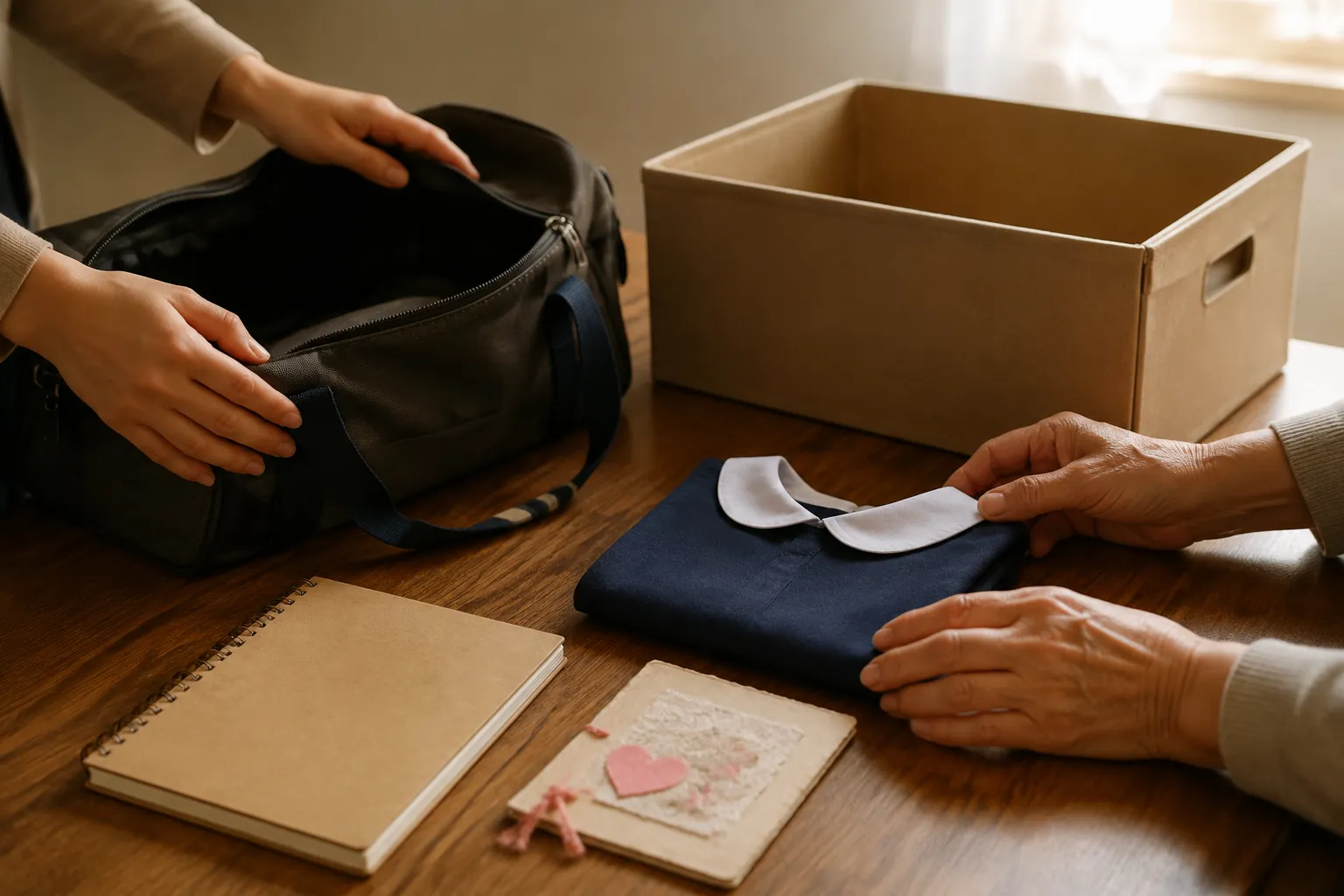
Many people who go back to the family home have seen a similar scene: the storage room still holds adult children’s textbooks, uniforms, notebooks, and old toys. Parents say, “See if you want to take these with you.” The children often reply, “I don’t need them anymore—just get rid of them.” Both sides seem to be talking about a batch of expired items, yet the tone often turns sharp very quickly.
What is really stuck is usually not whether a particular textbook or piece of clothing is worth keeping. What parents may see is a responsibility they can still carry for their children; what the children see is their parents’ home taken over by things no longer in use. Both feelings are real, yet they are rarely put on the same table and talked through.
Several in-home organizing cases show that belongings can hold a family’s relationships in place, and can also postpone a change of roles. These cases are not ordinary household statistics, and they cannot stand in as conclusions about everyone’s parent–child relationship; they do, however, offer a less blaming way to understand what is happening: when adult children return to deal with things they left in storage for years, they are not only clearing a corner. They are also returning present-day space and responsibility to their parents.
What sits in the storage room is often a responsibility not yet handed back
In a family factory that had been closed for years, organizing turned up the adult son’s childhood uniforms, school crafts, and a maternal health handbook. With each item they picked up, the elderly couple could tell the story that went with it. The family members who had asked for the organizing once wondered: was it the objects the parents could not let go of, or the memories tied to their child?
There is no single answer. Still, when parents keep their children’s belongings, it does not necessarily mean they consider every item precious. Sometimes an object is more like proof of a place. After children leave home, go to work, and start families of their own, parents can still extend the caregiver’s role through “I’ll keep this for you.” That is a way of living they know well, and one that once mattered a great deal.
So when a younger family member says, “Just throw it all away,” what parents feel may be more than a suggestion to tidy up. It can feel as if that place has been taken from them all at once. This does not mean adult children must bring every childhood item back to where they live now, and it certainly does not mean parents can store things indefinitely on their behalf. It is only a reminder that if we first acknowledge that belongings carry relationships, the decisions that follow need not start with blame.
Whoever owns the belongings should take part in the decision
A kind of imbalance easily takes shape in a family: parents live in the old home and carry the burden of space, cleaning, and storage, while children leave unused things there for years and, on occasional visits, say, “Don’t touch those yet.” After a while, these items left “for now” mix with the parents’ own belongings, and no one can say clearly which still have a use and which have simply never been faced.
At one organizing session, a father made a point of saying that the belongings of an older brother who was not present must not be touched. From a sibling’s point of view, that may feel inconvenient; from the parents’ point of view, keeping someone’s things is also keeping their place in the family. That boundary deserves respect, and the owner of the belongings also needs to take responsibility for what comes next.
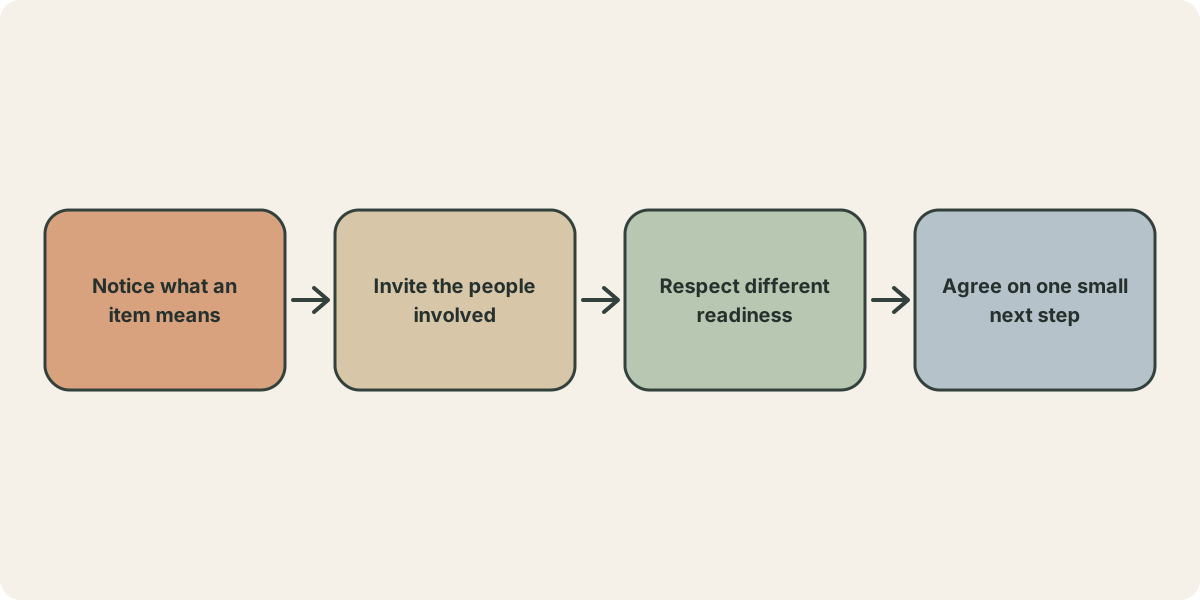
The most basic principle can be quite clear: do not clear out someone’s personal belongings without their consent; but the owner should not treat “don’t throw it away” as a permanent exemption from responsibility. A date can be set for coming home to take stock, and items can be sorted into keep, take away, pass on, and still to be decided. If something cannot be taken away in the short term, it should still be clear where it will sit, how much space it will occupy, and when it will be reviewed again. These arrangements may look administrative, but they can protect the relationship and keep the same conflict from playing out at every holiday.
Taking your own things away is a handover of roles
When adult children go home and sort their own belongings, they can in practice free space their parents need now. More importantly, they slowly return the role of “keeper” to the person who owns the things. Parents can decide again how that room will be used—perhaps for rest, reading, or exercise, or simply to leave a clear path through the house, without rushing to fill it with something new.
One daughter stayed with her seventy-year-old mother throughout the organizing and took some of the items away. That experience let the mother feel that someone was willing to face it with her, rather than only urging her to empty the room. After the organizing, she began to plan enka singing, hiking, and travel. This is one family’s experience; it does not prove that organizing belongings will necessarily change a life. It does, however, show that once space is freed, what surfaces is sometimes not only empty cabinets, but also everyday life that had been postponed for a long time.
An organizing day need not be designed as a major project. It can start with a desk, the top of a wardrobe, or a box of childhood keepsakes. Ask parents to say what they still remember, then let the children themselves decide which records to keep. When the aim is to keep a memory, photographs, a few representative objects, or a simple list often reduce the later burden of storage more than keeping the whole batch.
The point here is not that digitizing memories counts as done. It is to decide together, first, what is worth remembering. Some families find that what they most want to keep is the story a parent tells when they pick up an object, not the object itself. Some items still have use, and it is reasonable for them to stay in the home. The purpose of organizing is not to shrink the entire past into the smallest possible volume, but, in limited living space, to tell which things are worth continuing to care for, and which responsibilities should be taken back by the original user.
If children cannot go home for the time being, they need not ask parents to finish all the sorting in their place. They can first ask them to gather clearly personal items and photograph them, or to make a simple list by room or cabinet, and then confirm together when a return home is possible. These arrangements may seem slow, but they can keep a line said over a long-distance call—“just throw it all away”—from becoming a source of later regret or misunderstanding. What stays and what goes need not be decided in a single phone call. What matters is that the person responsible actually enters the decision.
Things a family made together should not be left for one person to finish
Some belongings were not left by a single child, and were not bought by the parents alone. A treadmill unused for years in one home was once described by a son as “historical shared karma” accumulated by the parents and three children together. That remark is a reminder that the origins of family belongings are usually more complicated than “who bought it.” Everyone once used it, added to it, or let it stay, yet the organizing work often falls on one person in the end.
Among siblings especially, it is important not to appoint the “person who is best at organizing” to decide for everyone. Having one person throw away others’ belongings may look efficient in the short term, but over time it can breed more suspicion and resentment. A better approach is first to list the categories that each person needs to confirm—for example documents, photographs, collections, children’s things, and shared equipment—and then agree on a deadline for replies. No reply does not mean the items can be dealt with at will, but they can, by prior agreement, be moved to a waiting-to-collect area so they do not scatter back into every corner.
The waiting-to-collect area should also have a clear boundary. It can be a fixed cabinet, a few sturdy boxes, or a stretch of space that does not block the walkway—not the place where everything in the house no one wants to decide about eventually ends up. Only when each family member knows where their things are can they take them away before the deadline, keep using them, or arrange a next destination. Spelling out the limits is not counting family affection too finely; it is keeping parents’ living space from being occupied indefinitely by “we’ll deal with it later.”
Facing this together also has meaning for sustainable living. Only after an item is clearly identified is there a chance to decide whether it should stay in use, go to someone who truly needs it, enter an appropriate recycling channel, or be given a responsible final disposal. If it remains mixed in the storage room, it can neither serve daily life nor find a suitable next place.
Before that, it also matters to separate “the belongings have to leave” from “the relationship is ending.” Parents can still hear how their children are doing, still gather at holidays, and still keep one or two truly representative items at home. Reducing the things they store on others’ behalf does not reduce how much they care; it only means caregiving no longer has to be expressed entirely through a room packed with things.
Ask a question that opens the conversation more readily
When we go back to the family home, we are used to asking parents whether they are short of anything, or whether they need something new. Another question may be more worth asking: “How much of my stuff is still in your house?” This is not asking parents to produce a list on the spot, and it is not turning organizing into an exam. It is letting adult children see again that their own responsibility is still sitting in that space.
Then we can ask: Which things do you think I need to look at myself? Which items are taking up the most space right now? Is there an afternoon when we could do just one corner? For parents, these questions convey “I am not leaving the burden with you.” For children, they are a chance to understand again how a home changes with each stage of life.
Belongings sometimes leave a trace of a relationship, but they need not occupy space in its place forever. When children are willing to take back the things they left behind, parents have more room to put their lives back in the present. Organizing is not a denial of the past. It is letting memory, responsibility, and living space each find a more fitting place.
Source: Liao Hsin-yun’s Facebook page (content compiled and adapted).