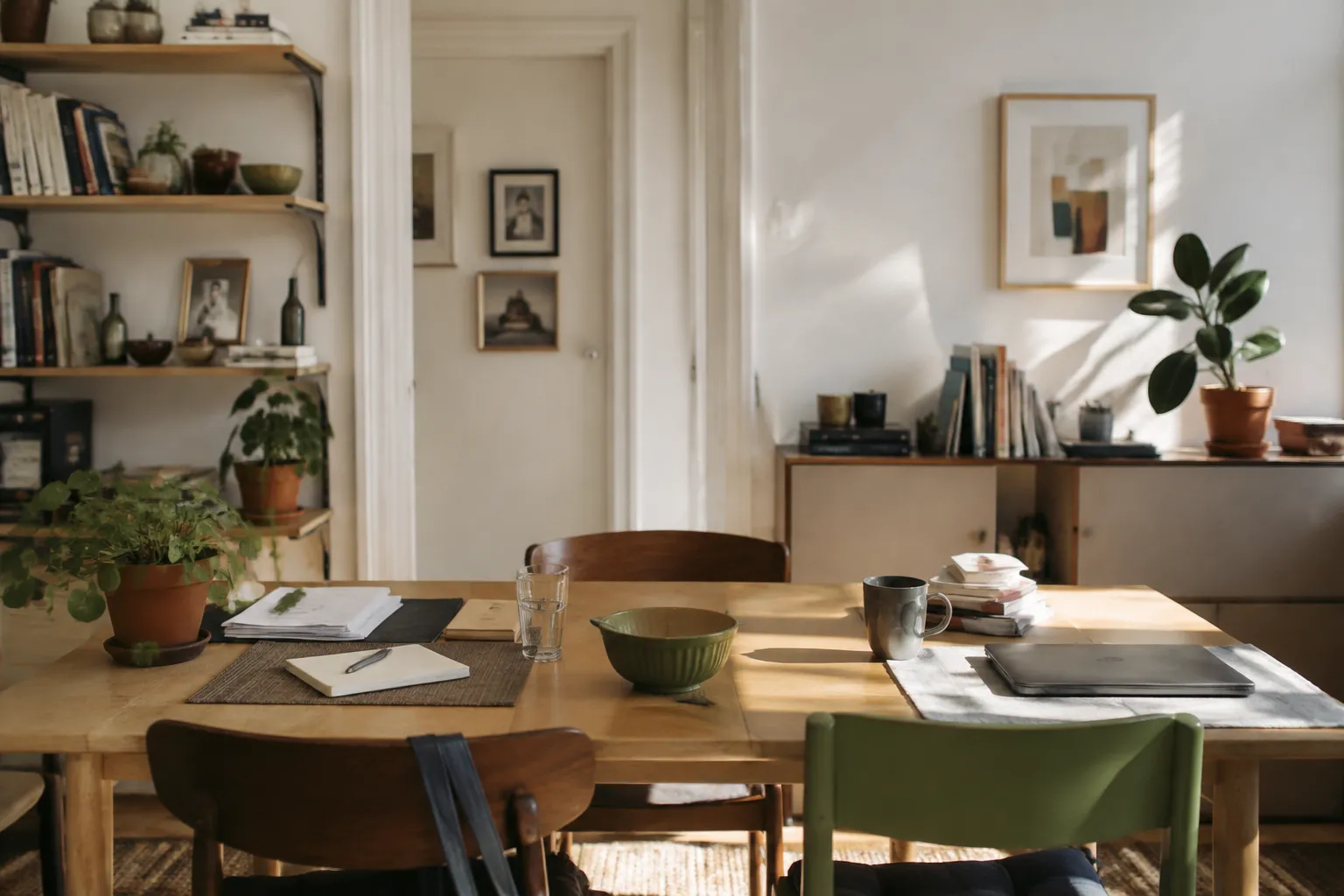
Six people, four chairs: that was the long-standing mealtime scene in one single-story house. When relatives came back for Lunar New Year, it was still six people and four chairs. Some took turns sitting; most of the time, people ate standing up. The arrangement went on for years, and everyone gradually grew used to it.
Too few chairs looks like a furniture-count problem, but it also raises a question that is asked less often: in a household, who has a comfortable, stable place? Whose needs get priority in how space is planned? Home organizing is not only moving objects to suitable spots. In a home where several people live together, space is a limited resource, and how that limited resource is allocated is often closely tied to whether each person can speak, negotiate, and decide.
The cases below all come from individual organizing visits and cannot be used to generalize about every family. What they offer is one way of rereading relationships through everyday space.
Space has never been a neutral container
When we talk about organizing, we tend to see objects first: more things, so buy a cabinet; cabinet full, so find another corner. But rooms, hallways, tabletops, and seats are not a backdrop without a point of view. When a family shares living space, every decision is answering: who may leave things here? Who has to shrink their own activity? Whose belongings may go untouched?
An elder of about seventy lived in a room of about four ping. Clothes hung behind the door; a chest of drawers and two three-tier cabinets blocked the circulation path, so the door could not open fully and she had to turn sideways to go in or out. In the source case, the relatives who lived with her preferred the shared areas to stay uncluttered, so they wanted all of her belongings kept only in her own room. It is worth noting that she had originally bought the house, yet that did not mean she could decide which parts of it she used.
This reminds us that ownership of the house, responsibility for housework, and everyday decision-making power do not necessarily rest with the same person. If we only ask the person in the room to “get it organized,” we may miss why the belongings could only be concentrated there, and whether she had a chance to take part in the planning.
What gets shrunk is often more than a room
In another source case, a four-story house had quite a few rooms, but most of them had become storage. The homeowner, who had personally overseen the building of the house, slept in a small dressing room. He said the children needed the space more, and that sleeping as if in a cave was fine; when someone suggested planning a room of his own for rest, he was surprised and asked whether he really could have one.
A concession like this may come from love, habit, or long-term caregiving, and it cannot be judged simply as right or wrong. Still, when someone consistently ranks their own needs for rest, storage, and activity last, even a large floor area at home will not necessarily turn into living quality they can use. Space taken over by objects, and space reserved only for some people, both end up making daily life cramped for others.
Sustainable living is about how resources are used, and that should also include whether living space can be used fairly. This is not a demand that everyone receive a room of exactly the same size. It is about every member having a basic range in which they can walk, rest, and keep personal belongings, and being properly asked before that changes.
This kind of review can also reduce unnecessary pressure from belongings. When each person’s everyday items have a clear, reasonable place, things are less likely to be forced into a shared hallway or to prompt buying another cabinet as a temporary fix. Spatial planning looks like a small matter; in practice it affects later buying, keeping, cleaning, and who bears the burden of dealing with things.
Places that cannot be discussed are often the ones that most need to be seen
Households often have “don’t touch” zones: a cabinet in the living room, an elder’s boxes, a table unused for years. In one source household, they said before organizing began that a living-room cabinet belonged to an elder and must not be moved at all. In another, because of the father’s health, they required that nothing be thrown away or moved, and that the organizing process be video-recorded so he could later compare.
The reasons in the two situations differ. The first may be about boundaries and habit; the second may be tied to unease that comes with illness. Calling both stubbornness is neither accurate nor helpful for conversation. What matters more is to recognize that some places become off-limits because they carry a sense of safety, memory, or worry about losing control.
So when facing objects that cannot be moved, the first step is not necessarily to persuade someone to give them up. It is first to confirm: whom does this place matter to? What is the reason for not moving it? Has it already affected others’ safety and basic use? Only when each person can state their reasons does it become possible to shift from orders and defense toward more concrete negotiation.
Organizing should not become a correction inside a relationship
If organizing is understood as the more powerful person requiring the less powerful one to correct themselves, the process often stalls. Belongings are sometimes the last range a person can still control at home. When they are urged to deal with them, what the person feels may not be help, but their own place being shrunk once more.
In the source account, the elder at first saw the organizer as “someone the family hired to throw my things away.” Later the wording changed to “helping me organize my room,” and it was made clear that she would decide what stayed and what left. Only then did the conversation slowly open. That case eventually produced eighteen bags of items ready to be passed on, including six bags of clothing and fifty umbrellas. These numbers describe only that service and should not be taken as typical organizing results; but they show that when control returns to the person concerned, change does not necessarily depend on force.
In another case, a treadmill that had sat for more than ten years and been almost unused was still, at first, something the elder insisted could be used. Only when the son was willing to take it apart, carry it, and send it to recycling together did the elder go along. Someone willing to share the physical and decision-making cost is more reassuring than a line like “Why haven’t you dealt with this yet?”
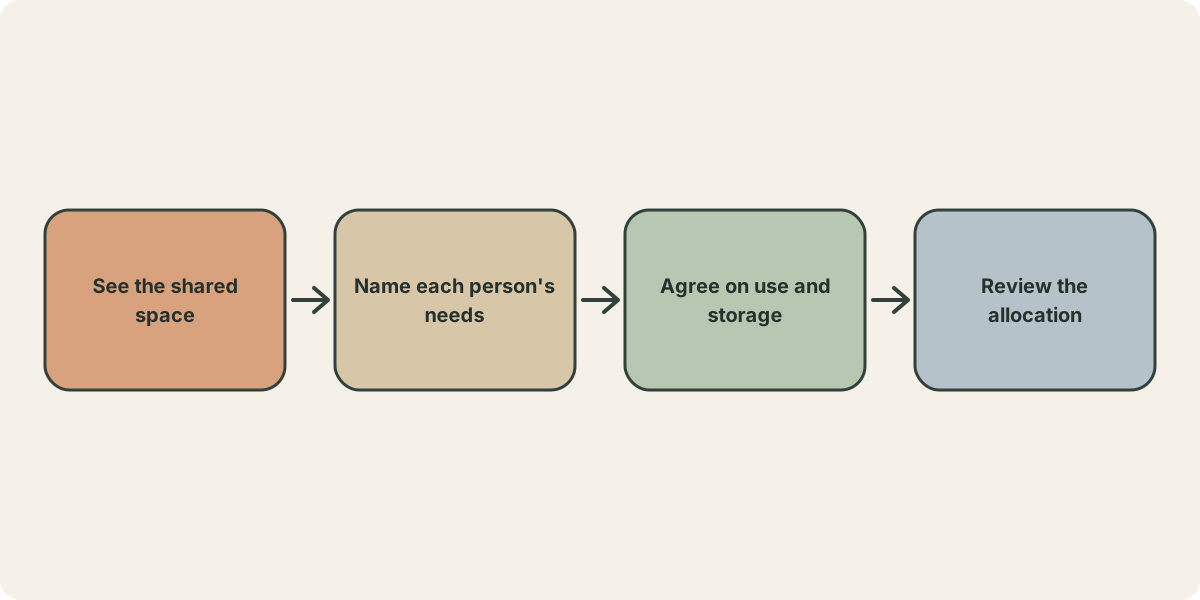
Start renegotiating from a single chair
Redistributing space does not require turning the whole house over at once. You can start from the most everyday questions: does everyone have a place to sit at meals? Can the door open fully? Is someone able to keep personal things only in a hallway or beside the bed? In shared space, is there one person who never has a usable tabletop?
The point of these questions is not to find out who did something wrong, but to let neglected needs for use come to the surface. Next, distinguish which objects are memories that truly need to be kept, and which are still usable resources that can be passed on or recycled, and talk through together who will take on cleaning, moving, and upkeep.
If discussion cannot reach consensus for the moment, you can still first set shared bottom lines that will not harm one another: keep escape and circulation paths clear, do not handle other people’s personal belongings at will, and give notice before moving things. These small rules cannot replace deeper communication, but they can keep a safer starting point for later negotiation.
A home that can keep working over time is not one in which a single person maintains the order alone, but one in which members can all be seen. When the allocation of space begins to hold each person’s life, belongings have a chance to return to suitable places, and relationships need not always be held together by giving way.
Source: Liao Hsin-yun’s Facebook page (content compiled and adapted)