One family lived in a traditional factory that also served as their home. The factory had been closed for years, yet the interior still held equipment, printer paper, and promotional flyers from the years it was in business. In the source case, the organizing work took four days and cleared out twenty-three bags of trash, thirty-six bags of recyclables, twenty-three bags of items to be passed on to others, and eleven pieces of large furniture. These figures belong to a single case and should not be treated as statistics for ordinary homes; they do, however, make one thing clear: although the factory had come to an end, the space was still serving the old way of working.
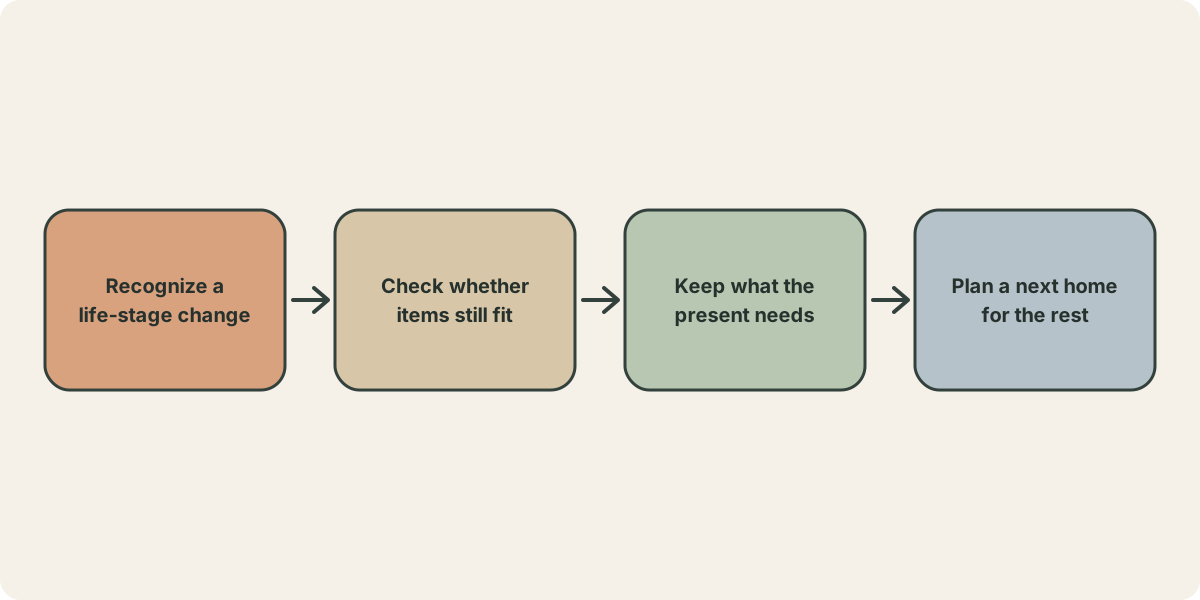
We often take organizing to mean that there are too many things, or not enough storage. Sometimes, though, the problem is that life has already moved on while the household system has not been updated. Family members, household size, daily routines, caregiving responsibilities, and work patterns all change. If objects and spatial arrangements remain stuck in the previous stage, even determined upkeep can still feel exhausting.
At the end of every stage, a fresh review is needed
Most life transitions do not happen all at once. Children grow up gradually, work winds down slowly, an elder’s health changes by degrees, someone moves in, and someone moves out. Because the change is incremental, families rarely declare, as they would when moving house: “From today on, we will rearrange this home.” The original cabinets, room uses, and storage habits simply continue as they were.
The family from the closed factory asked a very practical question: if we no longer pile up what work left behind, what should go here next? This is not a demand that the past be wiped away. It is a chance for the family to recognize whether what they truly need at this stage is a studio, a rest area, a caregiving space, or a shared place that can be put back into use.
Treating a change of life stage as a trigger for organizing can also keep objects from sitting unused for long periods. Rather than waiting until the hallway is packed before dealing with everything at once, set aside time when the family structure changes to take stock: which objects are still in use, which are merely holding a place for the past, and which can be given to someone who needs them more.
When the number of people changes, space does not necessarily free itself
In the source, one homeowner lived alone after a divorce in a space that had once housed a family of four. The former partner and children had already moved out, but the rooms, cabinets, and pathways still followed the logic of four people’s lives. The children came back once a month, yet the homeowner was affected every day by the old allocation. Only after the objects were gathered and the layout replanned was a room cleared, to be reserved for a mother who might later move in.
A household of four, a person living alone, and two people who may later share the home do not need the same system. This kind of adjustment also need not wipe away every trace of those who have left. Start by discussing the objects that will actually be used when they come back to stay, and give those objects a clear and limited place. The rest, if they occupy rooms for no reason other than “they used to be here,” deserve a fresh decision about where they should go.
Once space is clearly divided, the useful life of objects also becomes easier to see. Remaining in the home is then no longer only a matter of habit; it can be tied back to a living need that still exists.
Objects often keep, for the family, a relationship that has not finished being told
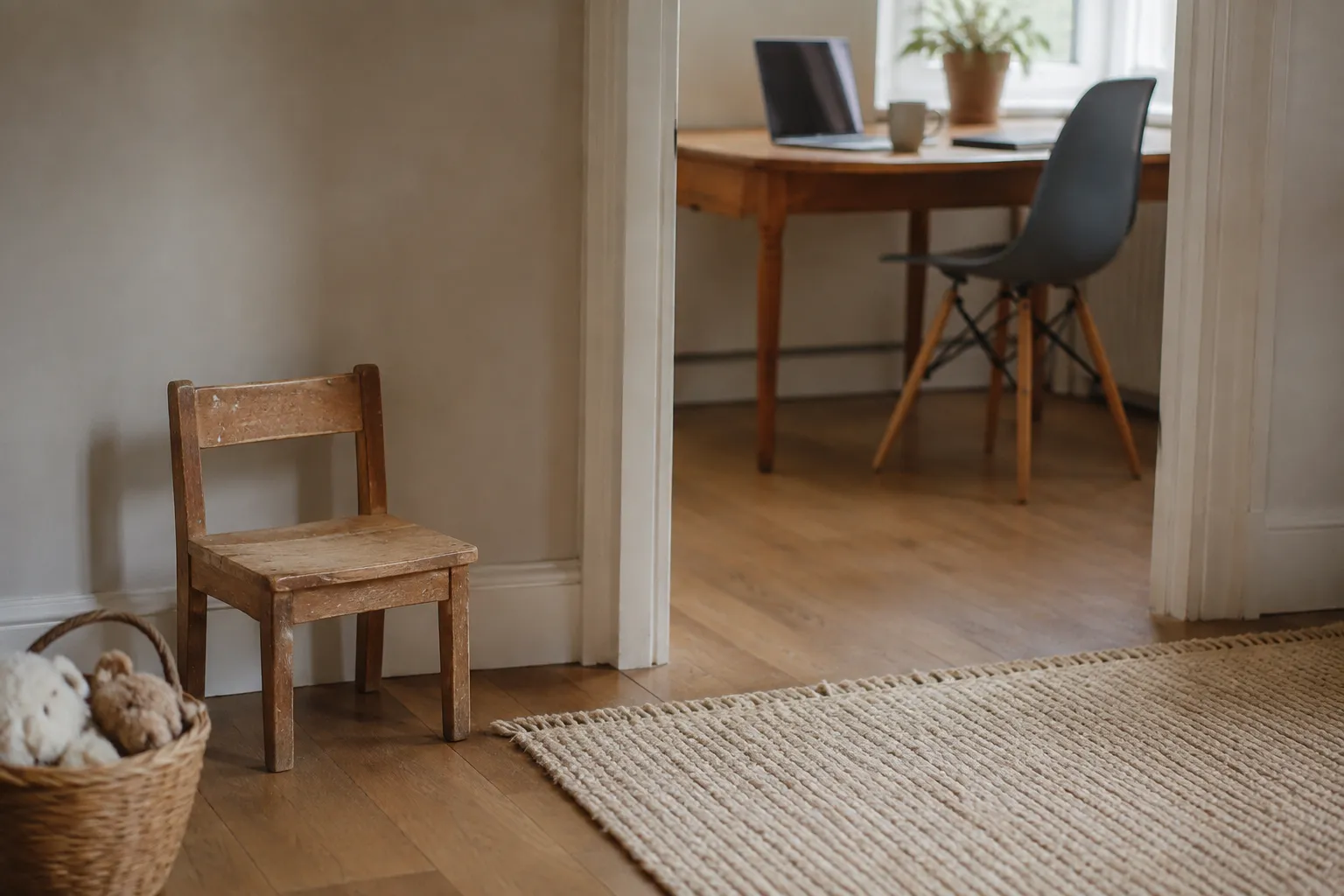
Parents’ homes often keep adult children’s textbooks, uniforms, school crafts, or childhood picture books. The younger generation may feel there is no place to put them, or even hope they can simply be dealt with; the elders, however, feel they will be used someday, or hope that future children will be able to leaf through them. On the surface the dispute is about objects; underneath, it may be about different imaginings of the relationship.
In the factory-home in the source, an adult son’s childhood uniforms, artworks, and a complete set of encyclopedias were turned up. There was also a mother whose daughter was already in university, who still kept picture books, hoping they could be read together when children visited later. These objects are not without feeling; rather, feeling does not necessarily have to be proven by keeping large quantities.
A gentler approach is to change “keep everything” into optional keeping: ask the owner first to pick out the few objects they truly want to take or to keep, photograph them, mark their stories, or agree on a clear period for confirmation. Other things that still have use value can find a path toward being passed on, reused, or recycled. In this way, memory is respected, and space need not remain occupied by unconfirmed expectations.
After caregiving ends or changes, a home needs to grow new functions
A change in a caregiving relationship is another moment that strongly calls for reorganization. In the source, a four-story house had thirteen years of three generations living together, and one family member’s needs had long been the household’s first priority. Three children were born in succession, yet rooms and storage never settled as they grew; the children had no fixed bedrooms, and schoolbags were often left beside the dining table. Only when the cohabiting elder moved back to the south did the spatial arrangements that had been postponed finally surface all at once.
The emergency arrangements of a caregiving period usually have their own necessity, and it is not appropriate afterward to blame the caregiver by the standard of efficiency. But when the responsibility shifts or ends, the piles and pathways formed for the convenience of care may no longer suit the next stretch of life. Replanning can start from safety and daily life: Does each child have a fixed place to sleep and study? Can the primary caregiver have a corner in which to rest? Are frequently used objects easy to reach?
These adjustments let the space serve once more the people who live here now, and they allow the time once given to caregiving not to remain in daily life as clutter and a sense of oppression.
A reset need not aim to get everything right in one go. Start with the area that most often gets stuck, assign it a new purpose and a period of observation; if it still does not work smoothly in use, then adjust the placement or capacity of objects. Letting planning follow and correct itself against real life usually does more to prevent new idleness and waste than buying a complete set of furniture all at once according to an imagined perfect home.
Keeping memories is not the same as keeping an entire old system
After parents pass away, belongings are especially likely to leave a space stuck in place. In a source case, after the parents of a two-bedroom home with a living room and dining room had died, the eldest daughter used the master bedroom, yet her father’s Tang-style clothing still hung in the wardrobe, teaching materials and manuscripts remained on the desk, and her mother’s calligraphy copybooks and sewing tools were scattered throughout. Her own work could only be squeezed into the living room, the daughter’s room, and the hallway; before guests came, she had to spend several days moving things.
After organizing, her work had a place where it could be displayed for the first time. This does not mean that the parents’ objects were unimportant; it means the home began to acknowledge that the person still living there also needed to be given a place. Belongings can be kept in a small, intentional way—for example, selecting objects that can represent a memory, paired with photographs, writing, or a shared family record. Other items, according to their condition of use, can be arranged to be passed on, reused, or handled appropriately.
Sustainable living is not about organizing every home into the same appearance. It is about letting objects change with people and needs, remaining in a position where they can be used, cherished, or properly kept in circulation. The next time the family structure changes, it may help to ask first: What kind of life do the people living here now need? Let the answer carry the objects into the next stage.
Source: Liao Hsin-yun’s Facebook page (content compiled and adapted).