When a home grows messy, it is easy to look first for someone who should be held responsible: someone who buys too much, who never puts things away, or who is simply not diligent enough. That kind of attribution comes quickly, and it makes people believe that if only that person changed, things would improve. In many families, however, the disorder is not caused by a single habit. It comes from roles, responsibilities, and the allocation of space having been out of alignment for a long time.
Someone takes on caregiving that should have been shared by several people. Someone strikes themselves from the allocation of space. Some belongings appear to belong to everyone, yet no one can actually decide whether they stay or go. These misalignments do not always turn into conflict at once. They often first become a hallway that grows narrower, a room that loses its function, a dining table that is taken over, or a family that begins to settle for “this will do for now.”
What follows is compiled from the on-site experience of particular families. It is not a general rule of family relationships, and it cannot be used to judge illness, personality, or the rights and wrongs of kinship. What these cases point to is a question asked less often: when a home becomes harder and harder to use, who is bearing a place that was never theirs—and for whom?
When the Most Urgent Thing Occupies All Attention
One homeowner brought her mother, who has bipolar disorder, to live with her—for thirteen years in all. Caregiving had to be handled continuously, so many other issues in the household were postponed: how belongings would be organized, how the couple’s living habits would be coordinated, what kind of space the three children would need as they grew. She often thought: her mother’s situation was already so much; how could she possibly have time for anything else.
A collaborating physician mentioned in the source reminds us that when a family marks one member as “the source of the problem,” other issues are easily covered over along with it. This does not mean that illness is the cause of the household’s disorder. Bipolar disorder requires treatment and support; it must not be treated as an object of blame. What truly brings a family to a standstill is that everyone gradually acquiesces in having all problems handled around the same caregiver—even matters unrelated to the person being cared for are put on hold.
In this family, the husband’s habit of keeping things was never properly discussed, and the children’s living space was never rearranged as they grew. When the mother later moved back to southern Taiwan, the problems that had been pressed down surfaced all at once. It looked as if they had appeared suddenly; in fact they were the accumulation of thirteen years left unaddressed. A family does not have only one line of tasks. If every resource is taken up by the most urgent matter, other relationships and living needs do not disappear; they only wait in the corners.
When Space Feels Insufficient, It Is Often Because Allocation Was Never Discussed
Another family lived in a four-story house: a couple and three children. Upstairs there were several rooms, yet there was no stable sleeping arrangement. The children sometimes slept on one floor and sometimes on another; schoolbags sat beside the dining table; the father looked for a place to sleep wherever he could. The house was not small, yet it had not made clear to each person where their own life was supposed to take place.
A shortage of space does not happen only in small homes. When rooms, tabletops, and storage places are not matched to the people who actually use them and to the activities of daily life, even abundant space will be taken over by temporary piles. Growing children need places to study and to store things; adults need places to rest and to handle housework; shared areas also need to allow eating, walking, and conversation. If these needs are never spelled out, belongings will make the decisions in place of the relationships: things go wherever there is room; whoever can yield more takes a step back.
After the organizing, this household reassigned how the rooms would be used. The daughter put her books, one by one, into the bookcase in her new room, and said that from then on she could invite classmates over. The meaning of those words was not only that a cabinet had become tidy. It was that the child finally knew she had a place where she could receive friends and settle her life. Once space was reallocated, the relationships also gained a little more room to reach outward.
When Someone Steps Aside of Their Own Accord, Their Needs Still Remain
The father of that same four-story household had, in order to give the children more room, taken to sleeping in a cramped dressing room. He believed the children needed the space more, and that it was all right for him to live as if in a cave. Later, when someone suggested setting aside a room on the fourth floor for him to rest, he asked in surprise: could he really have a room of his own to rest in?
This reaction makes visible that a role out of place is not necessarily imposed by others. Sometimes adults, used to giving and afraid of becoming a burden, take their own needs off the list of their own accord. But a need that has been excluded does not vanish because of that. Insufficient sleep, no quiet place to handle one’s affairs, nowhere to put personal belongings—these still return to the household in the form of exhaustion, stress, or still more temporary piles.
Another homeowner moved into the master bedroom after her parents passed away. Her father’s clothes still hung in the wardrobe; on the desk were his manuscripts and teaching materials. Her own things, by contrast, were scattered across the living room, her daughter’s room, and the hallway. This was not only that there were too many belongings; ownership had never completed its handover. Who may decide which items stay, who has the right to use which space—if these things are never made explicit, life remains stuck in a transitional state.
People at the Edge of a Relationship Often See First Where Things Are Stuck
There was an old family home converted from a traditional factory. Six adults sat down to eat, yet there were only four chairs. People took turns sitting; elders standing while they ate had already become the habit. For years, the family did not see this as a problem. The first person to raise a question was a younger member who had married into the family. After her daughter was born, she worried that the shared areas had been reduced to narrow passages, and that when the elders carried hot soup through, the child was also moving about nearby.
She did not directly ask anyone to throw things away. She first let her husband see how the space was affecting daily life. He spent a year talking with his parents before the family began to organize. Later he understood that the belongings piled up over the years were not one person’s problem, but the living result of several family members and children accumulating them together.
Someone standing at the edge of a relationship can sometimes more easily see the imbalance an existing family has already grown used to. That person does not necessarily understand more, and need not play the savior. Their role may only be to raise a question the household has not asked in a long time. Why do six people have only four chairs? Why is one person always the one who yields? Why is organizing always left to the same person? These questions begin to make habit something that can be discussed.
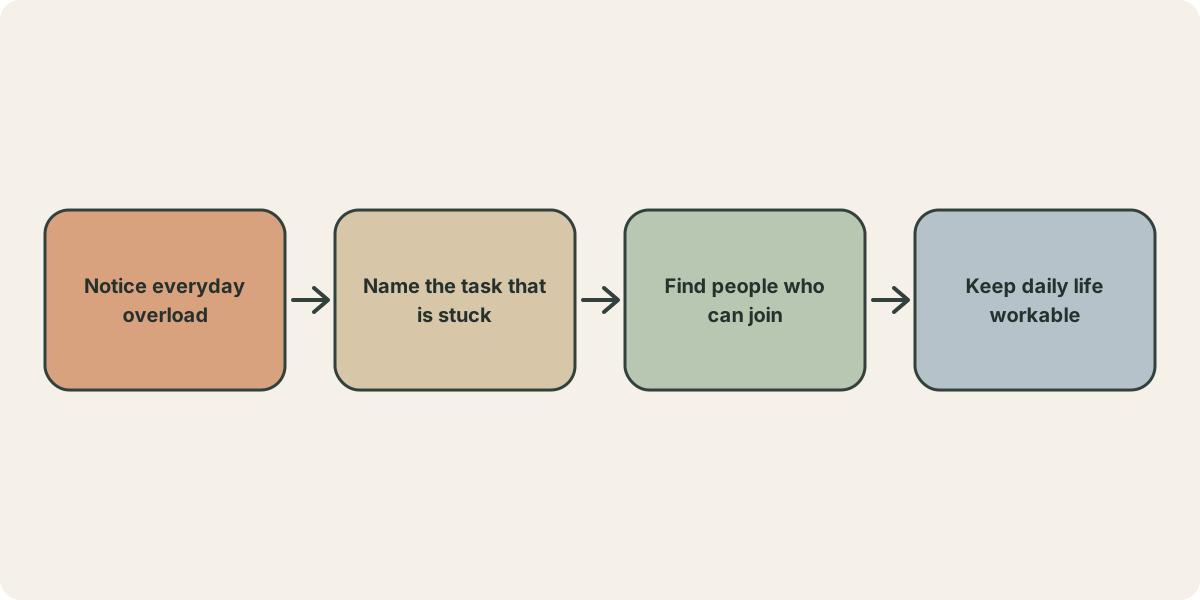
Put People Back in Place, and Bring Belongings Back Within a Manageable Range
Organizing cannot decide for a family who should make the sacrifice, nor can it directly repair every relationship. What it can do is let every activity of daily life find its place again: a place to eat can be used for eating; a hallway can be walked through; children have an area for books and toys; adults have space to rest and to store things. When belongings no longer occupy every surface, a family is also in a better position to talk clearly about who is responsible for what.
What sustainable living needs is not a flawless home, but a home that can be adjusted as members, ages, and needs change. Belongings will come in; people will also go through illness, growth, leaving, and moving. What truly matters is not keeping everything unchanged forever, but seeing that responsibility, space, and the right to decide no longer rest on the same person for a long stretch of time.
If a home has already grown so disordered that willpower alone can hardly restore it, there is no need to rush to ask who should be doing more. Begin with more concrete questions: Who is carrying a responsibility that is not theirs? Who has not been included in the allocation of space and time? Only when these two things are seen clearly can organizing become more than moving objects—it can let shared life find a sustainable order again.
Reallocation also does not mean slicing each person’s needs into unrelated compartments. Family life has always involved sharing and mutual yielding; the dining table, the hallway, and the living room all take on more than one kind of activity. The difference is whether this sharing is understood by everyone, and whether there is a chance to adjust it. When someone never has a chair, never has a place to sleep, or can only put personal belongings in a passageway, the harmony on the surface may only be the result of that person continually giving way.
Belongings here are like a mirror, reflecting a division of labor that has not yet been spoken aloud. What to keep, who may decide, when things need to be rearranged—there is no standard answer. But letting everyone take part in the discussion comes closer to a lasting way of doing things than leaving the person who can endure the most to absorb it in silence. Only after space becomes usable again does a family have the room to deal with the relationship issues that had long been hidden by clutter and urgent matters.
This is also why the conversations that take place in the course of organizing are worth keeping. Rather than rushing to fill a space with a new arrangement, first confirm whether it answers the actual needs of daily life. When an arrangement can be understood, used together, and adjusted again when needs change, the order of a home will not be only a brief stretch of tidiness.
Source: Liao Hsin-yun’s Facebook page (content compiled and adapted).