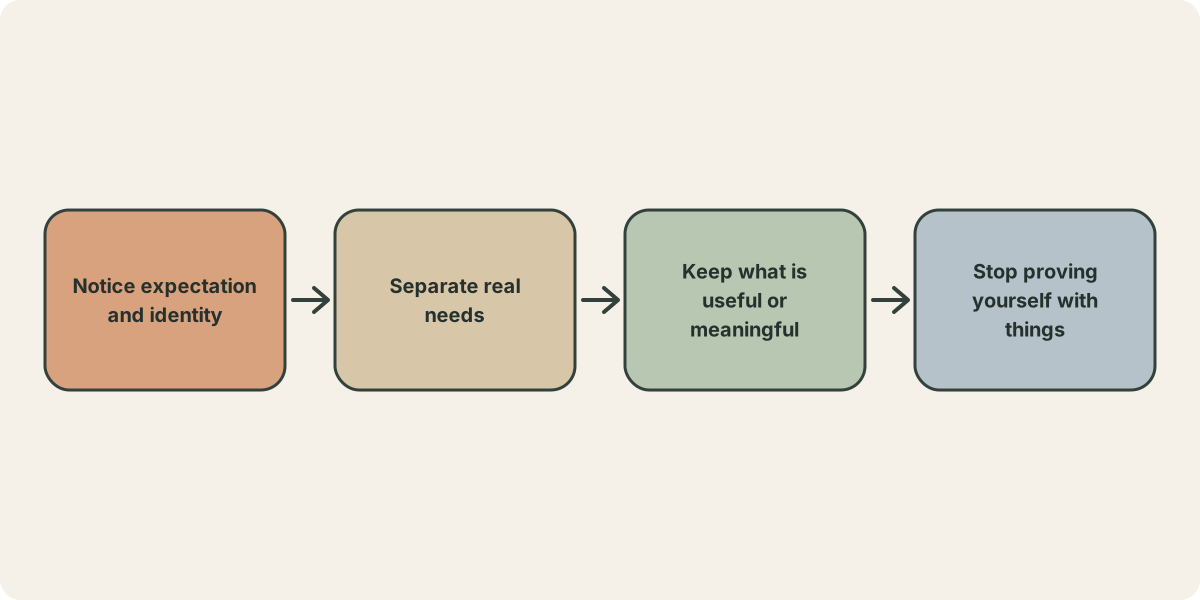
A forty-year-old mid-level manager spent several years collecting a full cabinet of luxury handbags. After the focus of her life changed, she looked back and said those bags had not truly increased her happiness. That remark need not be read as self-reproach after buying. It is closer to an honest note on use: belongings that once held her up had, by a certain point, already lost their original function.
Many belongings are more than objects. One may stand for a stretch of effort, a relationship someone does not want to lose, a self they hoped to become, or a childhood they hope their children will not have to repeat. When organizing reaches these things, saying “just throw them away” easily misses why they were brought home in the first place. What is truly worth asking is not whether a person bought rationally enough, but what need was placed on the belonging to speak for us—and whether, when life changes, we can care for that need in another way.
Belongings are sometimes self-proof the outside world can see
Reducing this kind of behavior to vanity does not help us understand it. People need to feel that they are good enough, recognized, and capable. When that confirmation is hard to obtain from life itself, they may look outward for evidence everyone can read. The brands and labels of luxury goods already carry a social language; a person need not explain much in order to project themselves as a certain image.
An interview in the source material mentions the term “social-evaluative threat”: the psychological pressure a person may bear when they fear negative evaluation, criticism, or rejection. At the time, this manager treated each bag as a reward for effort, and would also display them at social occasions to confirm her worth and ability. The physician interviewed observed that this kind of consumption can bring satisfaction quickly, temporarily soothe anxiety, and make a person feel safer at work and in social settings; it may not, however, address a more lasting unease in life.
This is not to say that everything attractive is suspect, or that people should not treat themselves. The problem is that if self-affirmation can be held up only by belongings others can see, that point of support is placed where one cannot fully control it. New standards, other people’s gazes, and the next comparison may all demand yet another piece of proof.
Once the setting changes, the original function may be left hanging
That manager later moved away from her original city because a family member fell ill, and her work became remote. In the past she often needed to meet clients, and clothing and accessories were part of work and social occasions; after she went remote, the chances to present herself to others each day dropped sharply. She said that except for a few specific social occasions, most of the bags simply sat in the cabinet, rarely used.
Belongings show a very practical side here: what they originally provided was not eternal value, but a role in a particular situation. After that situation is withdrawn, the object does not immediately lose its story, but its practical function grows unclear. This is also why organizing can sometimes feel like meeting oneself again. It is not that a person suddenly no longer needs beauty or affirmation, but that life no longer needs to be presented in the same way.
This case is one person’s change of life; it cannot be extended into a general rule about remote workers or luxury consumers. It suggests that the value of a belonging is not fixed in the price tag or the brand, but shifts with frequency of use, the role it plays in life, and the relational setting. When an object stops being used, that does not necessarily mean the past purchase was a mistake; more likely, the need of that time has already moved on to the next stage.
Different belongings may all be testifying to some kind of expectation
The way belongings speak for people does not appear only in a luxury cabinet. One father grew up with scarce material goods and had to share many things with his older siblings. After he became a parent, whenever one child clamored to buy a toy, he would buy the same for the other two as well, wanting every child to receive the same thing. Assembly toys at home accumulated to twenty or thirty boxes, some still unopened. For him, belongings may have been filling in a fairness he never received in childhood.
Another homeowner in her twenties treated her room as an extension of personal style. In-game spending accumulated to five or six hundred thousand, leaving her with almost no slack each month. Only when someone walked into the room and found almost no place to stand did she begin to re-examine her consumption. This is an individual case from the source material; the amount or living situation should not be treated as statistics about other young people. What it makes visible is that belongings and digital consumption alike can be used to hold up an imagined identity—and that this support becomes harder to ignore when it occupies too much space or too many resources.
What the three people wanted to prove was not the same: one wanted to prove she was worthy of affirmation, one that he could give his children fairness, one that her style existed. The common ground is not moral good or bad, but letting belongings furnish evidence for a description of the self. If we start only from “should this have been bought,” we may miss the anxiety, love, and expectation that actually need to be seen.
Keeping a memento is not the same as carrying a continuing burden
That belongings carry memory is not, in itself, a problem. The manager spent two days choosing: she kept the first designer bag of her life, and the first bag she bought from another brand; the rest she sold or donated. She did not deny that period of effort, nor empty out an entire life. She let a few objects keep the story, and let the rest leave the cabinet again.
When the interview turned to trophies, there was a thought worth pausing over: honor originally lives in the person; a trophy does not need to keep proving it. The same conversation also acknowledged that an old garment can let later generations know one once wore a certain size, and that that moment is real. The two statements are not in conflict. Keepsakes can help us remember, but they need not take on all the work of proving worth.
The key distinction may not be quantity, but for whom. If what is kept is so that one can remember, the object usually points to a concrete story, and the number is usually limited. If what is kept is so that others will continue to believe in oneself, it may need to keep increasing, updating, and being compared. The burden of the latter is not only money, but also space, attention, and whether family members must share the work of storage and upkeep.
Let worth return to people and relationships
When a person uses belongings to maintain a self-image, the hardest part is often not deciding whether to throw something away, but admitting that what needed care was something else: the need to be seen, an insistence on fairness, the anxiety of falling behind, or the wish to give a past self an answer. If these needs can be heard by family, friends, or community, belongings need not play the witness alone.
Sustainable living does not require everyone to live in extreme minimalism, nor does it treat every object with a story as waste. It is more like an invitation to put belongings back in a fitting place: what can still be used is used well, what truly matters is kept in small number, and what no longer serves life has a chance to change hands, be donated, or leave. Doing this is not a denial of the past. It is an admission that past effort does not have to remain piled at home in order to count.
Do not turn organizing into another form of self-denial
When dealing with symbolic belongings, what most needs to be avoided may be blaming oneself by another set of standards. Some people feel ashamed because they once bought so much; others worry that sending things away is like denying past effort or love for family. These feelings do not disappear because of a single phrase like “declutter.” If organizing is treated as a moral exam, people are more likely to hide belongings and postpone facing emotions that have not yet been named.
The cases in the source material offer a gentler direction: one need not choose between a full cabinet of belongings and a complete emptying-out. One can first pick out the few objects that best tell the story, and confirm whether they can still actually be seen, used, or cherished. If the remaining belongings no longer carry the original need, letting them leave is not a denial of that period of life; it is a way of letting memory no longer depend on keeping things in bulk.
This kind of choosing also involves family relationships. When one person’s self-proof occupies shared space, others may take on the costs of cleaning, storage, and not being able to find things. Conversely, if family members only urge discarding, they may also run into a life experience that has not yet been understood. Replacing “Why do you keep so much?” with “What did these things once do for you?” may not immediately change the quantity, but it can make a conversation possible.
The next time you face a belonging you cannot bear to deal with, perhaps ask first: is what I want to keep the object itself, or the self it once proved for me? If the answer is the latter, can we find a way to be understood by ourselves and others that no longer depends on adding more belongings?
Source: Liao Hsin-yun’s Facebook page (content compiled and adapted).