This article draws on two questions put to a professional organizer during a conversation. They are individual cases, not long-term statistics or general conclusions.
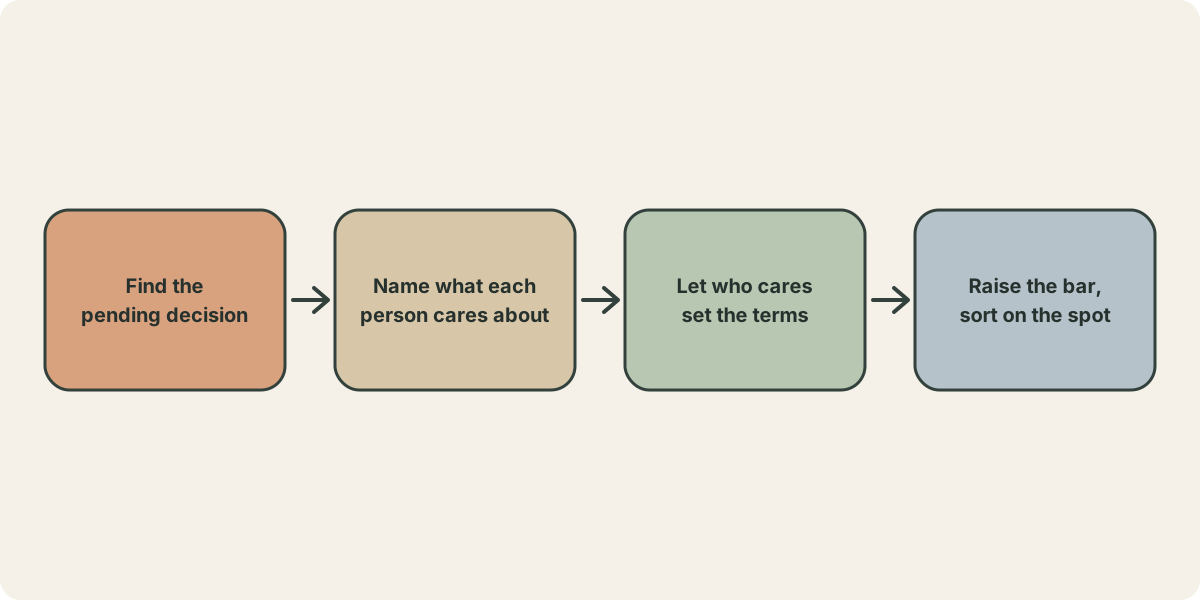
Storage disputes at home are rarely about the objects themselves. One person finds something convenient, the other finds it an eyesore, and both have a point, so the matter gets stuck on “who is right”. During one conversation, a professional organizer was asked two questions: one about a storage disagreement between family members, the other about a bag of documents that had gone unaddressed for a long time. The two questions look unrelated, but the approach to both starts from the same place: break the stuck situation down into decisions that can actually be made.
A disagreement over a cup
The person asking drinks protein powder every day. The shaker bottle gets used daily, so they simply left it beside the water dispenser, since that was the most convenient spot. Their partner disagreed: the cup is ugly, and leaving it on the countertop makes it one giant piece of clutter. They wanted it put back in the cup drawer. The person asking felt that taking it out and putting it away every day was a real hassle.
This kind of disagreement easily turns into a choice between two options: leave it out, or put it away. As long as the frame is a choice between two options, one side has to give in, and the person who gives in usually resents it, so before long there is another argument about something else.
Let the person who cares do the choosing
The organizer’s suggestion was simple. If the cup is too ugly, ask the person who cares about appearances to pick a shaker bottle they think looks good on the countertop, so the person who uses it daily can keep it beside the water dispenser without any guilt. If changing the cup does not solve it, find a box the partner finds attractive and put the cup inside, so that all anyone sees in passing is a good-looking box.
Neither approach decides who is right. They restate the problem as: the convenient location can stay, and the conditions for appearance are decided by the person who cares about appearance. One person wants convenience, the other wants something pleasant to look at, and both needs are built into the answer, so the two of them reach agreement on where the object belongs.
A bag of to-dos that kept getting heavier
The second question was about a kraft paper bag. The person asking had stuffed every to-do document and item they considered important into it and carried it abroad, thinking they would sort it out when they had time. They had since returned to Taiwan and the bag was still sitting there untouched. Every time they saw it, it reminded them that they ought to sort it out, and every time they skipped it again.
The organizer’s assessment: the standard for “important” was set too low, so a huge number of things all looked important. Important and unimportant items were bundled into one package that kept growing, until it became a great deal of pressure. The bag itself became a signal, hinting each time it was seen that something was still unfinished, that something still needed checking.
Raise the threshold and the pressure comes down
The approach is to sort things into two categories on the spot: the most important, and the merely fine. Only the most important deserve a place in the bag; everything less important gets dealt with quickly. The effect shows up immediately: the nagging pressure eases right away, and the bag stops delivering a reminder every time it is seen.
The limits of this method should be stated clearly too: the sorting has to happen on the spot. Put it off, and the bag will only keep growing. The “merely fine” category also has to be genuinely dealt with quickly, not moved into another bag to keep accumulating.
What the two questions have in common
The argument over the cup and the pressure from the paper bag both look, on the surface, like objects in the wrong place. The organizer’s conclusion: what is stuck is not the objects. The surface looks like mess, but underneath are emotions and relationships that have gone unaddressed. Every act of organizing is an act of deciding.
For storage disagreements between family members, “who decides which condition” can replace “who is right and who is wrong”; for a personal pile of to-dos, a higher threshold can replace “everything is important”. Both approaches reduce the number of things that have to be faced all over again.
One line to take away
When storage gets stuck, first ask which decision here has gone unmade, then ask who should make it.
Source: Liao Hsin-yun’s Facebook page (content compiled and adapted)