An elder of about seventy lived in a room of about four ping. Only while organizing did they discover they had fifty umbrellas. The umbrellas had been scattered behind the door, in cabinets, in bags, and beside the bed; looked at one by one, each seemed to have a reason to stay. Only when they were all gathered and laid out did the total become visible for the first time.
This figure comes from a single organizing case and cannot be used to measure other people’s habits with belongings. Still, many people have a similar experience: after living somewhere for a long time, they routinely detour around a particular corner, and they know a certain drawer will not open, yet they rarely stop to ask whether this has already begun to affect daily life. It is not that we do not care. People gradually adapt to the environment they see every day, and changes that ought to have drawn attention may slowly become background.
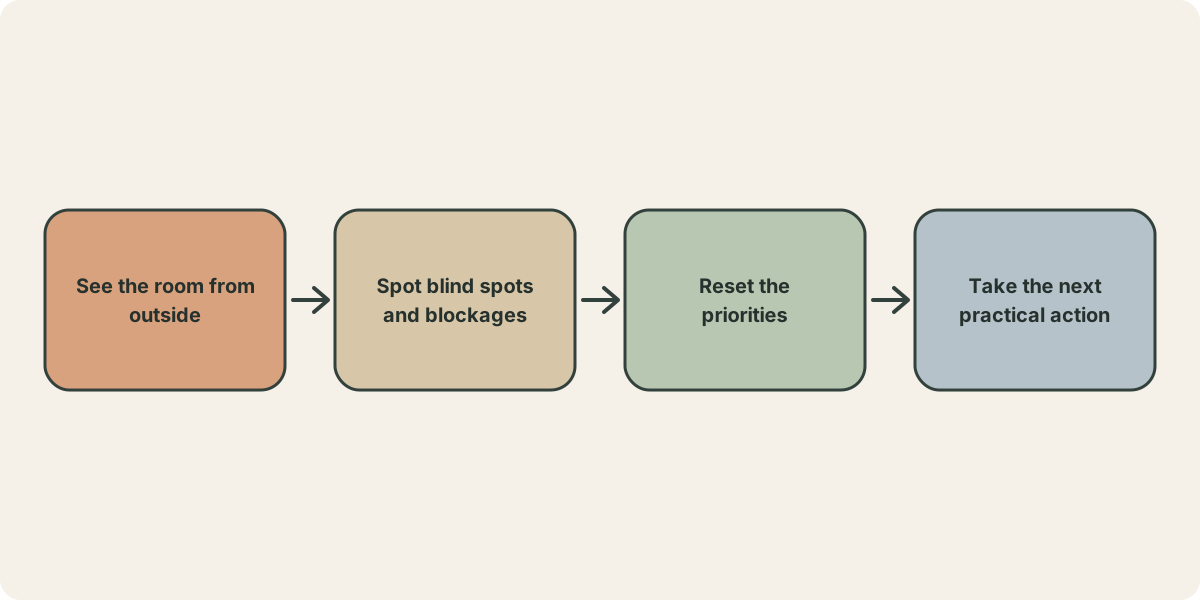
Before reorganizing, there may be no need to rush into deciding what to keep or pass on. Let the present situation be seen first; only then does judgment have a reliable starting point.
Familiarity can make change hard to notice
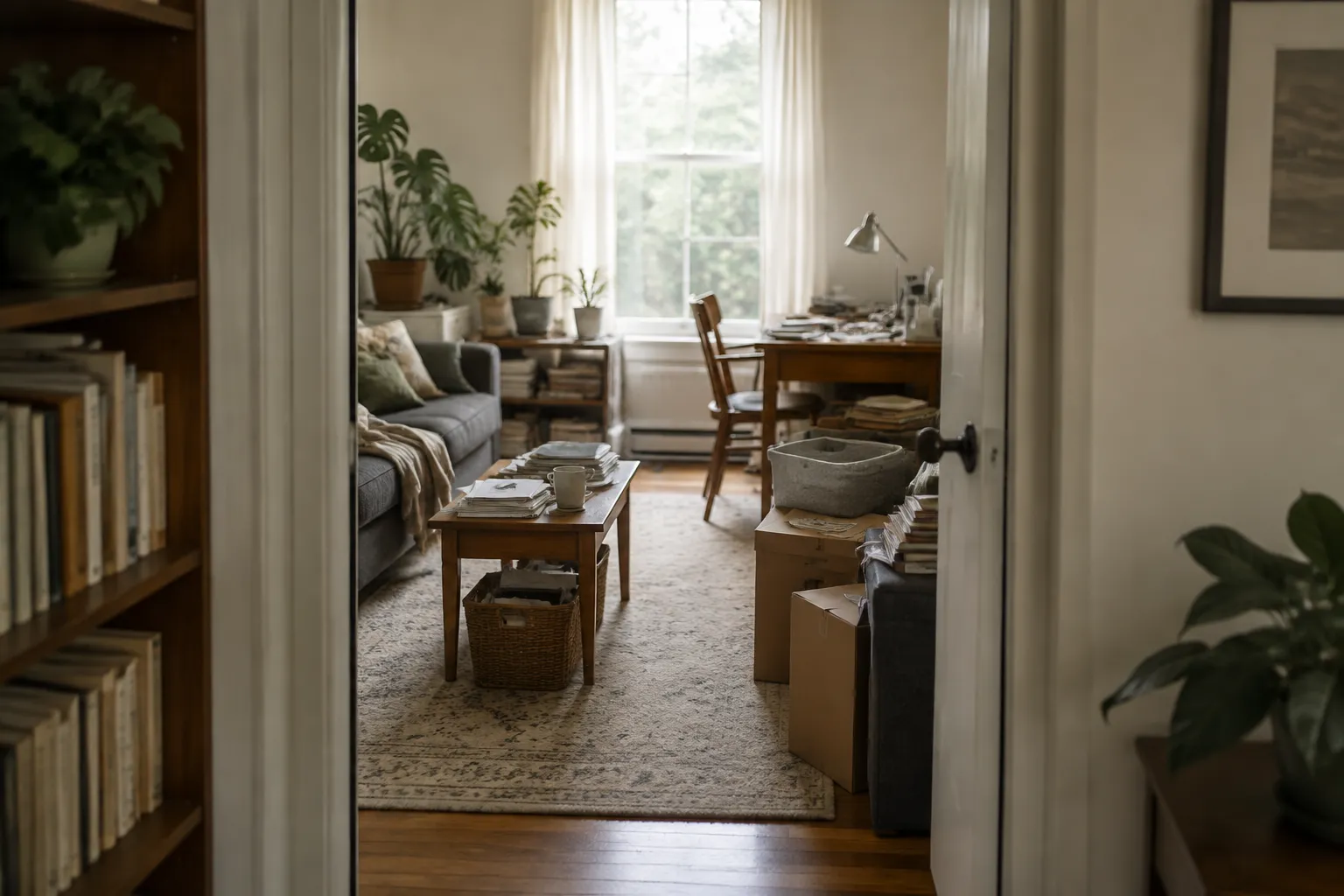
When clutter increases only a little each day, memory updates with it. Compare today with yesterday, and the difference is small; compare tomorrow with today, and it is still small. Over a longer stretch of time, floor space that was once walkable, a tabletop that was once usable, or a place where people could sit down to eat may have shrunk a great deal, yet the people living there still feel that “it has always been this way.”
In one household from the source, six adults had only four chairs for years. During Lunar New Year, someone had to eat standing up, yet the family at first did not find it especially inconvenient. Another person, who grew up in a home that also served as a traditional factory, said that having seen it from childhood on, it simply felt natural. These are not cases of anyone being especially unobservant. When an environment stays the same for a long time, the baseline for judgment is quietly rewritten by everyday experience.
For that reason, organizing should not reduce responsibility to “How did you not notice?” More helpful questions are: Which places used to be usable and no longer are? Which tasks have begun to take extra effort to complete? When daily life has to proceed by turning sideways, stepping over things, and moving objects again and again, the space is sending a signal.
A pair of new eyes brings not judgment, but a baseline for comparison
Someone coming in from outside can sometimes quickly see what the people living there have grown used to. A new member of the family was shocked the first time she saw the scene of six people and four chairs, because she remembered that in the home where she grew up, everyone could sit at the dining table. What she brought was not a comparison of whose home was better, but a baseline that everyday life had not yet adjusted.
This external perspective may come from relatives, friends, neighbors, or a professional helper, provided the other person can remain respectful. If the response is only to criticize the mess, it easily produces shame and defensiveness, which makes the problem even harder to face. A better invitation is to ask someone you trust to help point things out: “Where do you think this place is hardest to use?” That keeps the conversation on circulation, lighting, cleaning, and everyday needs, rather than examining a person’s taste or ability.
The value of an outside pair of eyes is that they offer a new angle of observation, not that they make every decision for the household. The people who live there still know best the history and needs behind each object, and they should retain the right to decide what stays and what goes.
Photographs can keep the obstacles we walk around in the frame
If you would rather not invite someone into the home, photographs are an easy place to start. In the source, someone who had grown up in crowded surroundings took pictures of the present state of the house and only then said that there was almost nowhere left to walk. In daily life at home, the body naturally remembers where to step over and where to turn sideways, and after going around the obstacles one can still reach the destination. A photograph, however, keeps every object that was walked around in the same frame.
The photographs do not need to look attractive. In daylight, take one shot each from the doorway, a hallway, the dining table, or the bedside, keeping the original viewpoint and without moving things first. Look again a few days later, or ask someone you trust only to describe the circulation and empty space they see. This is not for public sharing, and the photos do not need to be given to anyone. It is a chance to step back from a familiar space.
If a photograph would include a family member’s private belongings, shoot only a portion or avoid identifiable information. The point of observation is how objects occupy tabletops, floors, and doorways, not to collect anyone’s personal details. Setting the scope clearly also makes it easier for family members to take part.
Another approach is to mark activities. Over the course of a day, note where you look for things, where you move objects, and where piles make cleaning impossible. Recurring pinch points are often more specific than “the house is a mess,” and they make it easier to find a suitable order of improvement.
Only when like items are gathered does the total appear
An external perspective can also be created for oneself. One of the most practical methods is a gathered inventory. Choose one category of items, take them out of different rooms, bags, and drawers, and place them on a single surface. Food-storage containers, reusable bags, spare supplies, umbrellas, or charging cables are all suitable for a first exercise.
In the source case, after the elder’s room was cleared, the contents were counted by bags: four bags of coats, three bags of trousers, three bags of handbags, six bags of bedding, and six bags of miscellaneous items. These numbers record only the situation of that case at that time; they are not an ideal quantity to own. Their meaning is that items once scattered finally appeared in a single field of view, so the person involved could judge by what they actually had, rather than by unease or memory.
A gathered inventory can also ease the anxiety of “Will I not have enough after I deal with this?” When someone sees that they have four bags of coats, it becomes easier to think calmly about which still fit and work, which can be repaired, and which can be passed on, rather than worrying, in front of each piece, about a future shortage.
Only after seeing does it become time to choose where things go
The purpose of an inventory is not to turn every object into a number, nor to demand an immediate empty-out. First separate what is in use, what is temporarily uncertain, and what can be passed on or recycled, and give each category a clear place. If something has commemorative meaning, a small number can also be set aside to keep, with its story recorded. What truly matters is that what stays has a chance to be used and cared for, and that unused items no longer have to remain trapped in unseen corners.
If facing the whole home at once feels like too much, it is enough to finish one drawer or one category of items first. A small-scale inventory can build a sense of total quantity, and it is easier to confirm which methods actually fit one’s own daily rhythm, rather than chasing someone else’s standard of neatness.
After organizing, one homeowner looked out from a cleared balcony for the first time and said in surprise that this was what the view had been. That is not a result every organizing effort will produce, nor a standard that must be reached. It is only a reminder that change in a space often begins after it has been seen.
The next time the home merely feels “a bit crowded,” start by choosing one corner, one kind of item, or one photograph, and create a new point of observation for yourself. Seeing the present situation is not for blaming the past. It is so that living, using, and the flow of belongings going forward can have more choices.
Source: Liao Hsin-yun’s Facebook page (content compiled and adapted)