After a loved one dies, the clothes, letters, manuscripts, tools, and furniture left at home can easily put family members on opposite sides. One side feels that handling things too quickly looks unfeeling; the other feels that keeping everything will make it impossible for the household to go on living. What began as a conversation about remaining belongings becomes a contest over who is more filial and who is more cold.
Such judgments often come too soon. People already keep different timelines in the face of loss, and they may be ready for the same object to very different degrees. Cases from organizing visits show that some people clear things decisively because their caregiving responsibility has already run its course; others keep many things because each object is still attached to a memory they have not yet been able to set down. These cases reflect only the experience of each family and cannot stand in for all bereaved people, but they are enough to remind us that speed cannot be read as the depth of feeling.
Organizing remaining belongings is not a question with only right and wrong answers. It is more like shared work that needs coordination of time, space, and the responsibility of keeping things. Give slower people a place to pause, and spare faster people from carrying the pressure of living space alone, and a family will be less likely to turn grief into a new kind of harm.
The same home often holds more than one clock of mourning
After their parents died, two sisters had to face a space that had long been used both for teaching and for daily life. Manuscripts, lecture notes, slides, and everyday items were all still in place. The older sister remembered many stories and could not bear to part with teaching materials, notes, musical instruments, and childhood dance costumes; the younger sister tended to keep only what could be used now, and had once disposed of an architectural model she had completed as a student in order to free space for their father’s papers.
From the outside, the difference looks like nostalgia versus decisiveness. That binary, however, hardly explains the whole. The younger sister pressed for organizing because the older sister lived there yet had less and less room of her own. What she cared about was not wiping away traces their parents had left, but making it possible for the sister who was still alive to live well. The older sister’s wish to keep things was not necessarily a refusal to move forward; in her own time, some goodbyes were not yet finished.
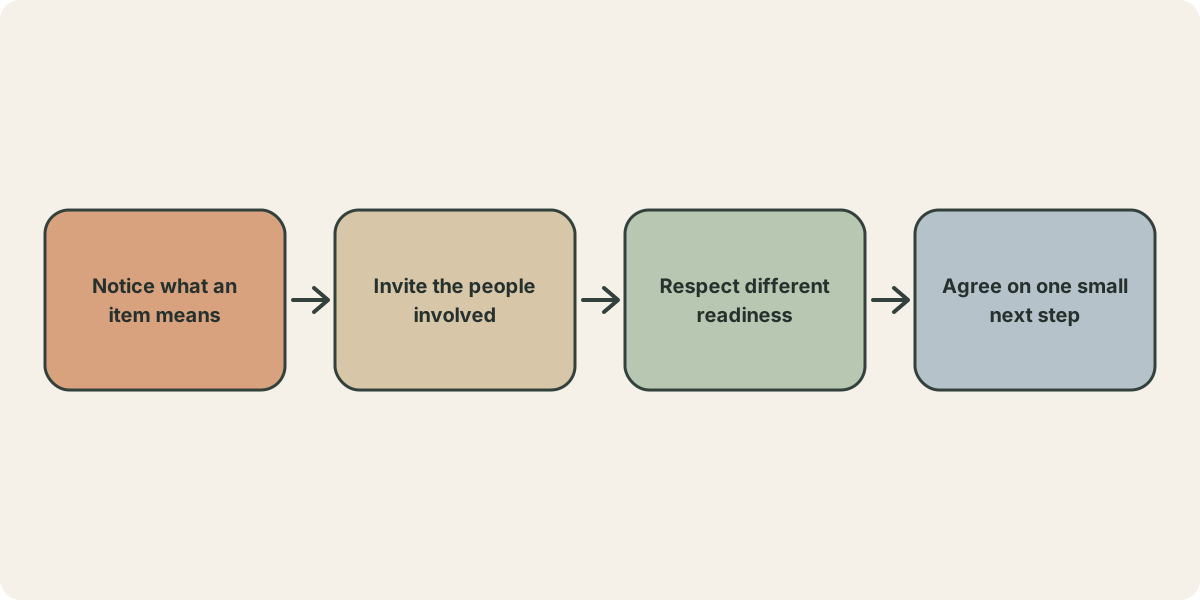
Admitting that the clocks are different does not require forcing everyone to agree on the same emotional answer. Family members can first make clear which items are too hard to touch right now, and which items, if left unaddressed, already affect passage, cleaning, or living. Separate feelings from practical need, and the conversation will no longer collapse into “How could you throw that away?” and “When are you finally going to throw it away?”
Someone who clears quickly may still be carrying a deep loss
A fast pace of organizing does not mean there is no attachment in the heart. When the younger sister mentioned above was planning the rooms, she hesitated over whether a bookshelf their father had nailed together himself would press on her sister’s living space. The moment the bookshelf was carried out, she felt as if she were truly saying goodbye to memory. That she could make arrangements quickly does not mean those arrangements had no weight.
In another case, the youngest daughter in a family had spent years caring for her elderly mother, handling rehabilitation, nursing care, and daily living. After her mother died, she went through medical treatment herself, and only after her strength had somewhat returned did she ask someone to help organize. Two rounds of organizing cleared out more than one hundred twenty bags of items, with large items taken away by a hauling truck. She decided quickly, but that was because her caregiving responsibility had already been carried as far as she could take it, and because she needed to make space again for her own body and for the life ahead.
This is one person’s experience and should not be turned into a formula that “those who have given care will be able to let go.” What it truly reminds us is not to infer feeling from the speed of handling things. A person can sort quickly and still be missing someone; a person can keep many items and still not know how to return to daily life. Treating speed as a moral score only makes it harder for people to say what they need.
Different objects, different degrees of readiness
The same person may also have different boundaries with different objects. One homeowner who had just ended a marriage could handle items left by a former partner, work mementos, and wedding photos, yet could not open her child’s drawer. She had already gone through one round of organizing on her own; after seeing the child’s schoolbag and toys, she closed the drawer again and decided to face it when she had help.
This experience is not, strictly speaking, the organizing of belongings left after a death, but it illustrates something important: not every item has to be handled on the same day, by the same standard. Dividing things into “can decide now,” “needs a shared decision,” and “not ready yet” can turn organizing from a one-time exam into a process a person can bear.
Setting things aside for now is not the same as letting piles take over. A pending zone needs a boundary, containers, and a date to look again—for example, gathering items first into several boxes marked with a date, to be opened again by the same family members in three months or six months. This is not a way of forcing people to forget; it is a way of keeping every hesitation from scattering through the rooms until even the things one truly wants to keep can no longer be found.
When looking again, start with questions that are easier to answer: Is this item something you hope to keep using, something that holds a memory, or something you are not yet ready to decide on? Different answers need not lead at once to the same treatment. What can still be used can return to a clear place; what one wants to keep as a memento can be represented by a small number of pieces, with their origin recorded; what cannot yet be touched stays within the range agreed on earlier. This kind of sorting is not meant to turn grief into a procedure; it is meant to keep grief from having to fill every space in order to have somewhere to stay.
Families can also avoid handling the hardest items at the moment when emotion is strongest. Photographs, handwritten notes, memorial clothing, and private papers often need more shared confirmation than ordinary household goods. Starting with duplicate containers, clearly damaged items, and unused everyday things can open some usable space in a room, and can also show the family that organizing is not the same as saying goodbye at once. After each small stretch is finished, people can pause to check whether they can still continue, rather than pushing grief until it runs out of control before they stop.
Memory needs a place, and so does life now
There is nothing wrong with mourning slowly, but when objects occupy space for a long time, the cost often falls on those who are still living. That older sister later moved into her parents’ master bedroom. The wardrobe still held her father’s clothes; teaching materials and manuscripts remained on the desk; her mother’s calligraphy copybooks, sewing tools, and newspaper clippings were scattered throughout. Her own belongings were instead squeezed into the living room, hallways, and other rooms; if anyone came to visit, she often had to spend extra days organizing in advance.
This is not to treat memory as a nuisance, but to recognize that space arranges how people live. When the past fills every corner, sleep, rest, receiving friends, and walking safely are all squeezed. Organizing remaining belongings is therefore not only about what stays and what goes; it also concerns whether those who are alive still have rooms they can use.
For a family, this is also a shared arrangement of resources. Desks, bedside space, hallways, and storage are limited; if all of it is given over to unfinished decisions, other family members often have to thread their way through cramped space, or buy still more containers and move the problem elsewhere. First confirming the functions needed for life now does not erase the person who has left; on the contrary, it lets the family, in a more stable daily life, slowly decide how they will remember that person. A home where people can rest, walk, and invite relatives and friends in is also more able to hold the moments when memories are spoken of.
Family members can first secure the basic functions of shared areas and of those who live there—for example, hallways, the bedside, the dining table, and essential storage. More commemorative items can then be gathered into one clear zone, reducing the chance that they scatter into every scene of daily life. Keeping a small number of objects that can tell a story is not a lack of respect for the person who has died; it may instead make those stories easier to see and to pass on.
Some families worry that once organizing begins, there is no going back. In fact, gathering first, recording first, and first marking out a temporary holding area all leave room to think again. What is truly hard to recover is often the conversation itself, once family members have spent so long blaming one another that they no longer talk. Rather than racing to prove who is more right, holding on to a relationship in which people can still consult together is what better protects what each person wants to keep.
Give disagreement a place to rest, rather than letting it keep spreading
What organizing remaining belongings most often needs is not a better argument, but an arrangement everyone can keep. Family members can list together the items that must not be touched, the items that need a shared decision, and the items that can first be gathered and sealed; then they can confirm who will be responsible for keeping them, where they will be kept, and when the next step will be discussed. The list does not need to be perfect, but it should let everyone know they have been heard, and that the responsibility will not rest indefinitely on the same person.
If emotions among family members are already very taut, it is all right to pause a large-scale organizing session. First complete the organizing of safety and basic living areas, then keep items that need time within a range that can still be tracked. When needed, ask a trusted relative or friend, or a suitable professional supporter, to be present and help everyone speak more specifically.
We cannot set for one another when it will be time to say goodbye, but we can decide together how memory need not prove itself by filling the rooms. When a family is willing to write different speeds into the timetable, remaining belongings are no longer only a fuse for conflict; they can also become the beginning of practicing care for one another.
Source: Liao Hsin-yun’s Facebook page (content compiled and adapted).