In some homes, the living room, a storage area, or a room kept closed for a long time looks as if time left it behind. Dust gathers on tabletops; chairs sit buried behind belongings; places once used for meals or for walking gradually lose their function. Onlookers are quick to ask: Why hasn’t anyone organized this? But before talking about methods, there may be a more fundamental question: Who is allowed to decide whether these things can be moved?
Organizing is not purely physical labor. Every time you shift an object, you may run into ownership, memory, family roles, and rules no one dares to name out loud. If a person has not been allowed to decide, even time, tools, and willingness are rarely enough to make a real start.
When Space Stands Still, the Rules Are Often Still at Work
In a source case, it was only after an important elder had passed away that someone said they could finally organize. That remark should not be reduced to criticism of anyone; it reminds us that a household may already have many unwritten no-go zones: a certain cabinet must not be touched, a certain table must not be moved, a certain room must not be entered. Over time, family members walk around those places, and may even stop noticing that they are still following the rules.
Even when the person who once made the calls is gone, the rules do not necessarily disappear at once. The body still remembers to take a detour; the relationships still remember not to touch. And so the space stays as it was. This kind of standstill does not always come from laziness, nor does it mean that no one cares. Sometimes no one has received a clear signal that it is now all right to talk about it again.
When Decision-Making Authority Is Unclear, Effort Easily Turns Into Rework
Another common situation: someone spends time sorting, clearing a pathway, or moving furniture, only for other family members to put things back where they were. There is no need to rush to blame anyone for not cooperating. If the household has never agreed which areas can be adjusted, which items should be left alone for now, and whose consent actually counts, it is easy for finished work to return to how it was.
This back-and-forth frustrates the person willing to take action, and makes others more anxious about being left out of decisions. Objects become the most visible carrier of tension in the relationship. It may look like a fight over a table or a cabinet; it may actually be a fight over whose life counts in this household.
Map What Can Be Moved First, Rather Than Demanding Total Change
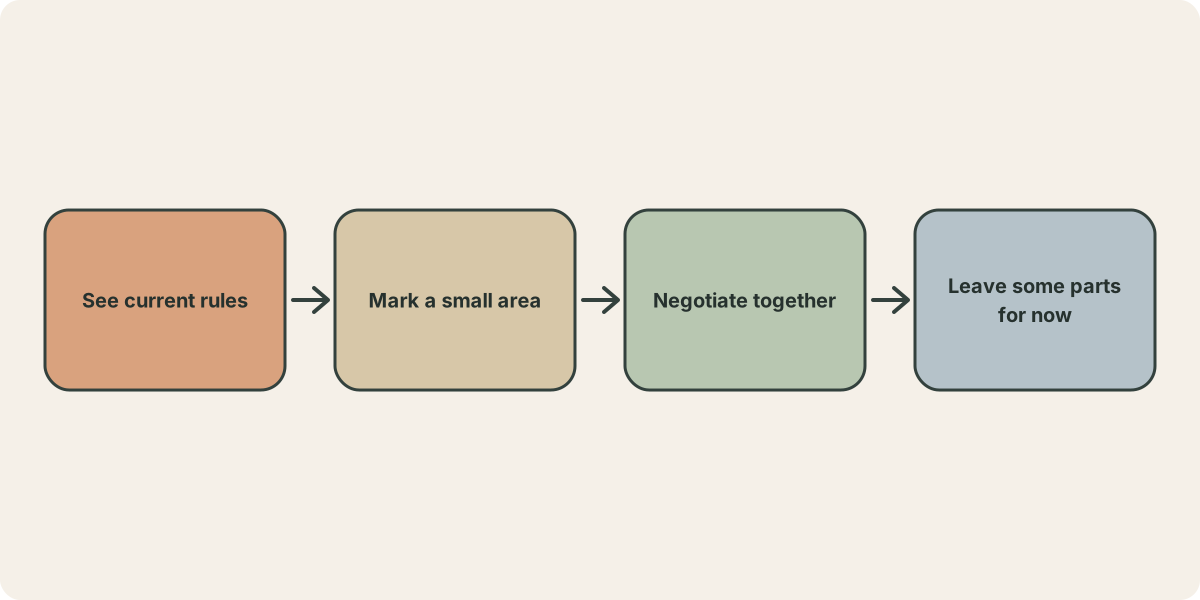
When a space has accumulated over a long time, proposing that “the whole house has to be organized” is often too large, and easily makes people feel they are about to lose control. A more workable starting point is to shrink the scope and make it concrete: this week, only one corner of the dining table; who looks through this box first; this walkway needs to stay clear; which things can be set aside for now, to be discussed when everyone is ready.
The clearer the scope, the easier it is for people to tell what they are agreeing to. This does not guarantee consensus every time, but it can turn a vague conflict into items that can be discussed. If someone is not present, you can still confirm how far they are willing to authorize, rather than leaving every decision on hold indefinitely.
A small-scale change does not mean a small goal. It lets the household first accumulate one experience: that when things are moved with everyone knowing, the space does not spiral out of control, and the relationship does not have to be held together by silence. That experience lays a foundation for the next round of negotiation.
Leaving Some Things Untouched Is Also a Form of Honesty
Some items carry deep memories; some family members are not ready yet; some issues need more time or outside support. Sustainable living is not about hurrying every object out as quickly as possible. It is about making limited household resources stably usable. If every item is treated as a problem that must be dealt with at once, the conversation loses its sense of safety.
You can start by listing clearly what will not be moved for now, and agreeing when to come back to it. This is not letting things slide; it is acknowledging that family members face change at different speeds. When what is being kept for the time being has a visible place, it becomes easier to deal first with the truly urgent issues of safety, circulation, or everyday use.
Let Organizing Become a Negotiation of Shared Life
A home is not only a container for belongings; it is also where several people’s lives meet. To make a space usable again, storage techniques are not enough. What is also needed is an everyday capacity to negotiate: who is using the space, who is responsible for keeping it up, who needs to be asked, and which decisions can be tried together.
The next time you see a corner that has not changed in a long time, perhaps there is no need to ask at once, “Why hasn’t this been organized yet?” You might first ask: Who can make decisions here right now? If we want to adjust something, what is the smallest workable step? When people know they will not be stepped over without warning, they are more likely to be willing to let objects and space start flowing again, together.
Source: Liao Hsin-yun’s Facebook page (content compiled and adapted)