Caregiving is often spoken of as a form of love, and often expected as a responsibility that will arise on its own. But when one person must keep giving up time for work, rest, medical care, and private life to fill another person’s daily needs, this responsibility is more than giving within a relationship; it is also a pattern of resource allocation that needs to be seen.
Many caregivers will not say directly, “I am put last.” More often they say it is all right, they can hold on a little longer, or they will take care of themselves once this stretch is over. Time, however, does not increase because of those words, and the body does not pause its signals because of a sense of duty. From several families at organizing visits, one can see that caregivers being placed behind others is not necessarily because family members do not care. Once caregiving arrangements lack a backup, space, and boundaries, this outcome easily becomes the everyday default.
These cases are the experiences of particular families at particular moments. They cannot represent all caregiving relationships, nor can they be used to determine the cause of any illness. What they can do is help us ask more specifically who has been carrying the load all along.
When caregiving fills the schedule, one’s own needs have no place
A homeowner approaching fifty was the youngest child in her family. After her older siblings married and moved out one after another, her mother’s medical care, daily living, and housework fell mostly on her. After her mother had a stroke and entered rehabilitation, the original caregiving arrangement broke down. She left her job and became a full-time caregiver. During that period, she herself went through two miscarriages, and her body had not fully recovered.
Looking back on those days, she said she had almost no life of her own. Only after her mother died in her nineties did it become her turn to go to the hospital for tests; she later received cancer treatment. This sequence of time makes one thing clear: her health needs were placed after her caregiving responsibilities. How the illness formed should still be judged by medical professionals. It cannot be reduced to a consequence of sacrifice, still less written as any kind of moral retribution.
What is worth noting is that caregivers have not necessarily chosen this ranking. When there is no one to hand the work over to, when every day is chopped up by follow-up visits, meal preparation, communication, and emergencies, “putting myself first” may not be an option that can actually be carried out. To treat this as an individual not knowing how to care for herself only covers over a gap that should have been addressed together.
Overload does not always look like fatigue
Another homeowner lived with her mother, who had bipolar disorder, for thirteen years. She noticed that how often she lost her temper with her mother went from once a month to once a week, and later even several times a day. She did not first understand this as overload; instead she blamed herself for not being tolerant enough, believing that because they were family, she ought to do better.
But growing difficulty controlling one’s emotions does not necessarily mean a person is worse. It may also be a signal that the current caregiving arrangement has already exceeded what one person can sustain over the long term. The collaborating psychologist in the source regarded this as overload, not mere tiredness. This judgment cannot replace a formal assessment, but it reminds us that a caregiver’s stress often begins with irritability, insomnia, difficulty making decisions, or losing patience over small things—not only after the person clearly asks for help.
If every signal is read as “you should be more patient,” the caregiver receives more self-demand and no more rest. The person being cared for also bears the effects of a strained relationship. Treating overload as a signal that something needs to be adjusted is a more responsible view for both sides.
A person’s place in the house tells the ranking
Whether a caregiver is put last can also be seen in living space. A father of three personally supervised the building of a four-story house. There were plenty of rooms, yet he settled himself in a cramped dressing room. He said the children needed the space more, and that sleeping as if in a cave was all right. Almost the entire house was arranged around the children’s needs; he alone had no place where he could truly rest.
Another elder, seventy years old, had originally purchased the house herself. To accommodate the needs of younger relatives living with her, she gradually retreated to a room of about four ping. Cabinets blocked the doorway, so she had to turn sideways to go in and out. The range she could still control was already small, yet she was still urged to hurry up and organize. These two families were not both long-term caregiving households, yet they share a similar mechanism: one person’s needs for sleep, quiet, and storage can be treated as the easiest to sacrifice.
Space is not simply a matter of ping. Who has a place where they can close the door and rest, whose things can stay, who always has to shrink their belongings into a corner—these are the physical traces left by a family’s ranking. Improving the quality of living is not only a matter of putting clutter away. It is also a matter of asking again: does this home keep a basic place for every member?
Organizing can reduce the load; it cannot replace support
In a caregiving relationship, organizing can indeed do some important things. It can clear walking paths and lower the risks created by piled-up items. It can gather frequently used things in one place and reduce the time spent searching every day. It can also clear a table, or space beside a bed, so the caregiver has a place at home to catch their breath for a while. These changes look small, yet they may spare daily life a great deal of extra drain.
Environmental improvement, however, is not a stand-in for caregiving support. It cannot fill in a caregiving roster that has long had no rotation. It cannot handle medical decisions, relationship conflict, or ongoing emotional distress. If every problem is handed over to organizing, as if caregiving pressure would vanish once the house is clean, what actually happens is that a responsibility that needed to be faced together is pushed back onto one person again.
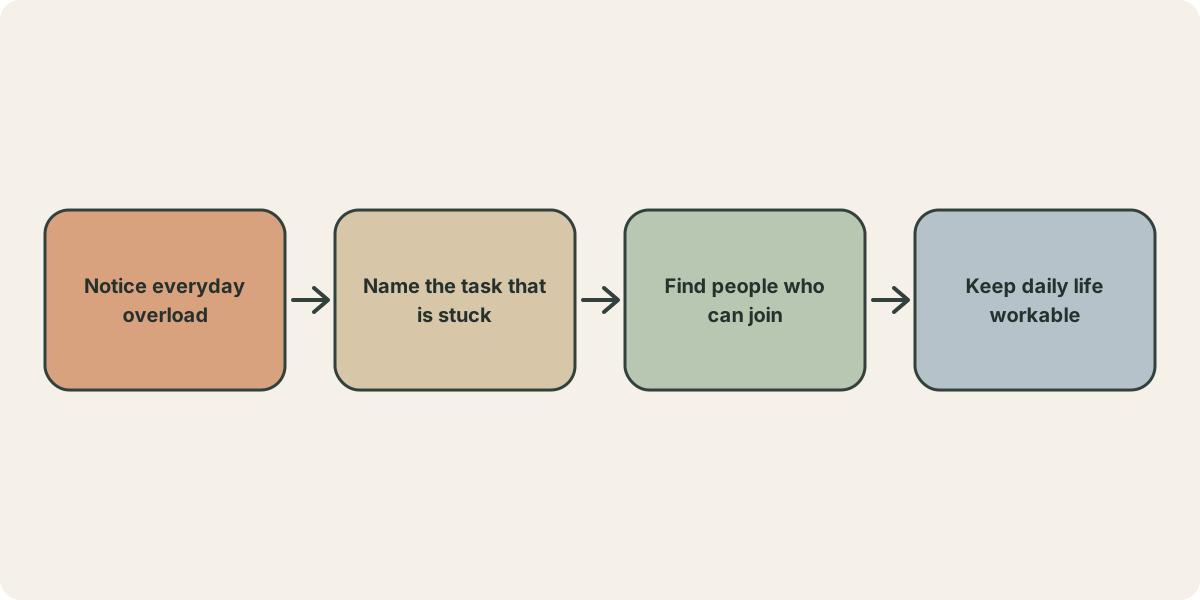
So the most important question when organizing may not be “what should be thrown away,” but “who can share the load.” Family members can start with a clear division of labor—for example, taking over a fixed stretch of time, jointly handling shopping and contacts, or first giving the caregiver a period of uninterrupted rest. These arrangements need not be complete all at once, but the caregiver’s needs must be formally put on the list.
Let caregiving last without exhausting one person
Sustainable living is not only about how things can be used longer; it is also about how people are not worn down by day-after-day responsibility. A household that can be maintained only by a single caregiver continually compressing themselves is hard to keep truly stable. When that person falls ill, leaves, or can no longer bear the load, the problems that were never addressed surface all at once.
A caregiver is not the last stop in a resource system. They, too, are a person who needs sleep, medical care, companionship, and private space. Rearranging the flow of the home, reducing unnecessary items, and making responsibilities clear cannot solve every difficulty, but they can keep “I’ll hold on for now” from being the only option.
To measure whether a family has support, one need not look only at how much the caregiver has done. One can also look at whether they can, one day, leave for a few hours with peace of mind; whether they can see a doctor when they need to; whether they have a corner they do not have to give up at any moment. Putting the caregiver back on the list of those who are cared for is the beginning of making life last.
Such change need not wait for a crisis. A family can first take stock of the times of day most easily interrupted, and of the tasks that only one person knows how to do. Writing down clearly where frequently used items are kept, letting others learn to take over simple household tasks, or setting aside a fixed period for the caregiver to rest—these are all ways of building the ability to hand things over. These practices will not erase the hardship of caregiving, but they can keep every detail from living only in one person’s memory and body.
The source cases also remind us that a caregiver’s need for space deserves to be discussed openly, rather than waiting until a room is squeezed so tight that one can no longer go in and out. A chair one can sit in, a path not occupied by clutter, a drawer for personal things—these look small, yet they say that this person, too, is treated as a family member. When a caregiver has a place to rest, to leave, and to come back to, caregiving is less likely to be built on continually using themselves up.
We also need not test these arrangements by whether they are “loving enough.” Being willing to adjust the division of labor, accept outside support, or move dangerous piles out of the way is putting care into conditions that can last. That a caregiver has some margin left is not a reduction in how much they care about family; it is allowing that care not to have to prove itself by exhausting them.
When the responsibility of caregiving can be seen, shared, and allowed to adjust with circumstances, a family can keep a life for each other amid change.
Source: Liao Hsin-yun’s Facebook page (content compiled and adapted).