A big cleanup has a sense of ceremony, but it does not necessarily change how belongings flow through a home. It needs an unbroken stretch of free time, enough stamina, and the resolve to finish in one go. For most busy families, those conditions rarely appear together. When people finally begin, they often give up because the scope is too large and the results too hard to see.
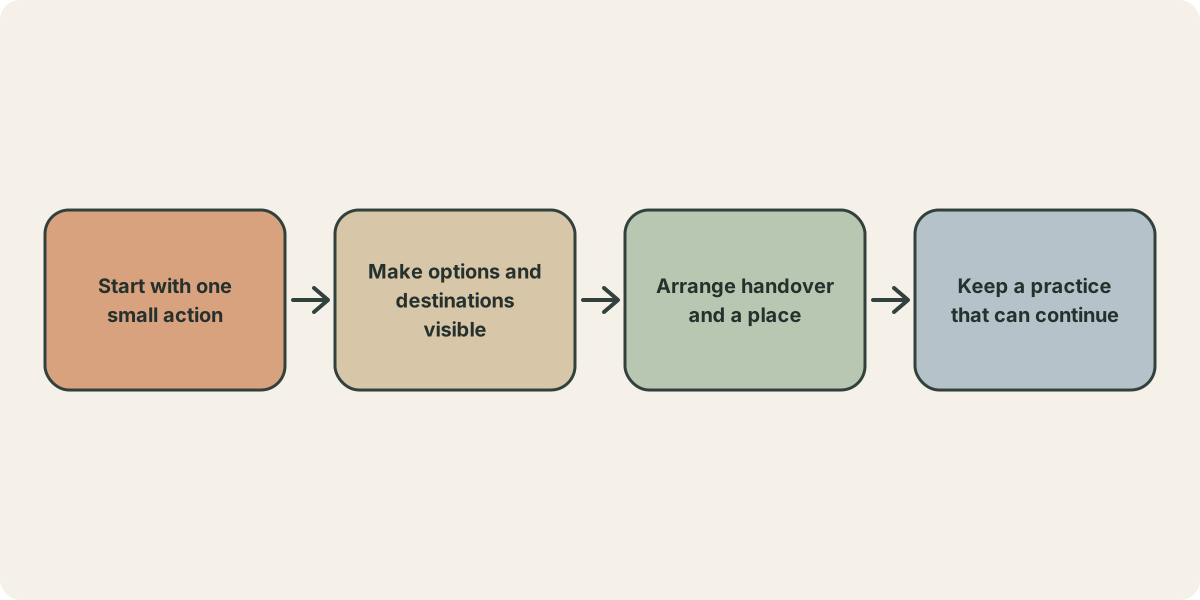
Handling one item a day is not a race for speed. It turns organizing from an occasional major project into a small decision that can be practiced again and again in daily life. Its value lies in lowering the threshold for starting, and in slowly making visible what has actually accumulated at home.
Why big projects so often stop at the first step
One homeowner once stayed up all night packing things away, yet still could not see a clear change the next day—left with exhaustion and a sense of powerlessness. A young person said they often had only ten minutes of motivation, because “having tidied and not having tidied looked about the same.” These experiences are not a lack of willpower. They come from a task design that lets feedback arrive too late.
When people cannot see completion, the next start becomes even harder. Treating the whole house as one task makes every item feel like something you cannot choose. Shrinking the work to a single drawer, a desktop, or one piece of clothing lets the decision actually land.
A small action has to be finishable today
One item a day needs at least four conditions: easy to start, repeatable, finished the same day, and with a result you can see. For example, clearing the dining table before bed: only one surface is handled, and the work does not spread to the whole house. When it is done, the table is immediately usable, and the next day you also know where to begin again.
Sorting items into keep, pass on, recycle, dispose, and undecided also reduces the sense of vagueness. Undecided is not failure; it is an admission that some items need time. As long as you set a date to review them again, you do not have to force a conclusion in the moment.
You keep going only when you can see it
When a four-ping room was being organized, the quantity only became visible after the items were gathered: coats, pants, bags, bedding, and miscellaneous things each filled several bags. The numbers are not there to blame the owner. They make the stock that had been hidden in the piles understandable. One less item a day is therefore not a trivial gesture; it is gradually restoring a feel for the total volume of belongings.
If a household shares simple labels or fixed places, it is also easier to keep things going. The point is not a neatness so complete that no trace of living remains, but that everyone knows where things can go and when they should be put back.
When the accumulation is large, seek support first
One item a day has its limits. Facing dozens of bags of items, large furniture, a move, or organizing after a family member has passed away, everyday speed is mathematically not enough to finish. What is needed then is one-time help, haul-away, and a division of labor among family members—not asking one person to slowly absorb the entire burden.
A major project reopens the space; small actions decide whether it can stay open. Handling one item today is not a pursuit of having less. It is leaving, for the things and the people who truly need to use it, a place that can still breathe tomorrow.
Source: Liao Hsin-yun’s Facebook page (content compiled and adapted)