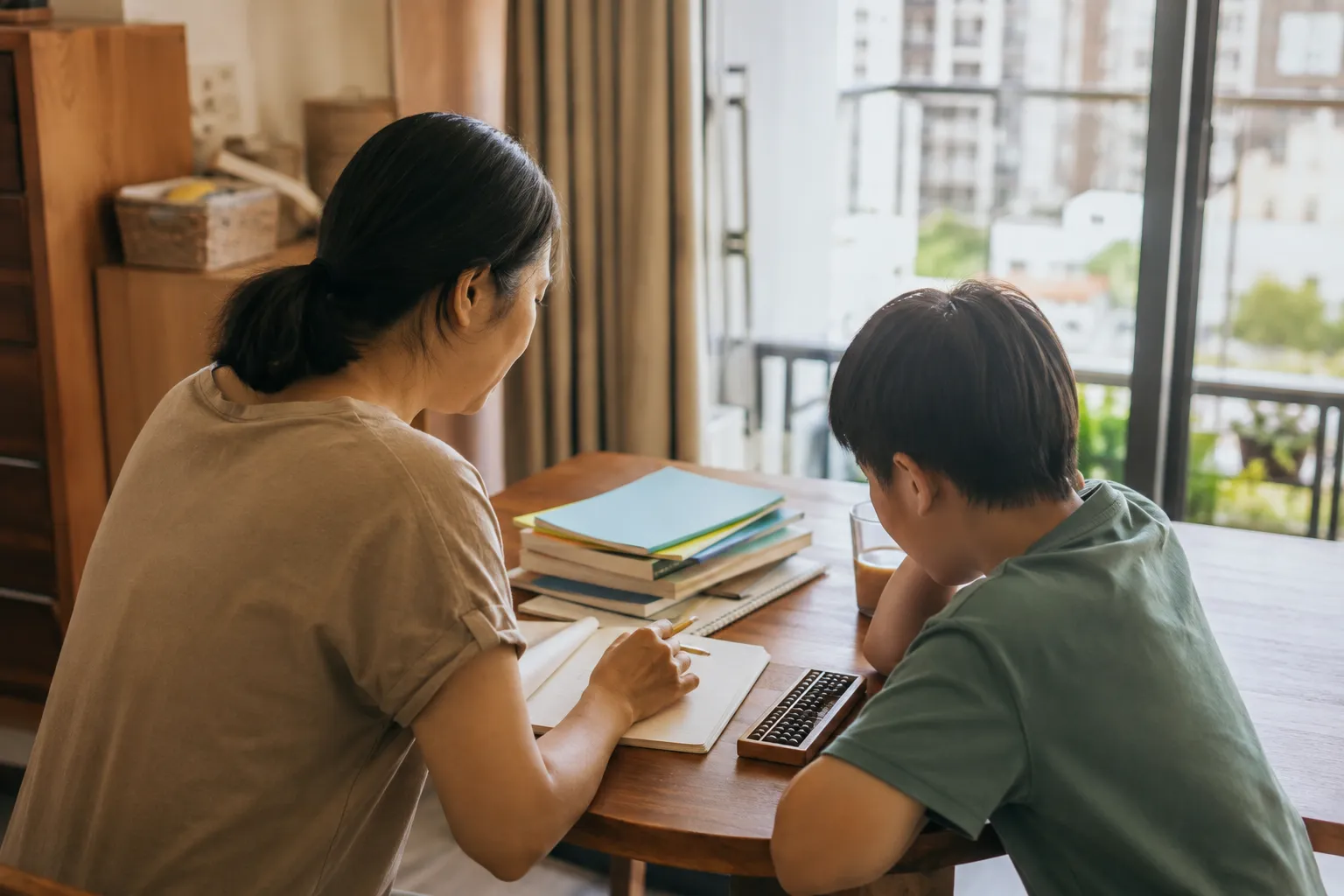
One hundred thousand NT dollars, spread over three years, nearly three thousand NT dollars a month. At an exhibition, a parent bought a children’s learning course. It included a simple computer and game software, promoted as a bridge from kindergarten all the way into elementary school. Four months later, the child had barely used it at home. The reason was straightforward: it was boring. The online games that usually held his attention moved faster; once they were back home, the educational software’s images and interaction lost their appeal.
This parent had already told herself not to buy children’s books or learning materials on impulse. When the product became a game on a screen, she was still tempted. This individual case does not mean that all courses or materials are useless. It does, however, show a situation many families know well: what parents buy is sometimes not only a tool or a body of content, but a promise that can hold their anxiety for a while.
What gets magnified at the exhibition is parents’ expectations
At an exhibition or promotion, the child is willing to try the product, and the parent can immediately see him absorbed in it. Sales talk often turns around expectations such as “learn while playing,” “if you don’t prepare now, will it be too late,” and “the child will like it.” These lines may not be describing everything a product can do. They place parents’ worries about learning, companionship, and the future into a moment when a decision has to be made quickly.
The problem is not that parents want their children to learn better. That feeling is natural. What truly needs to be distinguished is whether one try-out at the exhibition can stand for everyday use after going home. On site there is only one machine, and attention is focused on something new. At home there are tablets, phones, existing games, homework, dinner, and bedtime. That a child is happy in the moment does not mean he will, over the months that follow, come back to the same content on his own.
This gap is not limited to digital materials. Many parent-child products, tools for extracurricular skills, and learning kits also carry a household’s imagination of “not missing out.” When we buy a future possibility home in advance, the item may first go into a cabinet, waiting for a context of use that has not yet been arranged.
How many times it was used says more than what was promised
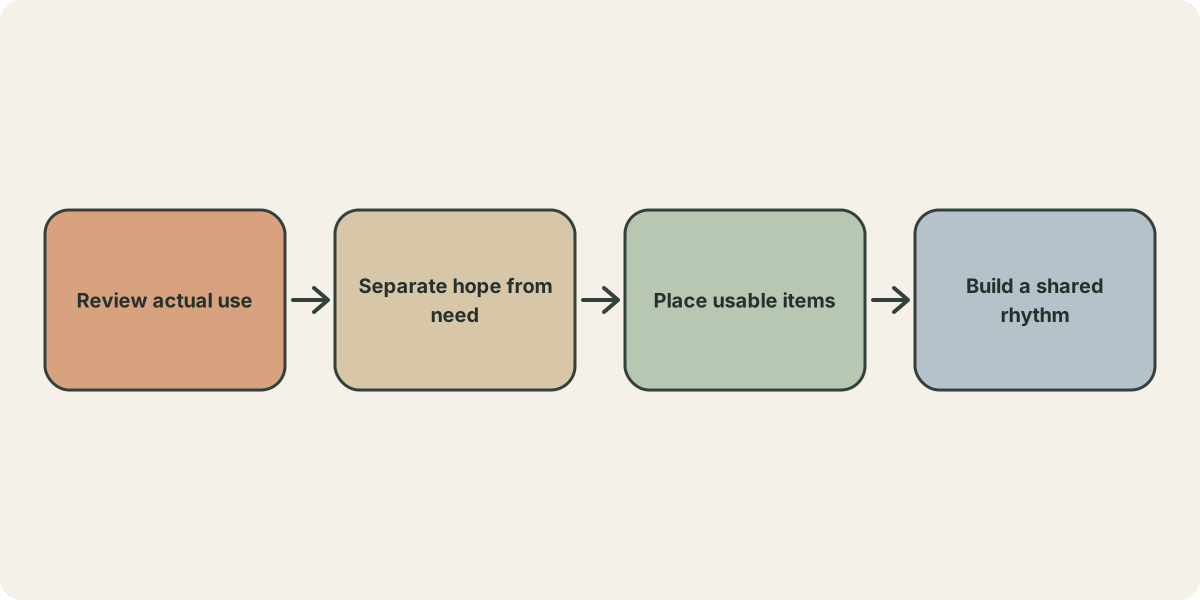
To judge whether a household purchase fits, the timeline can be pulled from the moment of sale to the period after buying. In the first month, who used it of their own accord? In the first three months, how many times was it used? When it was used, did an adult still have to urge or prepare for it again and again? This is not for blaming the child, nor for reducing learning to a count of uses. It gives the household a chance to see how actual living takes on an item.
In the source case, barely being used over four months is already a clear record of use. If the one hundred thousand NT dollars is seen only as a single payment, it is easy to stop at “we spent this much; we can’t waste it.” If it is seen as a tool that needs to enter daily life, the question becomes: does it truly coexist with the household’s time, the child’s interests, and other entertainment?
In another organizing case, a four-story townhouse, the father had grown up with scarce material goods. After becoming a father, he put many resources into his children, hoping each child would have toys of their own. During organizing, construction toys alone came to twenty or thirty boxes; some were still new and unopened. Each box may have had a reason when it was bought, but opening and use did not follow. This is one household’s organizing situation and cannot be taken as a statistic for families in general. What it reminds us is that love and expectation easily accumulate through items, yet do not necessarily turn into the companionship or activity a child actually needs.
What stays may not be the materials, but the anxiety
With a wrong purchase, what has to be admitted is often not only that the product does not fit, but also why one was persuaded in the first place. For parents, this may touch the pressure of “have I failed to prepare for my child.” So the item easily gains new reasons to stay: wait until he is a little older; he may like it later; keep it for the next child; it will come in handy someday.
At organizing visits, there have been homeowners who kept a daughter’s childhood learning materials because they remembered that the teacher taught well, and who kept picture books from childhood, thinking they could read them to children who might visit later. These reasons need not be mocked. They preserve fragments of a time when the family valued education. But if every item can only be linked to the past or to an imagined future, and has no user in the present, the home slowly becomes a warehouse of expectations.
When items sit here for a long time, the household bears more than a storage burden. Later it becomes hard to tell which can still be used and which are only hard to let go of; learning materials that could truly be reused also miss the right moment to be taken on. Sustainable living does not ask parents to stop investing in their children. It lets each investment have a chance to return to actual use and to relationships.
After it has already been bought, what choices remain
After buying a course that does not fit, it need not only be kept. The source case offers two low-threshold directions: if the hardware and content are still needed by someone, try passing them on so they can continue in use in another household; if you first want to confirm whether use is still possible, you can also set a small, concrete plan of use — for example, twenty minutes a day — watch for a period, and then assess.
Neither of these approaches, however, automatically deals with the terms of payment. Installments, early settlement, or cancellation still have to be checked against what was originally signed. More important, passing it on also has material limits. If the physical product is only a simple computer, other promises or services may not go with the hardware to the next user. That makes it unlike a picture book or a set of building blocks, which can more simply have their useful life extended.
So the key to reducing waste often lies not in how an item is handled after purchase, but in whether enough time is left before signing. When anxiety, a time limit, and a child happily playing appear together on site, stepping away for a moment and letting the decision return to an everyday picture of home is often more helpful than agreeing at once.
Turn expectation into a life that can be arranged together
A child’s learning is not only the two options of buying or not buying. If a household is truly interested in a certain kind of content, it can also start with the library, borrowing, a one-time activity, or materials already at home, and watch whether the child comes back to it on their own. This is not to turn all learning into an experiment. It gives a new investment a period that everyday life can verify.
For a child, being asked “how would you like to use this” also means more than simply being handed a new device. Adults can explain why the item was brought in, and also admit that it may not suit everyone. If the child does not like it, the household can handle what follows together, rather than leaving it in a corner to become a disappointment no one wants to talk about. This kind of conversation is also practice in one thing: an item is not a stand-in for a promise, and both using it and not using it can be discussed honestly.
When educational resources are placed back into a household’s time, relationships, and choices, consumption is less likely to become the only answer. The peace of mind truly worth keeping does not necessarily come from an order signed at once. It comes from family members knowing that, even without buying right away, they can still find a way of learning that fits the child.
Questions a family can answer together
Education should not be completed by purchasing alone. What a child needs may be content, time, and companionship, or it may only be a chance to try a different interest with peace of mind. For a household, first asking clearly “who will use it, when, and how” does not erase expectation. It instead gives expectation the conditions on which to land.
The next time you face a product designed for a child, the question might first be changed to: if we cannot close the sale today, will we still go looking for it together a week later? If the answer is still yes, then discuss whether it is suitable to bring home. This is not only protecting the household budget. It also makes space so that learning does not always have to be proved by a new item.
This kind of waiting also takes care of different people’s right to judge within the family. A child can have the experience of liking and not liking; parents can admit that they too can be affected by the atmosphere on site, rather than turning one purchase into a promise that someone must see through to the end. If a tool is not used in the end, the point is not to find out who was wrong, but to look back at what it was meant to solve, and at what the household still needs now.
Whether items can flow is also related to this kind of conversation. When a set of materials sits in a corner for years, its content, hardware, and services may become harder and harder to pass to someone else. If the household confirms earlier that it does not fit, it can at least still assess whether anyone needs the parts that can be handed on. This is not treating a child’s learning materials as secondhand goods. It is recognizing that every item needs a clear user and a context of use. Letting an item receive an honest judgment a little earlier also reduces the chance that it can only sit unused in the end.
When facing anxiety about education, society also need not place the responsibility only on individual parents. Exhibitions, time-limited pitches, and comparative language work precisely because many families worry that they are not providing enough. A community that can share experiences of borrowing, notes on actual use, and different paths of learning may let parents know that not every opportunity has to be seized on the spot. Sometimes, leaving time for discussion and observation is itself a responsible arrangement.
Source: Liao Hsin-yun’s Facebook page (content compiled and adapted)