An overseas internet plan could not be installed. The user spent five hours repeating the setup and asking for help, went through five customer-service agents, and still could not use it. The time already put in had gone beyond a reasonable range, but in the moment it is easy to think: try once more, and perhaps it will work. The fee already paid could not be recovered, yet new time and new strain kept being poured in.
This situation may seem unrelated to organizing at home, but it is in fact quite close. Many items are neither used nor sent away, not simply because people cannot be bothered to organize, or because the owner is too nostalgic. Sometimes they are stuck in an account that has not yet been settled in the mind: as long as they are still kept, it is as if the original decision has not been entirely wrong.
Why money already spent still shapes the next step
Economics calls spending that has already been made, and cannot be recovered no matter what is done next, a sunk cost. This is not a cold theory; it is a feeling very common in daily life. Something was too expensive, was bought by mistake, or after a few uses proved not to fit. To send it away can feel like having to admit, in so many words, that the money was wasted. So people choose to leave it for now, and deal with it some other day.
In the internet-plan case, the costs can be split into two: the fee already paid and unrecoverable, and the five extra hours plus a whole evening of irritation after arriving. The second cost keeps happening because people want to protect the first. Every extra customer-service agent is new effort used to prolong an old hope.
The household version of this is quieter. Something bought in the wrong size, awkward to use, or simply unsuitable is pushed to the back of a cabinet. It does not remind anyone to deal with it, and it does not at once fill the whole room, so the account seems as if it can be settled later. But the item does not recover its value for that. It only leaves sight for a while, while still occupying space and the chance of a next user.
Keeping something is sometimes defending a past self
When organizing a cabinet of things seldom used, people often hear two voices. One says the thing is still in good condition, and throwing it away would be a waste. The other says a good deal was spent at the time, so at least keep it a while longer. The first sentence may be about whether the item can still be used; the second may be protecting a past decision. They look similar, but they call for different handling.
In a source case, a homeowner began collecting designer bags after turning forty, one after another, until they filled the room. Some were bought at a promotion; some were travel souvenirs; a few she had almost forgotten she owned. After organizing, she kept two and resold or donated the rest. She said the bags had recorded her effort, but she no longer needed them to prove anything.
This experience cannot be applied to every collection. Souvenirs, collections, and aesthetic value can have meaning beyond practical use. Still, it lets us see that an item sometimes shifts from “something to use” to “something to prove.” When all that remains is the function of proving that one once worked hard, once chose well, once was worthy, it becomes hard to take the item out again, and hard to give it to someone who needs it.
Pull the question back to the future, not the past
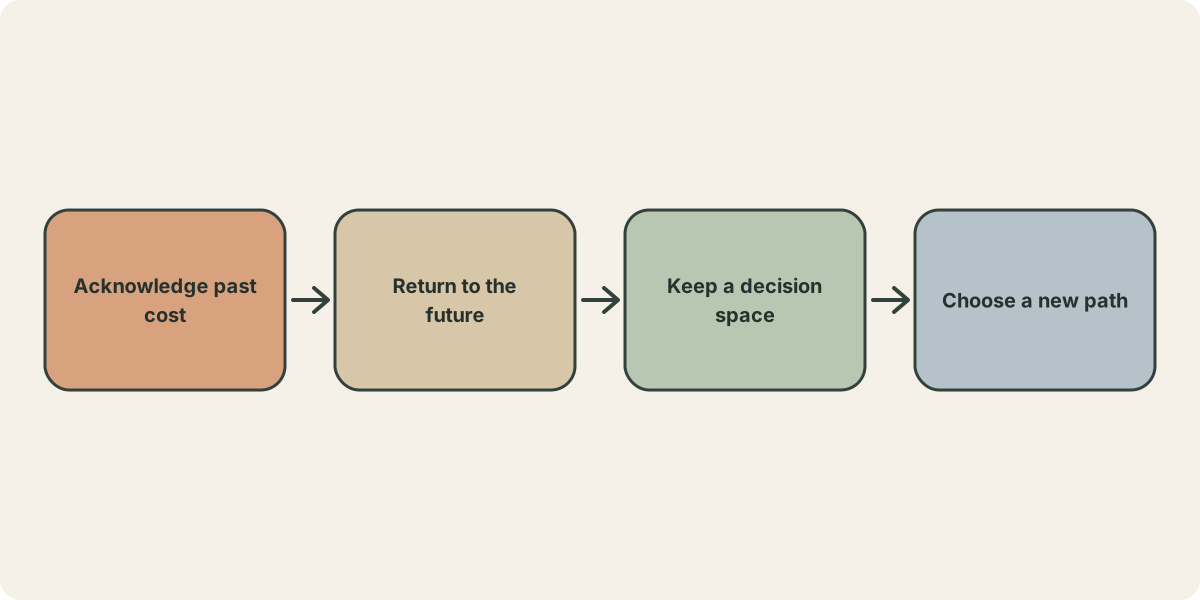
Recognizing sunk cost is not a demand that people throw everything away without feeling. It only moves the place of judgment back to the future. For items originally bought to be used, two questions can come first: in the coming year, will I use it? Right now, can someone else still use it?
These two questions will not change the cost already paid, but they can help decide the next step. If it will still be used, put it where it is easy to reach, and arrange for it to return into living; if it will not be used but is still in good condition, look within a feasible time for a chance to resell, give it away, or pass it on; if it is no longer suitable for further use, then consider recycling or final disposal. The point is not to keep every item, but not to let the number at the moment of payment become the only standard of judgment.
In the organizing records of ten households, there were five hundred and eighty bags of items cleared, of which one hundred and ninety-five bags were still goods that could be passed on. These ten households are individual paid cases with a professional organizer on site, not a random sample, and cannot be taken as a proportion for households in general. But they show that quite a few items were not unusable; they had simply stayed too long in their original space. If they had been recognized earlier and given to a next user, they might still have had a chance to replace a new purchase.
Once an item is frozen, options slowly grow fewer
Leaving something untouched is not a neutral choice. Appliances may lose takers because of specification, parts, or cleanliness; clothing may lose its chance of circulating because of storage conditions and changing styles; consumables may expire while no one is paying attention. Early on, an item left sitting might still be passed to someone else; later, what remains is only the responsibility of handling it.
This also affects the community and the flow of belongings. When large numbers of still-usable goods are locked for a long time in different households, people who truly need them may not find them, and may buy new ones instead. When the items are finally cleared all at once, secondhand channels then have to take on many kinds of things in different conditions in a short time. Circulation needs more than good intentions; it also needs the habit of judging while there is still time.
A boundary still has to be kept here. For items with commemorative meaning, what is being kept is memory itself, and frequency of use should not be the only standard. Other things kept because “they will be needed someday” may be tied to experiences of scarcity and to a family’s background of growing up. In a source case, a mother who had lived through wartime years was in the habit of sealing complimentary gifts away, box after box. Faced with items like these, rather than only calling them waste, it is better to discuss together what unease they carry, and to set a time when they can be looked at again.
First leave some room for judgment
What some people need is not to clear things at once, but a stretch of time without being hurried. Hesitant items can first be gathered in a small area, with a date set for looking at them again. If in that period they are never taken out for use, or if the only feeling left when they come to mind is unwillingness to admit the mistake, it becomes easier to tell what is actually being kept. This practice does not guarantee that every item will leave, but it can turn vague delay into a judgment that can later be looked back on.
Family members can also help one another confirm the state of items. Someone may be good at finding a place to give things away; someone may know how to recycle; someone may be able to say whether a given item will actually still be used. The point of dividing the work is not to force anyone to give things up, but not to leave one person alone with the feeling of “admitting a wrong purchase” and with the work that follows. When an outlet becomes visible, letting go need not be understood as denying oneself.
For the public environment, the longer items stay stalled inside a household, the harder it is for them to be taken on while still in good condition. Making transfer, repair, and recycling information easy to understand in a community can lower the threshold for an individual to handle an item. Still, no system, however complete, can make every judgment for us. The true starting point remains a willingness to look at past spending and the next choice as separate things.
What can still be done after checkout
Admitting that something does not fit will not bring the money already spent back, but it can stop new costs from continuing to grow. This may be the first step in sending an item out: not denying the self of that time, but acknowledging that the choice was made with limited information, a particular mood, and a particular living situation. The situation now is different, and the judgment can be made again.
If a family is going to organize together, language about “who bought carelessly” can also be avoided. Rather than chasing after blame, it is more helpful to ask together: are we keeping this because we will still use it, or because we do not want to face that it is of no use? If the answer is the latter, can a suitable outlet be found while it still has value?
Not every item has to have its fate decided at once. But if we are willing first to set aside the sum already paid, we may see a question that can move things forward: next, how can this thing truly serve living, or be of use in someone else’s life?
What some people need is not to clear things at once, but a stretch of time without being hurried. Hesitant items can first be gathered in a small area, with a date set to look at them again. If in that period they are never taken out for use, or if the only feeling left when they come to mind is unwillingness to admit the mistake, it becomes easier to tell what is actually being kept. This practice does not guarantee that every item will leave, but it can turn vague delay into a judgment that can later be looked back on.
Family members can also help one another confirm the state of items. Someone may be good at finding a place to give things away; someone may know how to recycle; someone may be able to say whether a given item will actually still be used. The point of dividing the work is not to force anyone to give things up, but not to leave one person alone with the feeling of admitting a wrong purchase and with the work that follows. When an outlet becomes visible, letting go need not be understood as denying oneself.
The longer items stay stalled inside a household, the harder it is for them to be taken on while still in good condition. Making transfer, repair, and recycling information easy to understand in a community can lower the threshold for an individual to handle an item. Still, no system, however complete, can make every judgment for us. The true starting point remains a willingness to look at past spending and the next choice as separate things. Only then can care for things stop remaining only in the heart, and become action that can actually be taken.
Once this honest confirmation is completed, the next time there will be no need to spend more time defending a past choice.
Source: Liao Hsin-yun’s Facebook page (content compiled and adapted)