Some things are rarely used, yet never leave the home. It may be an old suitcase, a piece of clothing that no longer fits, or a room that has not been touched for years. What others see is an object taking up space; the person who keeps it may see a relationship, an unfinished wish, or a self they once worked hard to prove.
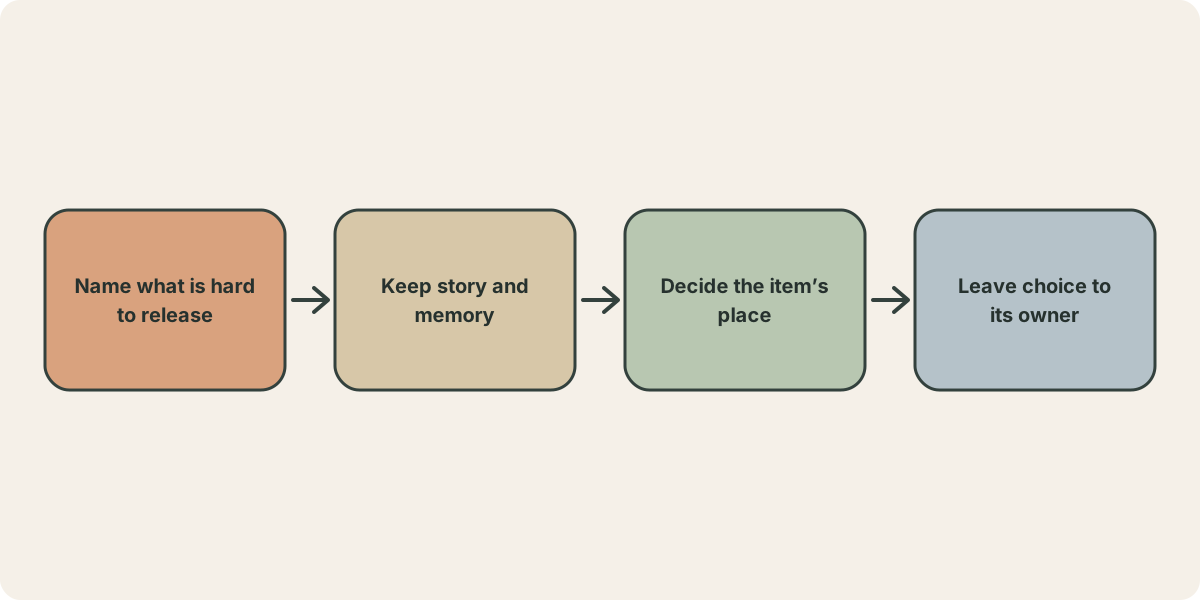
Organizing, then, need not begin with “Should I throw this out or not?” A more helpful starting point is to ask: What I cannot let go of—is it this object, or what it has been holding for me? When the reason can be named, the object no longer has to carry all the memory on its own.
Belongings often keep the stories we have not finished telling
A yellowed card may be tied to a relationship that has already ended; a box of letters may hold words that could not be said at the time. These things may no longer serve a practical purpose, yet they make it feel as if, so long as they remain, the past has not fully disappeared.
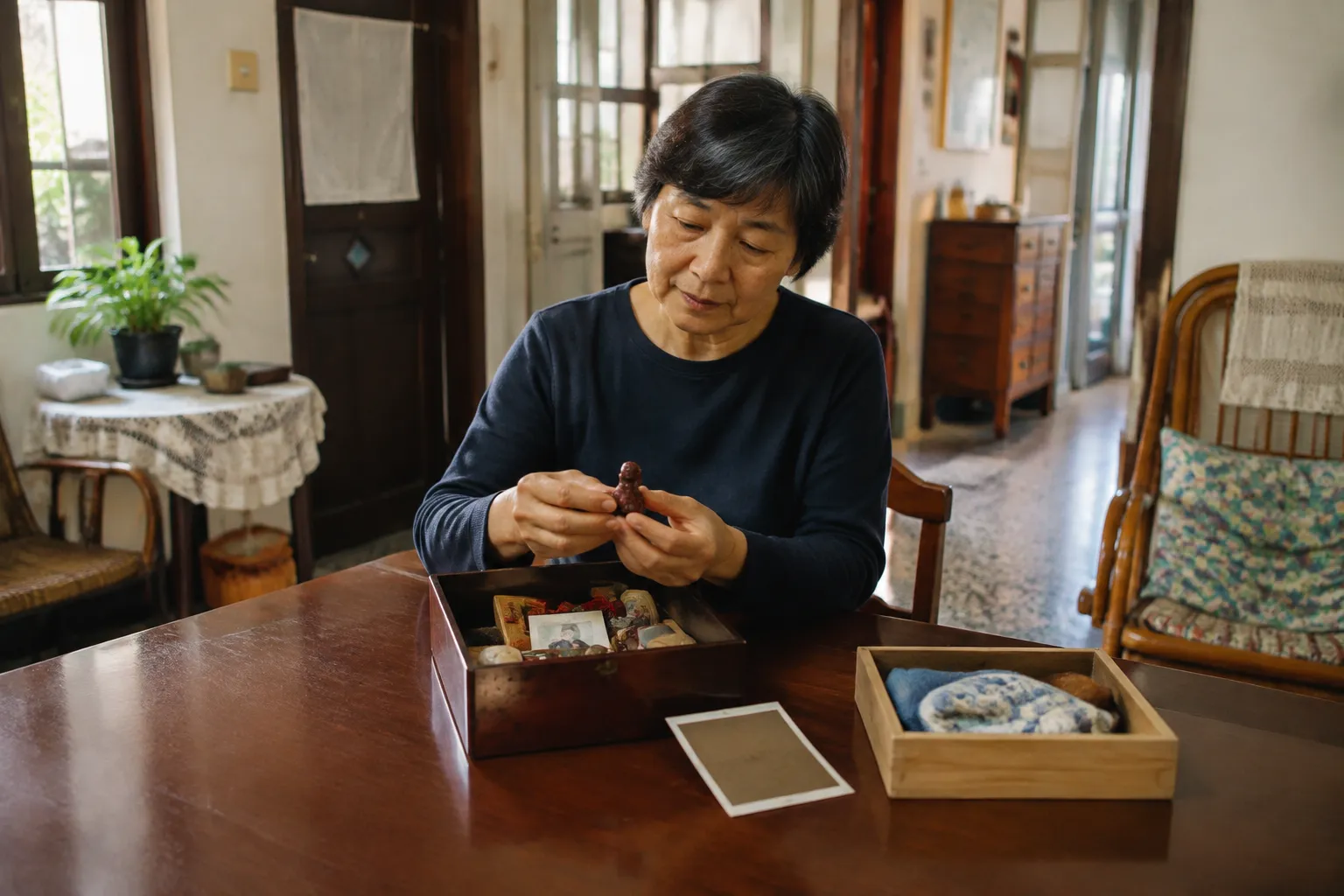
One resident who had moved several times always brought along a heavy wooden box. Inside were photographs and letters from earlier years. He knew he would almost never open it again, yet could not imagine it not being there. What truly needed to be seen may not have been whether the box took up space, but that those memories had not yet found a way of being held.
If an experience has already ended, keeping the object will not necessarily turn time back; if it still hurts, rushing to deal with the object will not necessarily resolve it. First allowing yourself to say “I am still sad” is often more honest than making a decision at once.
Regret need not keep living in a drawer
Other things we cannot let go of are bound to regret. It may be clothes bought for a certain body, a set of tools we once meant to learn but never touched, or a collection that stands for a life choice. They are kept as if to hold open a doorway for starting over.
Here it can help to look at the question over a longer stretch of time: Five years from now, when I see it again, will I feel reminded, or held back? The answer need not point at once toward letting go. Some people first take a photograph, write a short memory, or choose the one item that most represents those days. If the rest can be given to someone who will actually use them, that is not the same as denying what was once hoped for.
Letting belongings grow fewer is not cutting life experience away. It is acknowledging that some paths have already become part of who you are, and no longer need every object to prove it.
Past achievement is not the same as present worth
Certificates, trophies, old uniforms, and collections sometimes preserve the feeling of “I once could do this.” When a person is in a low period, these things are especially hard to deal with, because they feel like some of the few pieces of evidence one can still hold in hand.
It may help to change “Should I keep this?” into “What do I want to prove, and to whom?” If the answer is that you want to remind yourself you once worked hard, you can choose a more restrained way of keeping: hold on to a few items that truly matter, and photograph the rest, record the years, or gather them into a one-page record. A person’s ability and experience do not vanish because a trophy leaves; they have long since remained in how one works, in relationships, and in the choices one makes.
This kind of organizing does not deny what is treasured. It slowly turns keepsakes from a large pile into memory that can be seen and understood.
Love and remembrance can continue in other ways
A father’s watch, a rice cooker given by an elder, a card a child made—the difficulty is that they are bound to love. After a loved one dies, it is also common for a room to be left as it was, because moving the belongings can feel like admitting the person will not come back.
No one can set a timetable of grief for the person it belongs to. Some people organize quickly because they hope the belongings will continue to be used; some need years before they have the strength to open a drawer. Both paces deserve to be respected. What family can do is not to urge “It’s time to let go,” but to ask: Which one do you most want to keep? Which ones cannot be touched for now? How can I stay with you?
If they are willing, a new place can also be found for the belongings. Passing pet supplies on to animals that need shelter, and still-working appliances on to a household that has just moved, does not mean love is being handed away. When belongings go on looking after someone else’s everyday life, remembrance sometimes finds a gentler way to continue.
Leave the decision in the person’s own hands
What is truly difficult is often not the act of organizing, but whether one is willing to begin. Some families have urged for a year before the person agrees to start by looking at one small area. This waiting is not necessarily delay; it can be preparation for loss, change, and the unknown.
For belongings that cannot be decided on for the moment, a holding area can be set aside, a date written down, and an agreement made to look again in a few months. Photographs can also be taken, or stories told, so that memory has an outlet first. What matters is that personal belongings should not be dealt with without the person’s knowledge; space does need organizing, and trust also needs to be kept.
When we no longer press ourselves with “Are you ready yet?” and instead recognize the kind of attachment we cannot let go of, we can find a smaller, more workable next step. The object may not leave at once, but it is no longer that silent box of unfinished business pressing on the heart.
Source: Liao Hsin-yun’s Facebook page (content compiled and adapted)