The question most often heard while organizing is: “Should I throw this away?” For things that are damaged, expired, or clearly not going to be used again, the answer may not be hard. Faced with something in good condition, still of value, and possibly useful in the future, the same question easily stops people in their tracks. The more someone treasures resources, the less willing they may be to let go lightly.
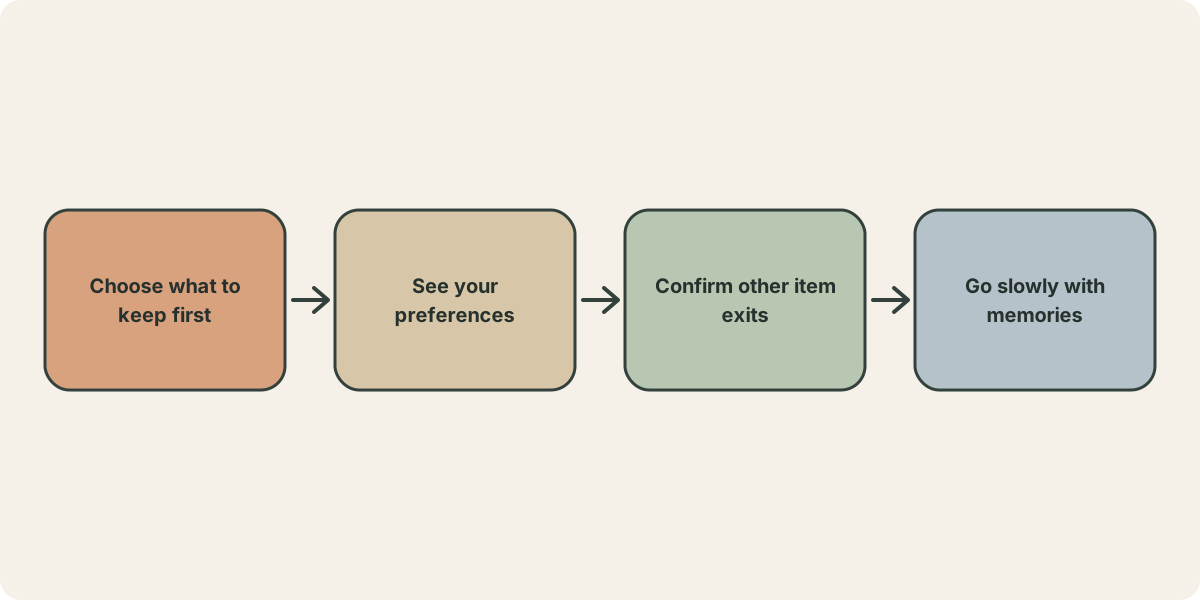
Changing the question can sometimes get the choice moving: instead of first asking what to discard, first pick out what you truly want to keep—the items that best meet your own needs. This is not an encouragement to throw things away casually. It is about first establishing a measure defined by the user, then finding a suitable destination for the rest. The point of sustainable living should not be emptying a space alone, but reducing unconscious accumulation so that resources that still have a use have a chance to be put to good use.
Why “Should I throw this away?” gets people stuck
The source describes a pattern of keeping still-usable items over a long time as “preservation-type hoarding”; the term has no clear origin or year, and should not be treated as a formal classification. If it is understood simply as a common pattern of keeping things, the reasons behind it are not hard to see: the items are not of poor quality, may still have a market price, and also carry hopes of valuing things, thrift, or preparing for a rainy day. Asking someone to throw them away at once can feel like saying that past judgments were wrong.
Debating every item one by one can turn organizing into a long self-trial. When people delay or become defensive, it is not necessarily irresponsibility; the way the question is asked may make the psychological cost of deciding too high. Understanding this first can help family members urge and blame a little less, and give organizing a chance to become a shared discussion rather than a contest over who is better at letting go.
Standards emerge when you start from preference
One household had a large number of paper bags. While organizing, no one asked the homeowner to throw any of them away at once. She was asked first to pick out “the best.” She gathered the paper bags she considered most distinctive and of the highest quality, then put the older or easily torn ones in another area. Next, she named several uses by situation: those suitable for making crafts, those usable for gifts, those usable when asking someone to carry things, and those she would not mind using for everyday odds and ends.
Once the standards were stated clearly, the remaining bags that neither fit a use nor were especially wanted no longer needed to be defended one by one. The homeowner herself decided to let go. This is a single case and cannot be used to claim that everyone will organize quickly just by changing the question. It does show, however, that starting from the keeping side makes it easier for the person involved to express preference, and that preference can become the basis for later sorting.
Choosing what to keep also means seeing the exits
Picking what to keep does not mean the rest can only become trash. In the source, the paper bags were later taken to a store with a paper-bag collection point, so that people who needed them could take them freely. Whether such a destination is suitable still depends on the condition of the items, local rules, and the needs of those receiving them. Not every item can be passed on, and “donating” should not be treated as a shortcut that removes the need to judge.
A more complete way of thinking is: of what you keep, will it actually be used; of what can be passed on, is it clean, safe, and useful to the recipient; of what can be recycled, does it meet the right sorting rules; of what can no longer be used, how can it be disposed of responsibly. If you only move unneeded things to another corner, or hand them to a place that cannot handle them, the problem has merely left your sight. Including the exits in organizing is what shows respect for resources and for other people.
Keepsakes need a slower pace
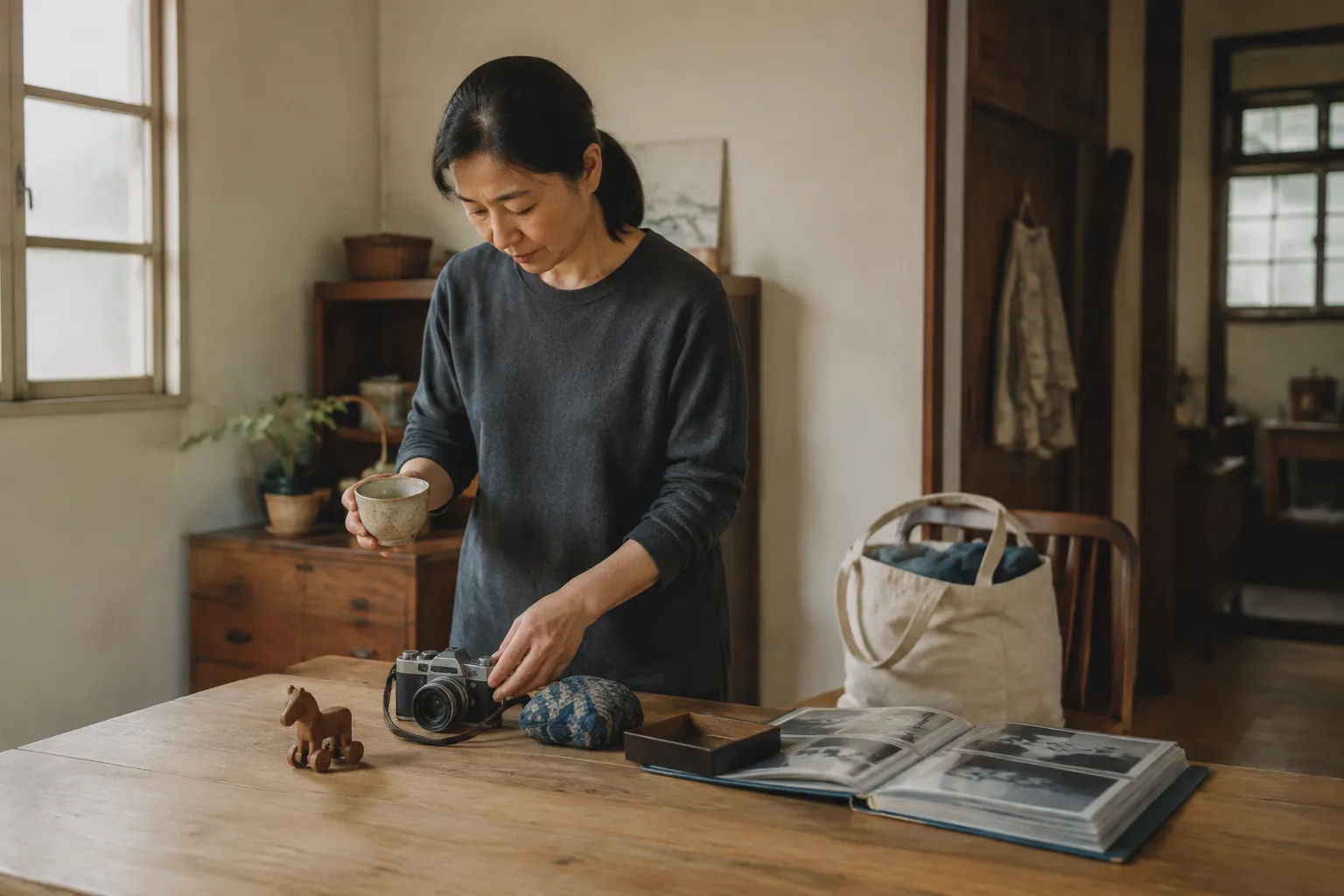
For some items the difficulty is not use, but memory. In the source, when the homeowner dealt with her collection, she first distinguished what she used often and liked, what had commemorative meaning but was no longer used, and what she had completely forgotten she owned. Even with a clear sequence, the whole process still took two days. That time is the experience of this case and cannot be taken as a standard for others; it reminds us that items with a high emotional load need not be rushed.
Faced with her child’s communication notebooks and artwork from kindergarten through elementary school, the homeowner in the end kept only a few of the most representative pieces, photographed the rest for the record, and then let go. Photographing is not the only answer, nor is digitizing memories a requirement of being mature; some people still need physical objects to hold a story. What matters more is letting the person involved decide what best carries the memory, and having time to explain why it is being kept.
Let reduction become clearer care
Starting by picking the best is not turning organizing into a beauty contest, nor asking everyone to keep only expensive or perfect items. What counts as “best” can be frequently used, easy to handle, carrying a story, repairable, or suited to real needs in daily life. Every household’s standard is different; income and a sense of security also affect reasons for keeping things. No universal list can decide for someone else.
The value of this approach is that it moves attention from loss toward choice: Which items do I want to keep taking part in my life? How much space, upkeep, and time do they need? Do the other items have a more suitable user, or a destination as materials? When the questions become concrete, reduction is no longer only making things fewer; it is making what remains easier to see, use, and care for.
The next time you face a pile of things you cannot bear to deal with, you might set aside “Which one should I throw away?” and first ask, “If I could keep only some of them, which would I most want to keep?” When the standard is spoken in your own words, the path ahead gradually becomes clearer.
Make choosing a process you can look back on
When you actually begin, you can first set a very small range—for example, one drawer, one bag of paper materials, or one collection box. After spreading out what is inside, do not rush to decide keep or go. First pick a small number of pieces you most want to keep using, the ones that best represent this category of items. The standard can be practicality, durability, ease of repair, appearance, or memory; it can also simply be that holding the object still feels pleasant. The point is that the standard is spoken by the person involved, not defined for them by someone else.
After the selection, look at whether the remaining items still have a clear role. Some can become backups, some are suitable to be passed on, some can be recycled by material, and some have reached the point of needing disposal. Every exit should respect the receiving end: do not wrap dirty, damaged, or unsafe things as goodwill; do not dump a quantity you do not want to face onto other people. If a reliable destination cannot be found for now, you can first set a pending area and a date to look again, so that “later” does not become indefinite keeping.
This process also suits family negotiation. Shared items often involve different people’s memories and rights; the person organizing need not decide outright in the name of efficiency. You can first ask each user to pick out the most important part, then discuss how much the shared space can hold, which items need to be visible, and which should be passed on. This is especially true of a child’s artwork, things left by elders, or a shared collection. Reasons that are seen may not change the final result, but they can reduce hurt in the relationship.
Items kept after the choice also need to be actually used. You can arrange an accessible place for them and check their condition regularly, rather than turning the “selection” into another sealed storage zone. If after six months or a year they still have not been used, ask again whether the original standard still applies. This is not a demand that every item be used at high frequency; it is allowing life to change, and allowing people to revise a decision. Dates should be adjusted according to the nature of the items and the household’s situation; no time limit need be treated as a moral exam.
Starting from the keeping side does not necessarily lead in the end to fewer items, but it often leads to a clearer relationship. When people know what they cherish, they can also better tell what they are keeping only out of habit, guilt, or uncertainty. Reduction then shifts from a one-time cleanout to more honest care for objects, space, and resources. If a decision cannot be made for now, it is also possible to admit you are not ready, keep a small number of items pending confirmation, and not throw things away in a hurry under pressure. Good organizing allows hesitation, but it also gives hesitation a place and a time that can be looked back on, so that objects no longer silently occupy every available space.
However much is kept in the end, being willing to recognize what you truly need is already an important beginning. Objects can accompany people; they can also, at the right time, be passed on, reused, or bid farewell. The purpose of choosing is not to empty a space, but to return limited space and energy to a life that is still worth caring for in the present.
When organizing no longer forces people to deny the past at once, but invites them to choose for the present, both the leaving and the keeping of objects can be more peaceful. That peace also gives later reuse and disposal a chance to be done more carefully.
Source: Liao Hsin-yun’s Facebook page (content compiled and adapted).