“I’ll keep this; I’ll use it later” and “I’ll keep this money; I might need it later” follow almost the same pattern. Both pause the resources we have now in exchange for a guarantee about the future.
Belongings are usually treated as a matter of living habits; money is treated as a matter of financial attitude. Discussing them separately is not wrong, but they share one thing: as long as the future has no date, no purpose, and no quantity, holding on is hard to bring to an end.
“Later” may be a recipient with no deadline
Keeping a stock of supplies you use at a steady rate is preparation. Handing things over to a “later” with no point in time, however, can let holding on stretch on without end. Without a date, you do not know when to check again. Without a purpose, you cannot tell whether you truly need it. Without a quantity, it is hard to know what counts as enough.
The costs, though, arrive now. Belongings take up space, add time spent searching, need to be cleaned and maintained, and may eventually need to be hauled away. Resources left standing still also mean they cannot, for now, be used by anyone else.
A sense of ease is booked in the present; the costs appear in installments. That is why people so easily feel only the former.
Accumulating more does not necessarily bring more peace of mind
One interview account describes a person who had long relied on the numbers in a bank account to confirm they could still hold on. Even with money, they still feared it was not enough, and even found it more exhausting than having none. This account can only illustrate one possible psychological mechanism; it cannot be used to infer everyone’s situation.
Home organizing visits show similar outcomes. In one household, unopened boxes were stacked in the entryway and living room; most skincare products had expired two or three years earlier, and unopened fragrances had already oxidized. Another household was in the habit of keeping items in complete sets, packaging intact, while the quantity gradually compressed the study into a single narrow passage.
The motives in these cases were not entirely the same: some sought comfort, some cherished belongings, and some imagined a future. What they share is this: increasing the stock does not automatically increase use, nor does it automatically buy a grounded sense of security.
Turn “I can’t let it go” into questions that can be answered
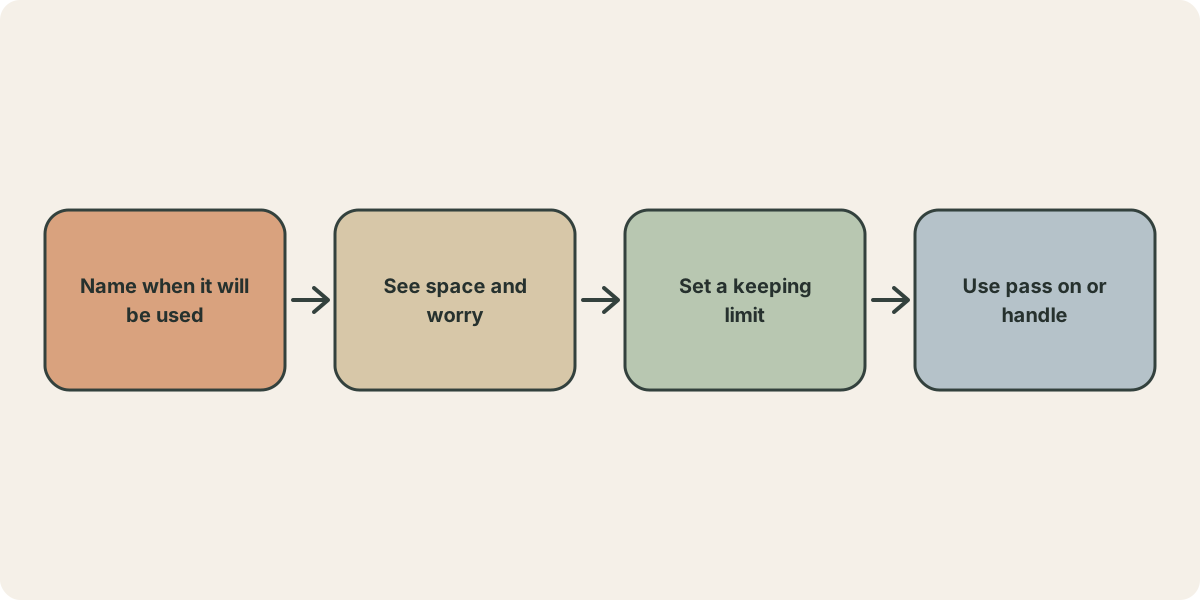
“I can’t let it go” is a feeling, but it is hard to use it directly to decide the next step. It can be turned into three concrete questions: What is this being kept for? Until when do I plan to keep it? How much counts as enough?
These three questions do not ask every household to turn life into a spreadsheet, nor do they involve arranging anyone’s money. They simply give “later” a few more conditions that can be checked. If they can be answered, holding on comes closer to a plan. If they cannot, the resources may only be locked in place for now.
Both keeping and circulating need boundaries
Ten households that commissioned organizing work cleared out a combined 580 bags, of which 219 were trash; the rest went to recycling or were passed on. This is a total from organizing-site cases, not a typical household ratio, and there was no tracking of whether each item had been kept “for later.”
What it can remind us is that when belongings stay in the home too long, they still have to face a destination in the end. Some items can still be handed on; some can only be recycled or disposed of. Setting a review time early lets the decision happen while more options remain.
A reserve with a time limit, a purpose, and a quantity to go by turns anxiety into preparation. Left with only the line “I’ll use it later,” today’s resources may stay parked in waiting.
Source: Liao Hsin-yun’s Facebook page (content compiled and adapted).