After moving into a new home, the old furniture she kept using still worked, yet something always felt off. She later replaced the dining table, cabinets, and sofa; each piece looked good on its own, but together they still felt uneasy. This is one longtime professional organizer’s observation, from the source, of her own home. She found she was skilled at giving each item a place, yet rarely considered the relationship between pieces of furniture.
A home that looks cluttered does not necessarily mean every item lacks value, and it is not only a matter of quantity. Sometimes what truly adds to the burden is that materials, colors, sizes, sorting methods, and storage containers are each speaking a different language. Each purchase may have been a reasonable choice on its own, but what a space needs is whether those choices can work together.
A Reasonable Piece Does Not Automatically Become a Comfortable Whole
When we buy a table, we look at size; when we buy a storage box, we look at compartments and capacity; when we add a cabinet, we ask whether it will fit. These judgments are all necessary, but they only answer the question of a single item. When different colors, materials, and shapes accumulate in the same space, the eye has to keep switching, and finding things and keeping order become more laborious.
This is not a demand that every home have a consistent style, still less that life become a showroom. Families naturally keep belongings from different generations and different stages. The point is to make everyday objects easy to recognize alongside one another, so that putting things back does not depend on one person remembering every detail. A sense of the whole, here, is not an aesthetic threshold; it is a way of reducing everyday friction.
In a Four-Ping Room, Quantity and System Both Went Wrong
On the surfaces of a four-ping room, cosmetics were piled up and mixed with stray stationery, medicine, and accessories; items sat in whatever cardboard boxes came to hand, making things hard to find and the space visually messy. In the organizing record, the household cleared out four bags of trash, one bag of recycling, and eighteen bags of items passed on, and moved out one hanging rack, one chest of drawers, two chairs, and two appliances.
These figures are a record of a single organizing site and cannot be used to measure other households. They do make clear, though, that this room needed more than a few replacement containers. The total volume of belongings exceeded the space, and the containers lacked consistent sorting; the two problems were stacked together. After organizing, the team took off the wardrobe door panels and used small drawers of more consistent size to form a storage wall, making everyday items easier to recognize.
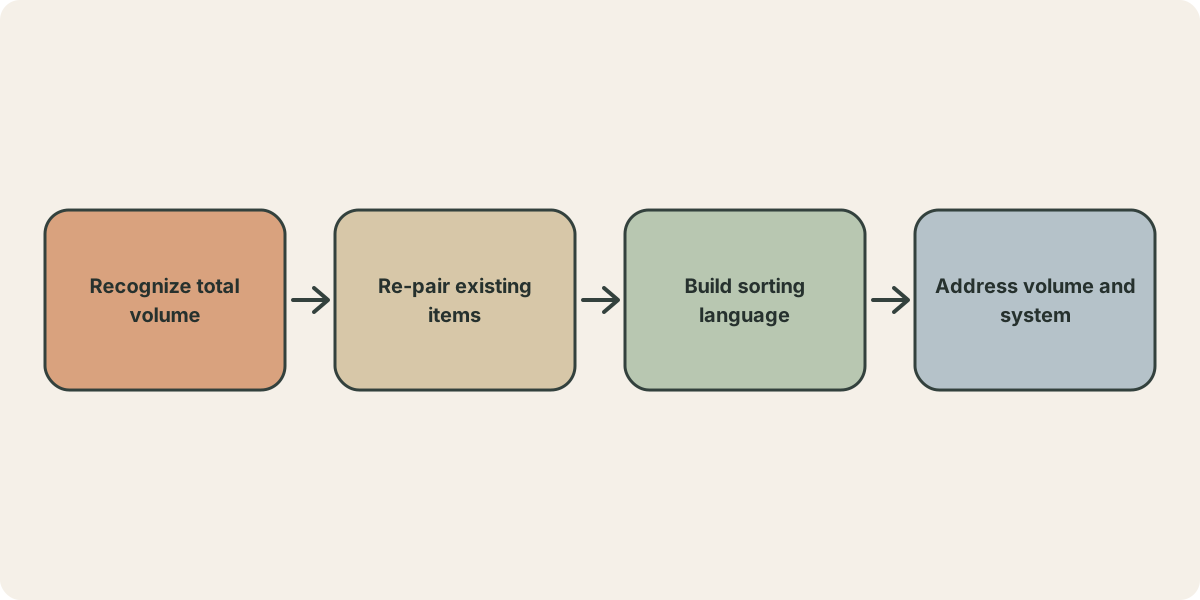
The order of this process matters: first let items that are no longer needed leave, then decide how to arrange what remains. Without that earlier reduction, even the most attractive containers may only hide surplus belongings more neatly.
A Shared Household Also Needs a Shared Language of Sorting
In another case, both people living together wanted a tidy home, but their ways of storing things differed. One was used to grasping the big picture; the other was good with details. Both were trying, yet belongings still ended up scattered across different floors because the sorting principles did not match. This was not about who was better at organizing; the household lacked a language both could follow.
In a shared space, if the system exists only in one person’s head, others can hardly take over. You can start with a very small range: agree first on a fixed place for everyday medicine, stationery, or tableware, and distinguish them with names every cohabitant can understand. Sorting does not have to be fine-grained all at once; what matters is that everyone can find things and put them back.
This kind of coordination may look unrelated to sustainability, yet it affects whether items are bought again, whether they can keep being used, and whether they are seen when needed. Making a household’s information about its belongings clear is itself a step toward reducing idle resources.
Start by Rematching the Items You Already Have
When people notice that a space does not cohere, the most instinctive response may be to buy a batch of new storage products or furniture to unify it. That easily creates a second wave of inflow: the old things are still there, the new ones come in, and in the end there is even more to deal with.
The direction proposed in the source is to rematch existing belongings first. Colors need not be identical; you can start by placing similar ones together. Concentrate the use of containers of the same material. First move the few objects most likely to cause visual interference out of everyday sight. Once the gaps are clear, then judge whether anything truly needs to be added. This approach does not chase perfection; it lets change begin with the resources already at hand.
Light can be understood with the same idea. One high-wattage lamp lighting the whole room evenly, and several lower-wattage lamps placed in different spots, may give similar brightness but different feelings. The former answers “is it bright enough?”; the latter also attends to places for reading, rest, and lingering. A space’s sense of the whole often comes from many small relationships, not from one expensive new item.
Unifying Cannot Replace Reducing
Some collections are kept intact, with consistent packaging that shows how much care the owner has put in; yet once the quantity accumulates, the study is left with a passage of only three steps. This case reminds us that system and quantity are two different questions. Coordinated style can reduce the feeling of clutter; it cannot make an occupied walkway reappear.
Therefore, before organizing, you can make two judgments: Does this item still support life as it is now? If it stays, can it form a clear place and purpose with the things around it? The first question addresses total volume; the second addresses relationships. Neither asks anyone to discard quickly; both are meant to keep new purchases from covering over old difficulties.
A home does not need every item to be the same in order to have order. What is more worth thinking through together is this: without buying more things, can we make what remains easier to find, easier to use, and easier for every person in the household to take over?
Source: Liao Hsin-yun’s Facebook page (content compiled and adapted)