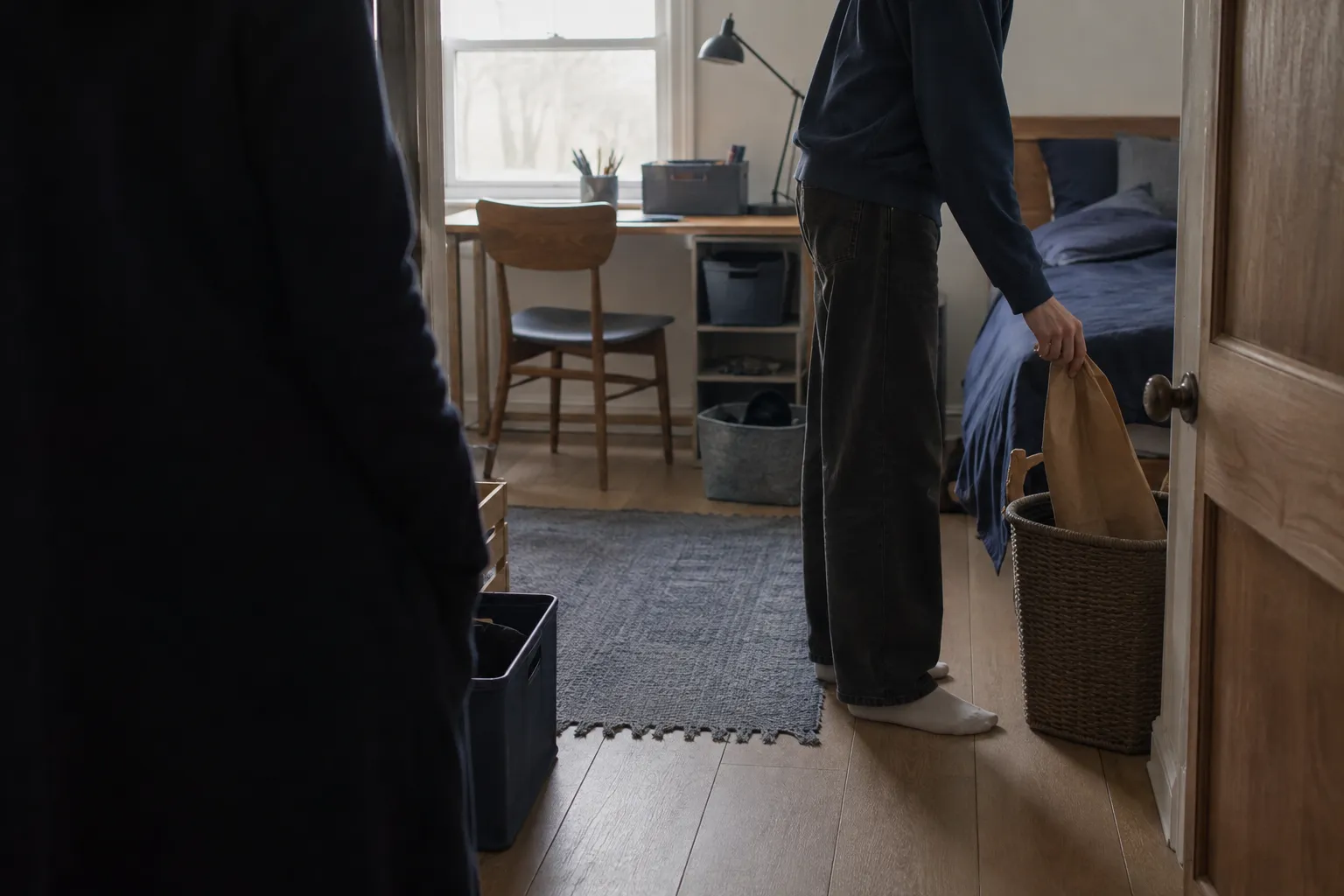
Parents say, “No eating in the room,” yet the child stuffs empty wrappers under the bed. The rule looks as if it has been followed, but the problem has not gone away; it has only been moved out of sight. Scenes like this easily make adults angrier, and make the child even more determined to shut the door.
Room organizing is often understood as a problem of obedience, but it also involves life skills, spatial boundaries, and whether parent and child can negotiate. If a rule only forbids, and offers no follow-through that can actually be done, the child may have little choice but to find a way around being scolded. For a room to become a place where someone can actually live, adults need to offer more than orders.
After a prohibition, there has to be a path that can be taken
“No eating in the room” states only the outcome; it does not deal with the details after the behavior has already happened. Where should empty wrappers go? How should drink cups be handled? What needs to be taken out of the room that same day? If the trash can is taken away and nothing is put in its place, the child may still eat in the room, only hiding the garbage more thoroughly.
Workable agreements are usually specific. For example: put an easy-to-carry recycling bag by the door; before bed each night, bring out any containers with food residue; pick a set time once a week to look together at the bedside and the desktop. These steps do not guarantee an instant change of habit, but they offer a process that does not have to be guessed at.
Adults can also think about their own similar behavior. Stuffing clutter into a storage room, pushing boxes still waiting to be dealt with into a corner, and hiding trash under the bed may not be as different as we like to believe. When adults are willing to admit that they put things off too, rules are less likely to become one-way blame.
Ownership cannot replace everyday negotiation
When conflict escalates, “This is the house I bought” can slip out easily. Whose name the house is registered under does matter for law and major decisions; but whether a room can be used well still depends on the person living in it tidying, taking things out, and resting there every day. The two cannot stand in for each other.
If a child feels that their space can be taken back at any moment, it is hard to feel invested in keeping it in order. Especially after adolescence begins, closing the door, choosing how things are arranged, and keeping personal belongings are often part of how they practice boundaries. Respect is not the same as permissiveness; it means letting the child know which things they can decide for themselves, and which things affect shared living and need to be talked through together.
Rather than stressing rank, a more helpful way of putting it is: “This is your room, and I hope you can use it comfortably; but leftover food brings smells and bugs, so we need to find a way to handle it together.” The former lets the child hear a threat; the latter explains concrete consequences and shared responsibility.
Decision-making power has to be visible in the outcome
Some parents agree in advance to let the child organize on their own, then cannot help picking things back up when they see childhood clay, picture books, or toys about to be thrown away. The child is dealing with life as it is now; what the adult is keeping may be their own memories. When those things end up back in the room, the message the child receives is: you can decide, as long as the result matches what we want.
If certain items really do matter to the parents, they can say so plainly, and find another way to keep them that does not take up the child’s space. The child may also choose to keep a few things, but the whole room need not become an adult’s memorial. Making the choice show up in where an item finally stays matters more than how much respect was claimed at the start.
This also reduces waste later on. If things the child truly no longer needs can be sorted out while they are still in good condition, there is a chance to pass them on to relatives and friends who need them, to the community, or to an appropriate recycling channel, instead of letting them become, years later, a whole bag of unrecognizable clutter.
Autonomy has a scope, and it also needs a safety bottom line
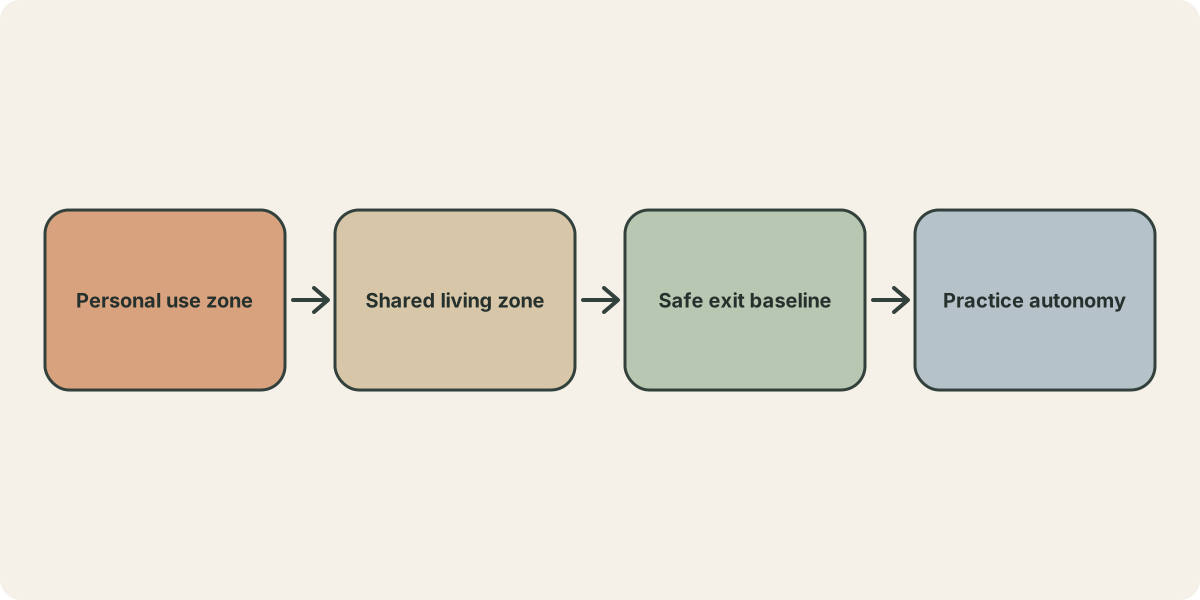
How things look behind the bedroom door does not have to match the parents’ taste, but hygiene and safety are shared matters. Rotting food, pests, blocked passage, and piles that obstruct an escape route do not belong to one person’s room alone. When these situations arise, adults need to step in, but they can make the reason clear: this is already affecting other people in the house, so we will handle it together.
Even when stepping in, the child’s role can still be kept. First ask them to choose which area to start with, which items they need to decide on themselves, and which moving and cleaning the parents can help with. If the situation allows, also set out zones first: things that can be looked over again, things still to be decided, and things that can be dealt with. These steps may look slow, but they keep the child from being left with only the experience of having everything emptied out.
Let the space become a place to practice living
A room is not only a place for a bed and a desk; it is also a small world where a child practices managing time, belongings, and boundaries. Adults can provide tools, design a process together, and offer recognition when something is finished, but they can hardly form each day’s habit in the child’s place.
It can help to start from the most troublesome spot: the desktop, the bedside, or around the schoolbag. Ask the child what extra use they hope the room will have—perhaps being able to study, to rest, or to invite friends in. When organizing reconnects to the life they themselves want, and not only to an adult’s demand, change has more reason to stay.
True autonomy is not shutting the door so that no one can come in. It is, within a clear safety boundary, gradually learning to make one’s own space usable for oneself, without harming shared living. This capacity will leave the room with the child and enter a larger everyday life.
Source: Liao Hsin-yun’s Facebook page (content compiled and adapted).