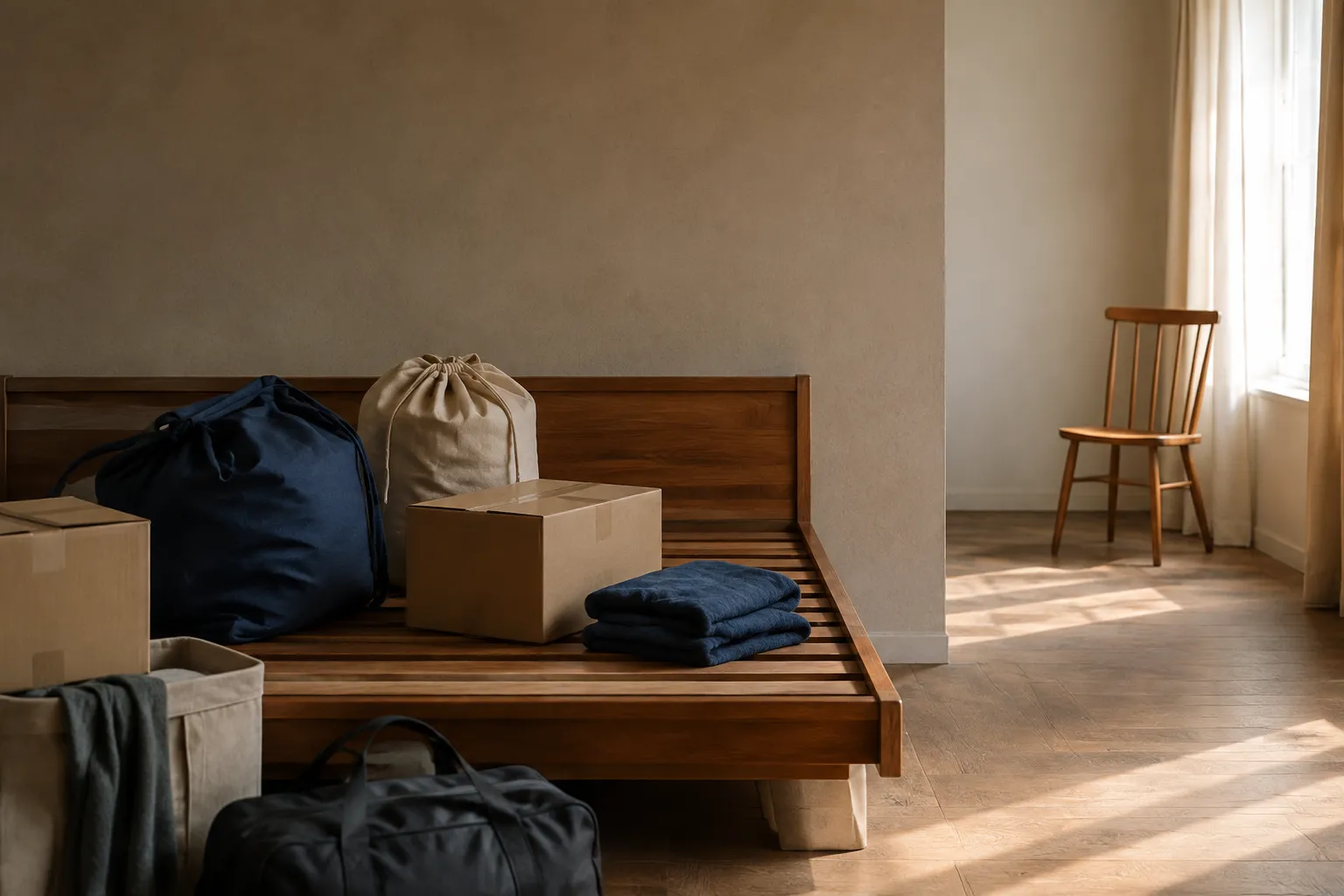
When a room looks messy, we often notice tabletops, floors, and scattered small items first. But some of the reasons a space is hard to restore are hidden in larger objects. A crib a child has long outgrown may no longer serve as a place to sleep, yet it continues to catch unopened parcels, misshapen bags, and clothes that never made it into storage; a bassinet, a sit-up chair, and a safety gate may still sit beside the bed. They have not immediately become waste, but they are also no longer serving present-day life.
These objects deserve to be seen again, not because a home should be empty, but because space itself is a shared resource. When hallways, rooms, or common areas are occupied for long periods by objects whose function has ended, what is affected is often more than appearance: movement, cleaning, rest, and whether family members can comfortably use the places they share.
The discussion below draws on ten paid home-organizing cases assisted by professional organizers, and on on-site experience from several of those households. This is not a random sample, and it cannot be used to infer that every household will face the same situation. What it offers is a way of looking: how large objects, once they leave their original use, may become new entry points for accumulation, and why people so often find them hard to deal with.
The problem with large objects is not just a missing patch of floor
The most obvious effect of large furniture, baby and toddler gear, exercise equipment, or equipment left after a business closes is the floor space it occupies. Once their function has ended, however, the impact is usually more than one patch of floor. A bed frame, tabletop, or cabinet top at a convenient height is easily treated as a place to “put this here for now”; a cabinet that is both deep and large may tuck items into depths where they cannot be seen and are hard to take out. When an object is too heavy or too hard to take apart, the floor around it also becomes an extended holding zone.
This is not an accusation that people lack organizing skill. Putting things in a handy spot is a natural response in everyday life. The problem is that when a temporary holding place remains for a long time, “temporary” may never have an end. What began as one unused large item slowly attracts more small ones, so people mistake the problem for too much clutter and never see the object that first changed the conditions of the space.
After an organizing session, one mother was still puzzled: the room was not small, and the layout was not bad, so why did it get messy again so quickly? The professional organizer first asked her to take down the crib her child no longer used. Once the frame was moved, the room not only gained space; it also lost a surface that could keep catching items set down for later. She then sorted her child’s clothes and cleared out five bags. This is one household’s experience on a single day, and it is not enough to prove that removing a large object will always have the same effect. It does, however, remind us that before reorganizing, identifying which objects are still serving daily life may be more helpful than immediately buying new storage products.
When function ends, the object is not necessarily without value
Deciding whether a large object should be dealt with is not a binary of “new or old,” nor is it a matter of treating everything still usable as surplus. The more important questions are: Does it have a clear, ongoing use in the present? Who is using it? If it will not be used in the near term, is there a concrete reason to keep it, and a time to check again?
A table, for example, still performs its function if someone eats, works, or sits with a child over homework at it every day, even if it is worn. Conversely, if the surface has long been stacked with things waiting to be dealt with, what is actually being used may only be its capacity to hold items temporarily. A cabinet is the same: it can be a place where things are easy to find, or, because it is too deep and too full, a place where judgment is postponed. These questions need not lead to immediate disposal. They give a household a chance to distinguish whether what is being kept is a present need, a foreseeable future need, or a decision not yet faced.
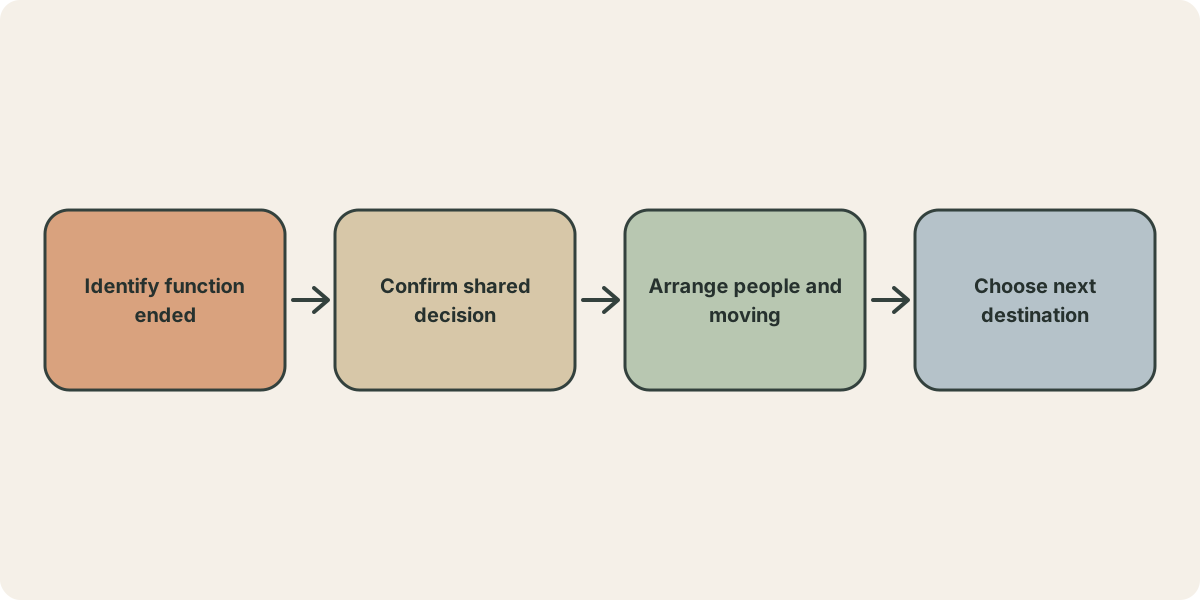
This line matters especially for households that have lived through caregiving, a move, a job change, or the death of a family member. Some large objects are tied to a sense of security, memories of raising children, a working life, or family relationships, and cannot be decided by the person who cares most about neatness acting alone. Framing “the function has ended” as a shared observation, rather than a judgment on the object’s owner, can bring the discussion back to living conditions: What does keeping this item here support now? And who is taking on the work of moving, cleaning, or storing it?
Households can also set a gentler pace for this kind of discussion. They might, for example, agree on a period for reuse or for checking again, keep the object during that time, but stop treating it as a place to pile things at will; when the period ends, they confirm together whether use actually happened. This is not a way of quantifying emotion; it is a way of keeping unspoken expectations from stretching on without limit. In shared spaces, a clear review date also lets everyone know whether what they see is a temporary arrangement or a living choice that needs to be renegotiated.
The real difficulty is getting a large object to its next stop
Whether a small item stays or goes often takes only one judgment. A large object usually needs a decision, labor, tools, transport, and a destination all at once. Even if the object is still usable, that does not mean anyone is able to take it. This is also why many large items are kept for years: it is not that no one notices they take up space, but that every step requires extra arrangements.
The ten organizing cases together cleared 580 bags of items, of which 219 bags were recorded as trash, 166 bags as recycling, and 195 bags as passed on. These figures describe only what these ten households handled with organizing-service support; they cannot be treated as typical household proportions. The way large objects were recorded was also inconsistent: in one household, 23 bags of trash already included eleven large pieces of furniture such as a treadmill, a bicycle, and a desk; another household separately sent out 22 metal chairs, which were not included in the 580 bags. One household described a single household’s haul as one and a half clearance trucks. Different recording methods cannot be added into one statistical table, but they are enough to show that bagged items and large objects require different ways of handling.
In a household-factory case that had been closed for years, a treadmill that had sat unused for more than a decade was first moved to the doorway to wait for a neighbor to take it. Two days later, no one had come, and the family finally took it apart and drove it to recycling. This process does not mean all exercise equipment should follow the same path. It shows that “still usable” answers only the condition of the object; it does not answer whether the conditions for transport, matching, and handover exist. If those conditions are not there, the item easily stays at home, waiting for a moment that may never come.
Make reuse an option, and also recognize that it has conditions
If a large object is still safe, intact, and of use, looking first for someone to take it on is an option worth trying. Handover, however, is not simply putting the item at the door. It usually also requires confirming size, condition, photographs, and how and when it will be picked up. Some objects are suited to matching within networks of acquaintances, neighbors, or the community; others first require understanding local rules on clearance, recycling, or dismantling. Different materials, sizes, and conditions of use open different paths.
For that reason, sustainable living should not turn “sending it out” into another pressure that must be completed alone. For older people, caregivers, people without a vehicle, or people who find it hard to move heavy objects, what may be missing is not willingness, but the conditions needed for accompaniment, inquiry, transport, and handover. If family, community, and related services can provide clear information and a division of labor, items have a better chance of leaving the home while they still have value, rather than remaining until delay leaves only a last-resort disposal.
At the same time, it is necessary to leave room for the possibility that handover is not suitable. Objects that are damaged, raise hygiene concerns, are missing parts, are overly aged, or no longer meet conditions for safe use should not be forced onto the next person out of reluctance to waste. Respecting the value of an object also includes facing its present condition honestly. Judging first whether it is still usable, then choosing handover, material recycling, or handling according to the rules, is more responsible than calling everything that leaves the house reuse.
Start with one large object, and let space return to living
Faced with an entire room, people easily stop because the workload feels too large. Rather than requiring a complete empty-out in one go, it is better to start with one large object whose function has most clearly ended. Family members can first walk through together, list unused beds, equipment, cabinets, or appliances, then ask four questions in order: When was it last used? Does anyone need it now? If it is to stay, where can it go without getting in the way of living? If it is to leave, who can help with the next step?
The purpose of these questions is not to force a quick decision, but to break a vague to-do into work that can be handled together. Someone confirms ownership and whether the item stays or goes; someone looks up a suitable destination; someone arranges transport. Items that need a decision from the person concerned still leave that person with the choice. When responsibility no longer falls entirely on one person, large objects need not remain forever in the place of “we’ll deal with it later.”
Restoring a space to usability does not have to mean pursuing emptiness. It means people can walk, rest, cook, work, and be together. If a large object is still supporting these everyday activities, it is worth using well. If its function has ended, arranging an honest and achievable next stop for it is also a way of leaving more livable space in the home.
Source: Liao Hsin-yun’s Facebook page (content compiled and adapted)