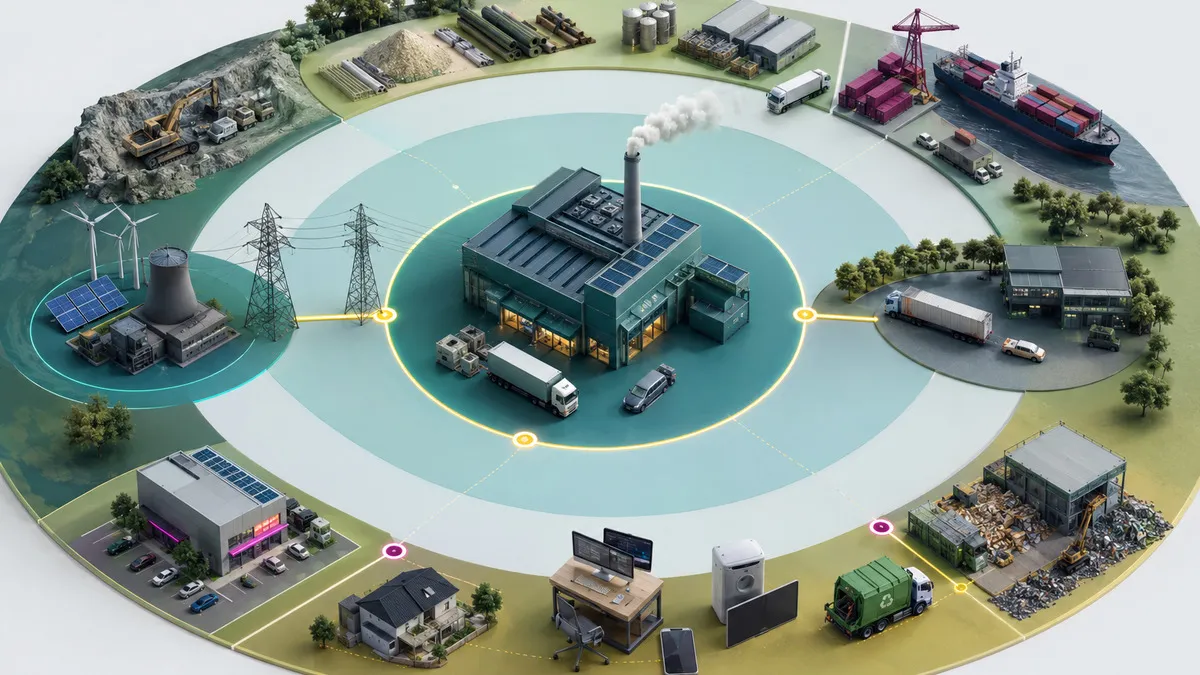
Once a company starts a carbon inventory, it soon runs into three terms: Scope 1, Scope 2 and Scope 3. They are not a ranking of how serious emissions are; they sort greenhouse gases into different categories according to the emission source and the company’s degree of control over it.
Scope 1 covers direct emissions from sources a company owns or controls, such as boiler fuel, fuel for company vehicles, process emissions and refrigerant leakage. Scope 2 covers indirect emissions from purchased electricity, steam, heating or cooling. Scope 3 covers other indirect emissions across the value chain, from raw material procurement, logistics and business travel to product use and final disposal.
The largest emissions may lie outside the company walls
For manufacturing, factory energy use may account for a large share; but for retail, finance, technology brands or food companies, Scope 3 is often the main source. A bank’s branch electricity use is limited, yet the economic activity supported by its lending and investment may generate enormous emissions. A brand may own no factories at all, but emissions from its suppliers and from consumers using its products remain closely tied to its business model.
Scope 3 is the hardest, because the data is scattered across suppliers, customers and different countries. A company may only be able to start with industry-average factors for estimates, and then gradually obtain actual supplier data. This uncertainty does not mean the calculation can be skipped; it means the boundaries of the calculation, the data quality and the improvement plan must be clearly explained.
In 2025, the GHG Protocol and the International Organization for Standardization (ISO) announced a collaboration aimed at aligning corporate greenhouse gas inventories with standards such as ISO 14064-1; related revisions are still moving forward in 2026. This shows that global inventory rules are also being adjusted, with the goal of making corporate data more consistent and comparable while genuinely supporting reduction decisions.
An inventory should not become a way of pushing responsibility outward
There is good reason for large companies to request data from their suppliers. But if all they do is hand over a complicated spreadsheet and expect small and medium-sized enterprises to bear the cost of systems and verification on their own, what comes back may be nothing more than numbers produced to tick a box. Real supply chain decarbonisation requires shared methods, education, tools, financing and long-term procurement commitments.
The same emissions may appear in the inventories of different companies. This is not necessarily a double-counting error; it reflects each party taking responsibility from its own position in the value chain. A corporate inventory is not an attempt to total up emissions for the whole world, but a way of identifying the parts a company can influence.
The value of the three scopes is not to carve up emissions so that responsibility can be passed around, but to let a company see which emissions it can improve directly, which require changes in procurement and design, and which call for cooperation with the supply chain and with consumers.
The question in carbon accounting has never been “whose tonne is this?” What matters more is whether the people along the same value chain can work together to make that tonne genuinely disappear.
References
-
Greenhouse Gas Protocol, Corporate Standard and Scope 3 Standard.
-
GHG Protocol, Corporate Suite of Standards and Guidance Update Process, updated through 2026.