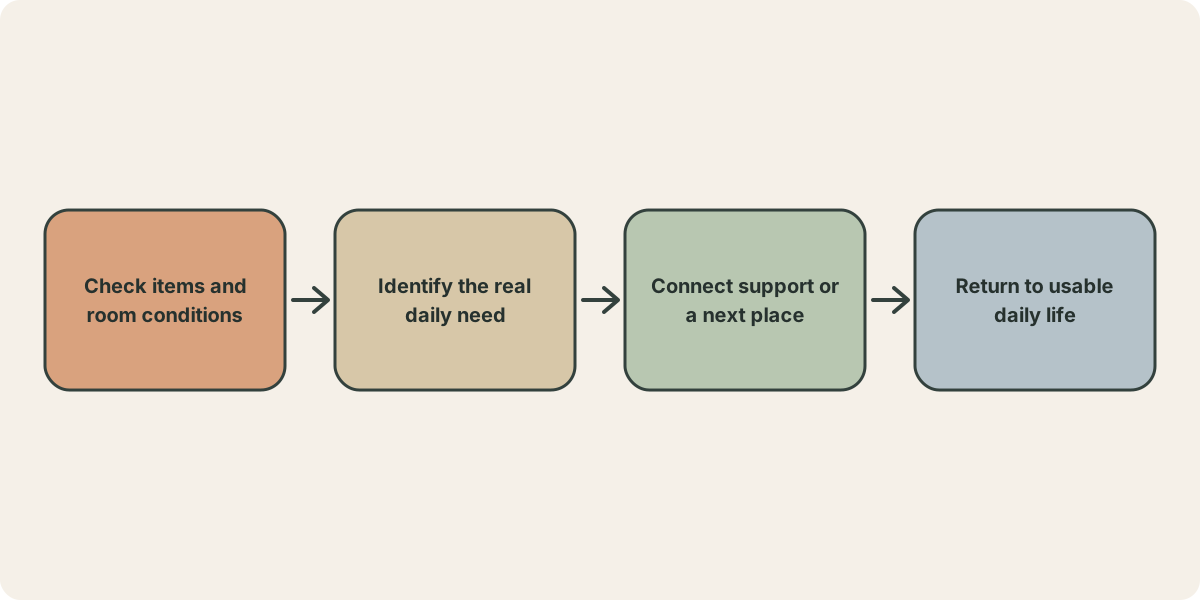
New items are easy to sell. Damaged items have existing hauling and recycling channels. What most often gets stuck is the stretch in between: things that still work, but the household no longer needs them and does not happen to know anyone who will take them. So they stay on the balcony, in the storeroom, or at the end of the hallway, and are only dealt with once their condition has grown worse.
This is not simply a personal choice. Getting an item from a home into the next user’s hands takes photos, a judgment of its condition, a listing, replies, arranging a time, and moving it. For busy families, people living alone, or caregivers, that chain of work is often harder than having it hauled away.
It Looks Valuable, but Handling It Is Costly
A treadmill little used for years was moved to the doorway. After two days with no one to take it, the family dismantled it and sent it for recycling. In another household, twenty-year-old tiles could be handled neither by a bulk-waste truck nor by a garbage truck; the homeowner had to go online and find someone to take them. Neither item had immediately lost its function. What stalled was the time, the vehicle, and the coordination needed to realize its value.
Reuse, then, cannot ask only whether something can still be used. It also has to ask who can handle this stretch of the journey. If every search and transport duty falls on the original owner alone, the most reasonable choice is often the one that takes the least effort.
The Cases Show Demand Held Back
In in-home organizing records from ten households, 195 bags of items were passed on, 219 bags were classified as trash, and another 166 bags went into recycling. These ten households are not a random sample, and because professional organizers assisted, the figures cannot be used to estimate society as a whole. But at these sites, the volume passed on was close to the volume of trash, showing that quite a few reusable items were still waiting for an outlet.
Some households sent out complete sets of furniture, a basketball stand, or iron chairs; others donated office paper supplies and encyclopedias to organizations. What these successes usually had in common was not that the items were especially high-end, but that someone knew where the need was and could complete the handover.
Recycling and Reuse Do Not Play the Same Role
Recycling matters. It lets materials return to the processing system under suitable conditions. But if goods that can still be used safely are handed on, product life can be extended and the need for new purchases reduced. The two need not compete with each other. The point is to make a clearer split while items are still in good condition.
The premise is that unsuitable items must not be dumped on the recipient. Goods that are broken, soiled, missing parts, or raise safety concerns must be described honestly; otherwise so-called donation is only shifting the cost of handling. The value of reuse is built on the next person actually being able to use the item.
Prepare a Path for the Middle Stretch
Communities, nonprofit organizations, and public services can consider whether there is donation information that is easy to find, regular exchange hours, space for temporary storage and sorting, or arrangements to help move large items. These measures do not guarantee every item a destination, but they can make reuse happen not only when someone happens to know a person in need.
When an item leaves a home, selling it or throwing it away should not be the only two answers left. If society can take up this middle path, valuing things need not depend on individuals exhausting themselves to see it through.
Source: Liao Hsin-yun’s Facebook page (content compiled and adapted)